← BACK TO ARCHIVES
Heritage-Black
Heritage Synthesis: Terracotta fragment of a kylix (drinking cup)
Curated on Aug 08, 2026 // Node: LDN-01
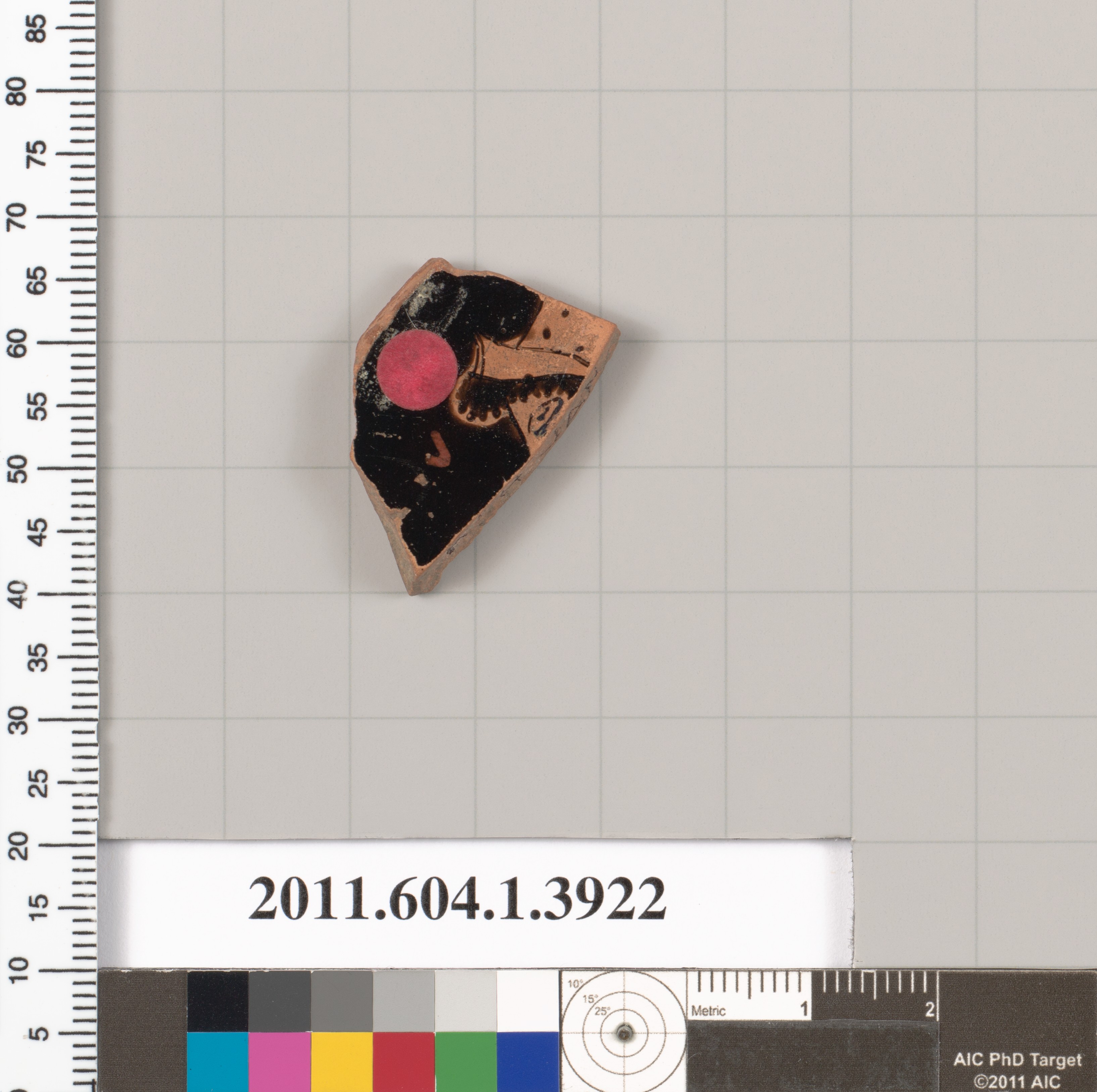
The Dialectics of Vessel and Void: Terracotta Fragments and the Architecture of Old Money Restraint
The internal genetic code of Lauren Fashion—that profound dialogue between the jade-green silk scroll of the *Wangchuan Villa* and the bronze chill of the *Three-Pierced Ritual Dagger*—establishes a foundational principle: the vessel is never merely a container, but a carrier of *dao* (道). The scroll embodies the “soft-hidden” (柔隐) ideal of spiritual dwelling, while the dagger manifests the “hard-manifest” (刚显) imperative of ritual order. Yet both converge on the axiom that material form must transcend its physicality to become a condensate of worldview. When we turn to the museum artifact at hand—a terracotta fragment of an Attic kylix (drinking cup)—we are not encountering an alien object, but rather a parallel expression of this same philosophical architecture. This shattered shard of Greek sympotic culture, with its painted tondo and its curved wall, offers a profound hermeneutic key for decoding the 2026 Old Money silhouette. It teaches us that true luxury is not an accumulation of surface, but a disciplined negotiation between the vessel’s exterior authority and its interior void—a principle that must govern our forthcoming collection.
I. The Kylix as a Philosophical Artifact: Beyond the Sympotic Surface
At first glance, the terracotta kylix fragment appears to belong to a radically different aesthetic universe. Its material—lowly fired clay—contrasts sharply with the precious silk of Wang Wei’s scroll or the enduring bronze of the ritual dagger. Yet this very humility is instructive. The kylix was the vessel of the *symposium*, the Greek ritual of collective drinking that was as much a political and philosophical institution as a social gathering. Its shallow, wide bowl was designed not for mere consumption, but for the *display* of painted narratives—mythological scenes, erotic encounters, athletic victories—that unfolded as the drinker tilted the cup. The fragment we possess, likely from the tondo (the circular interior base), preserves a sliver of this narrative world. The exterior, however, would have been black-glazed, a field of absolute, unadorned darkness.
This dual structure—the austere black exterior and the revelatory painted interior—is the kylix’s deepest philosophical contribution. It embodies a dialectic of concealment and revelation. The vessel’s outer form is one of disciplined, almost monastic restraint; its inner truth is a world of vibrant, complex signification. This is not a contradiction but a deliberate design. The Greek symposiast understood that meaning is not broadcast but *discovered*. The exterior’s silence creates the condition for the interior’s speech. This is precisely the logic of the *Three-Pierced Ritual Dagger*: its bronze severity and geometric punctures do not invite casual reading but demand a ritualized, initiated gaze. The kylix, in its fragmentary state, intensifies this effect. The broken edge reveals the raw terracotta core—a cross-section of the vessel’s very being—reminding us that the artifact’s power lies not in its completeness, but in its *capacity* to have held something sacred.
II. From Sympotic Vessel to Sartorial Silhouette: The 2026 Old Money Grammar
How, then, does this terracotta shard inform the 2026 Old Money silhouette? The Old Money aesthetic—often misread as mere understated tailoring—is, in its essence, a philosophy of the vessel. It is about constructing a human form that, like the kylix, presents an exterior of formidable restraint while harboring an interior of cultivated depth. The 2026 collection must therefore move beyond the clichés of neutral palettes and cashmere twinsets. It must embrace the *architectonics* of the kylix: the relationship between the outer shell and the inner void.
First, consider the *exterior discipline*. The black-glazed wall of the kylix translates directly into our silhouette’s outer layer. We are not speaking of literal black, but of a *chromatic austerity*—a deep, absorbent darkness that refuses to reflect the gaze. This manifests in our outerwear: a long, structured wool coat with a high, closed collar; a tailored jacket with suppressed waist and extended shoulder, creating a sculptural carapace. The fabric must be dense, with a matte finish that absorbs light rather than reflecting it. This is the sartorial equivalent of the kylix’s black glaze. It signals that the wearer is not performing for the external world; the exterior is a boundary, a threshold, not a billboard. The seams must be impeccable, the construction invisible, so that the garment reads as a monolith—a single, unbroken surface of intention.
Second, the *interior revelation*. The kylix’s painted tondo is the secret life of the vessel. In our 2026 silhouette, this translates to the *inner layer*—the blouse, the lining, the hidden seam. Here, we permit the eruption of narrative. A silk charmeuse blouse in a deep, jewel-toned print—perhaps a subtle *brocade* motif inspired by the *Wangchuan Villa*’s landscape, or a fine *lace* insert at the cuff that echoes the kylix’s painted figures. This interior richness is not meant to be immediately seen; it is a reward for intimacy, for the moment of unbuttoning, for the gesture of reaching into one’s own history. The Old Money wearer understands that true luxury is *private*. It is the flash of a gold-thread embroidered hem when the coat is lifted, the whisper of a silk lining against the skin. This is the “soft-hidden” (柔隐) principle of the scroll, but now rendered in the kylix’s dialectical structure: the exterior’s silence is what grants the interior’s voice its power.
III. The Fragment as Design Principle: Wabi-Sabi and the Luxury of Incompletion
The most radical lesson of the terracotta fragment, however, lies in its *brokenness*. We are not looking at a pristine kylix but at a shard. This fragmentary state is not a loss but a gain. It reveals the cross-section, the raw materiality of the clay, the thickness of the wall. In Japanese aesthetics, this is the principle of *wabi-sabi*—the beauty of imperfection, impermanence, and incompletion. For the 2026 Old Money silhouette, this translates into a deliberate embrace of *tactile honesty* and *structural exposure*.
We will introduce garments that reveal their construction rather than hiding it. A wool jacket with an exposed, hand-finished seam; a *cashmere* sweater with a deliberately dropped stitch, revealing the loop structure of the yarn; a *velvet* gown with a raw, unhemmed edge that frays slightly, showing the warp and weft. These are not signs of negligence but of supreme confidence. They declare that the wearer does not need the illusion of perfection; she possesses the reality of substance. This is the “赋器以灵” (infusing the vessel with spirit) principle applied to the fragment. The broken kylix is more spiritually potent than the whole one because it shows us the *truth* of the vessel—its clay, its fire, its purpose. Similarly, our 2026 garments will expose their own “clay”: the quality of the fiber, the integrity of the weave, the honesty of the cut. This is the ultimate luxury—the ability to show one’s structural truth without fear.
IV. Synthesis: The Vessel of the Self in 2026
In conclusion, the terracotta kylix fragment is not a decorative inspiration but a philosophical blueprint. It teaches us that the Old Money silhouette of 2026 must be a true vessel—an external form of disciplined, almost severe restraint (the black glaze), an internal world of rich, narrative complexity (the painted tondo), and an honest, exposed materiality (the broken edge). This triad—exterior authority, interior depth, and material truth—constitutes the new grammar of heritage luxury.
The silhouette we will present is long, columnar, and architectural. The shoulder is defined but not padded; the waist is nipped but not cinched; the hem falls with a weighted gravity. The palette is dominated by *Heritage-Black*, deep charcoal, and ink-blue—colors that absorb and withhold. Fabrics are chosen for their density and their drape: double-faced wool, heavy silk faille, sculptural *brocade*. The interior layers are a secret garden: *lace* insets, *gold-thread* embroidery, hand-painted *silk* prints that reference the *Wangchuan Villa*’s landscape. And throughout, there is the deliberate, confident exposure of construction—a seam, a raw edge, a visible stitch—that speaks to the wearer’s unshakeable possession of her own materiality.
This is the 2026 Old Money silhouette as a vessel for the modern self. It is not about showing wealth; it is about showing *being*. It is a garment that, like the kylix, holds a void—but that void is the space for the wearer’s own interiority, her own painted tondo, her own narrative. The fragment of terracotta, broken and ancient, thus becomes the most contemporary of guides: a reminder that the most profound luxury is not in the completeness of the form, but in the depth of the void it contains, and the honesty of the material that contains it. This is the dialectic of the vessel and the void, translated from the Greek symposium to the modern wardrobe, and it will define the heritage of our next season.
Heritage Lab Insight
Genetic Bridge: Archive node focusing on Heritage-Black craftsmanship.