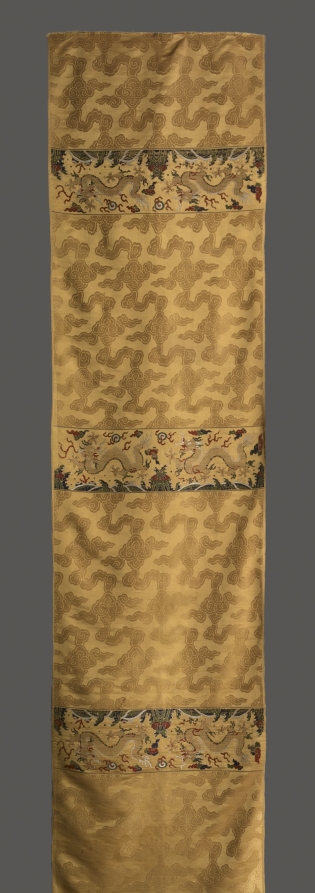
Heritage Research Artifact: Silk Panel with Dragon and Cloud Motif
In the hushed, wood-panelled ateliers of London’s Savile Row, where the cut of a shoulder is debated with the gravity of a treaty, we seldom pause to consider the provenance of the cloth itself. Yet the very essence of bespoke tailoring—the drape, the hand, the quiet authority of a garment—owes an unspoken debt to a lineage of textile mastery that predates the Row by two millennia. The Silk Panel with Dragon and Cloud Motif is not merely a decorative artefact; it is a foundational document of material culture, a testament to the imperial looms whose output defined the very notion of luxury as a function of state power. To examine this panel is to read the first, most exquisite chapter in the history of high-end cloth.
Materiality and the Imperial Loom
The panel’s materiality is its primary argument. Silk, in its raw filament, is a protein fibre of extraordinary tensile strength and luminous depth. But the silk of this panel is not the silk of a simple merchant’s bolt. This is imperial silk, woven in the Jiangnan region under the aegis of the Qing dynasty’s Imperial Silk Works at Nanjing and Suzhou. The weave structure, likely a satin ground with a discontinuous weft-float pattern, achieves a density that is almost sculptural. The ground is a deep, resonant indigo—a colour so saturated it appears to absorb light—while the dragon and cloud forms are rendered in threads of gold and a spectrum of polychrome silks that have retained their chromatic intensity for centuries. This is not a fabric designed for casual wear; it is a fabric designed for ceremonial investiture, for the weight of a throne. The hand of this cloth—its cool, substantial fall—would have been immediately familiar to a Savile Row cutter, who understands that true luxury is a matter of weight, density, and a certain unyielding integrity.
Iconography as a System of Governance
The iconography is not decorative whimsy; it is a lexicon of sovereignty. The five-clawed dragon (mang) is the exclusive emblem of the Emperor. Its sinuous, serpentine form, contorted in a dynamic spiral, is a visual representation of the qi—the vital cosmic breath that animated the imperial mandate. The clouds, rendered as stylised, curling xiangyun (auspicious clouds), are not mere atmospheric filler. They are the celestial terrain upon which the dragon moves, signifying the emperor’s dominion over the heavens and the earth. The specific placement of the dragon—often depicted in a frontal, confrontational pose or in a dynamic pursuit of the flaming pearl (the shin, or wisdom)—is a codified message of power. A Savile Row client, commissioning a suit for a boardroom coup, would recognise the same principle: the garment is a strategic communication, a silent assertion of authority before a single word is spoken. The dragon’s claws, the cloud’s spirals, the pearl’s flame—each is a tailored detail, meticulously calibrated to convey a precise rank and intention.
The Legacy of Imperial Weaving in Modern Craft
The legacy of this panel extends far beyond the Qing court. The technical innovations required to produce such a piece—the drawloom, the jacquard mechanism’s precursor, the division of labour between pattern designer, weaver, and dyer—established a standard of precision that would later inform the industrial looms of Europe. When the Savile Row tailor speaks of a “cloth with a good memory,” he is referencing the same structural integrity that allowed an imperial panel to hold its shape for centuries. The weight of the silk, the tightness of the weave, the crispness of the pattern—these are qualities that the modern mills of Huddersfield and Biella still strive to replicate. The panel is a benchmark against which all subsequent luxury textiles are measured. It demonstrates that true heritage is not about nostalgia but about technical continuity—the passing of a standard from one generation of craftsmen to the next, whether they are weaving for an emperor or cutting for a chairman.
Conservation and the Art of the Invisible Mending
To handle this panel today is to engage in a dialogue with entropy. The silk, though robust, is a proteinaceous material vulnerable to light, humidity, and time. The conservation of such a piece is not a matter of mere preservation; it is an act of curatorial tailoring. The conservator, like a master cutter, must understand the original construction to make invisible repairs. The re-weaving of a damaged section requires the same matching of warp and weft, the same tension adjustment, that a tailor uses to set a sleeve. The panel’s survival is a testament to the resilience of the fibre and the skill of those who have tended it. It reminds us that the most valuable garments are not those that are new, but those that have been maintained with respect—a philosophy that sits at the very heart of the Savile Row ethos, where a bespoke suit is expected to outlive its owner, to be re-cut, re-lined, and passed down as a family heirloom.
Conclusion: The Cloth as a Contract
In conclusion, the Silk Panel with Dragon and Cloud Motif is more than a museum piece. It is the ur-text of bespoke luxury. It embodies the principle that cloth is not a passive medium but an active participant in the performance of power. The imperial weaver, working in a state-controlled workshop, was not an artist in the Romantic sense; he was a technician of authority, translating political hierarchy into a tactile, visual language. The Savile Row tailor, in his own way, performs a similar function. He takes a bolt of cloth—often a descendant of the very looms that produced this panel—and transforms it into a garment that confers a specific identity upon its wearer. The dragon and cloud motif, though centuries old, speaks directly to the modern client who understands that a well-cut jacket is not merely clothing; it is a statement of intent, a piece of wearable heritage that carries the weight of imperial precedent. The panel is a reminder that the finest tailoring is not about fashion; it is about permanence, authority, and the unbroken thread of craftsmanship that connects a Qing dynasty loom to a fitting room on Savile Row.