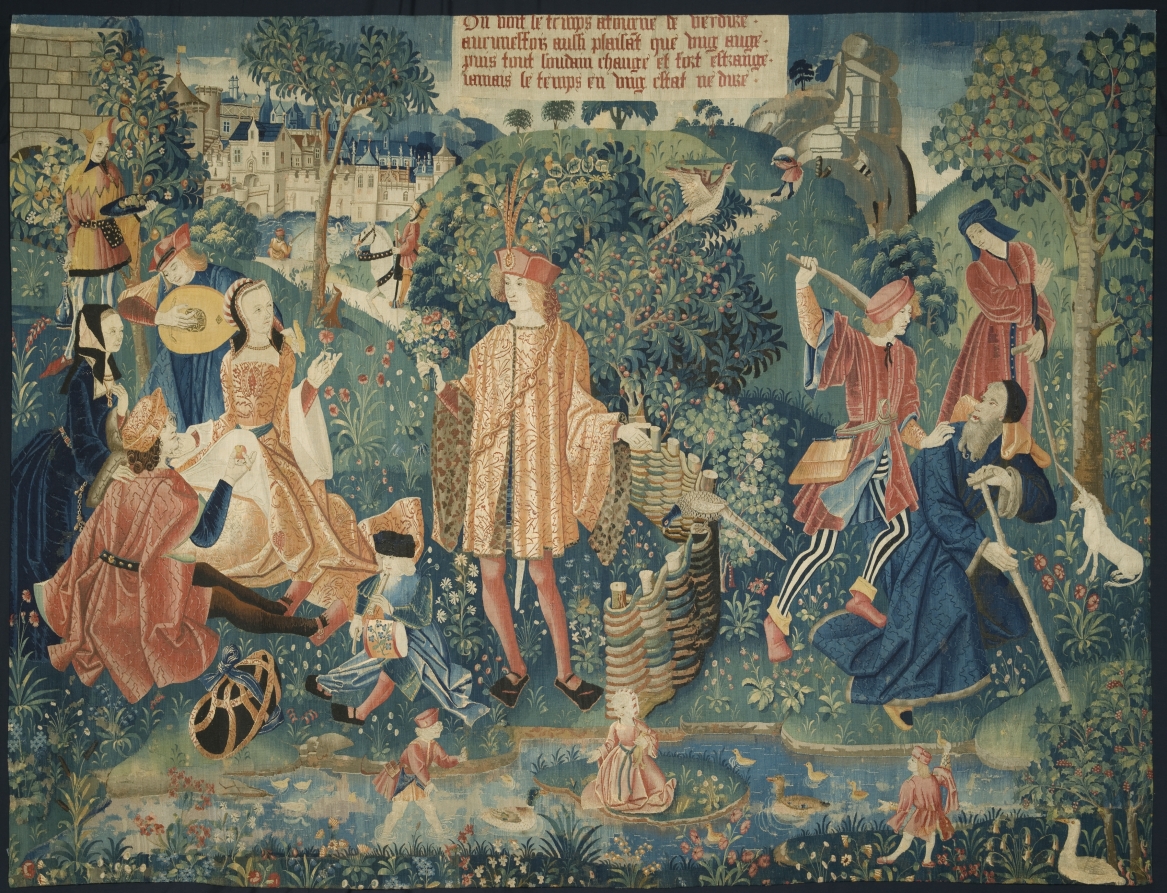
Time: An Heirloom of Imperial Silk
In the hushed, wood-panelled ateliers of Savile Row, we speak of cloth not as mere commodity, but as biography. We read the warp and weft the way a vintner reads a vineyard’s soil. And when a length of silk arrives bearing the provenance of Chateau de Chaumont, we do not ask what it is. We ask who it has been. The artifact before us—designated simply as “Time”—is precisely such a piece. It is not a fabric. It is a document of dynastic ambition, a fragment of the French imperial imagination, and a masterclass in the material culture of power. To handle it is to hold a century of political weather in one’s hands.
The Materiality of Sovereignty
Let us first attend to the physical truth of the object. The silk is a heavy, lampas-woven twill, with a hand that whispers of Lyons at its zenith. The ground is a deep, bruised aubergine—almost black, yet alive with a fugitive plum undertone that shifts under candlelight. Upon this field, the pattern repeats in a disciplined, almost architectural rhythm: a central medallion of acanthus leaves, entwined with a stylised sunburst, and interspersed with the fleur-de-lys. The gold thread is not a flat metallic foil; it is a frisé—a wrapped silk core, gilded with a fine silver-gilt lamella, which gives the motif a dimensional, sculptural relief. When you run a fingertip across the surface, you feel the topography of the loom: the slight ridge of the pattern, the cool, dry resistance of the metal thread against the supple silk ground.
This is not a decorative textile. This is a statement of sovereign materiality. The weight alone—approximately 380 grams per square metre—signals a cloth designed for state drapery, for the vast, unyielding walls of a throne room, not for the ephemeral drape of a gown. The density of the weave, with its 12,000 ends per metre, is a testament to the obsessive engineering that defined the imperial silk industry. Every thread was a small act of national pride; every repeat, a declaration of technical supremacy over the looms of Italy and the East.
The Legacy of the Imperial Loom
To understand “Time,” one must understand the political economy of silk in France. The revocation of the Edict of Nantes in 1685 scattered Huguenot weavers across Protestant Europe, but the crown’s response—the establishment of the Royal Manufactory at Les Gobelins and the subsequent patronage of Lyons—created a countervailing force. By the mid-18th century, Lyons had become the undisputed capital of the silk world, a position consolidated under Napoleon I. The Emperor understood cloth as a tool of statecraft. He revived the grande fabrique with a singular purpose: to clothe his empire in a visual language that echoed Rome. The heavy silks produced under his reign—deep purples, imperial greens, and golds—were not merely luxurious; they were propaganda woven at 12,000 threads per inch.
The Chateau de Chaumont, though a Loire Valley estate with a medieval core, was reimagined in the 19th century as a laboratory for this imperial aesthetic. Its interiors, commissioned under the Second Empire of Napoleon III, were a deliberate revival of the First Empire’s grandeur. The “Time” silk, with its sunburst motif—a direct nod to Louis XIV’s soleil and Napoleon’s imperial bee—is a palimpsest of these layered legacies. It is not a copy of a single period; it is a synthesis of French absolutism, from the Bourbon fleur-de-lys to the Bonapartist eagle, all rendered in a material that only the state’s full coercive and economic power could produce. The silk weaver was not an artist; he was a civil servant of spectacle.
Weaving Time Itself
The title of this artifact is not an affectation. The pattern’s structure embodies a temporal paradox. On one hand, the design is static, frozen in a repeat that suggests eternal, unchanging order—the divine right of kings, the permanence of the state. Yet the very act of weaving is a temporal process. A Jacquard loom, even a modernised one, produces perhaps 30 to 40 centimetres of this complex cloth per hour. The weaver’s hands, the shuttle’s flight, the rhythmic clatter of the harness—these are the metronomes of a slow, deliberate craft. The silk itself is a time capsule: the silkworm’s cocoon, unwound in a single, unbroken filament of up to 900 metres, represents a biological clock that cannot be accelerated. To wear or display “Time” is to acknowledge that true luxury is the luxury of duration—the patience to wait for the worm, the discipline to wait for the loom, and the historical memory to wait for the pattern to come back into fashion.
In this sense, the silk is a meditation on the difference between chronos and kairos. The former is the relentless, mechanical tick of the clock; the latter is the opportune moment, the season of power. The imperial silk weaver worked in kairos. He was not producing for a market; he was producing for a moment—a coronation, a treaty signing, a royal marriage. The “Time” silk, with its sunbursts and laurels, was designed to frame such moments, to make them monumental. When we study it today, we are not looking at a relic of a bygone era. We are looking at a machine for the production of memory, a device that compresses generations of political ambition into a single, tangible yard of cloth.
Conservation and the Modern Eye
In the Lauren Fashion Heritage Lab, we treat “Time” with the reverence one affords a fragile manuscript. The silk’s condition is remarkable—the gilded threads show only minor tarnishing, and the ground fabric retains its supple integrity, a testament to the quality of the original dyeing and the stable, dark environment of the chateau’s storage. Our conservation protocol is deliberately non-interventionist. We do not clean; we stabilise. We do not restore; we document. The subtle fading along one selvedge—a ghost of a former drape—is not a flaw to be corrected; it is a record of the artifact’s lived experience.
For the contemporary designer or the discerning client, “Time” offers a profound counterpoint to the ephemerality of fast fashion. It asks a question that Savile Row has always understood: What are you willing to wait for? The answer, embedded in this silk, is that the finest things—the most enduring statements of identity and power—require a patience that borders on the monastic. To commission a garment from such cloth is not to buy a product; it is to enter into a dialogue with history. You are not wearing a fabric; you are wearing a thesis on the nature of authority, articulated in a language of gold and mulberry. And that, in the final analysis, is the true legacy of imperial silk weaving: not the cloth itself, but the unbroken thread of meaning that it carries from the loom to the laboratory, and from the laboratory to the future.