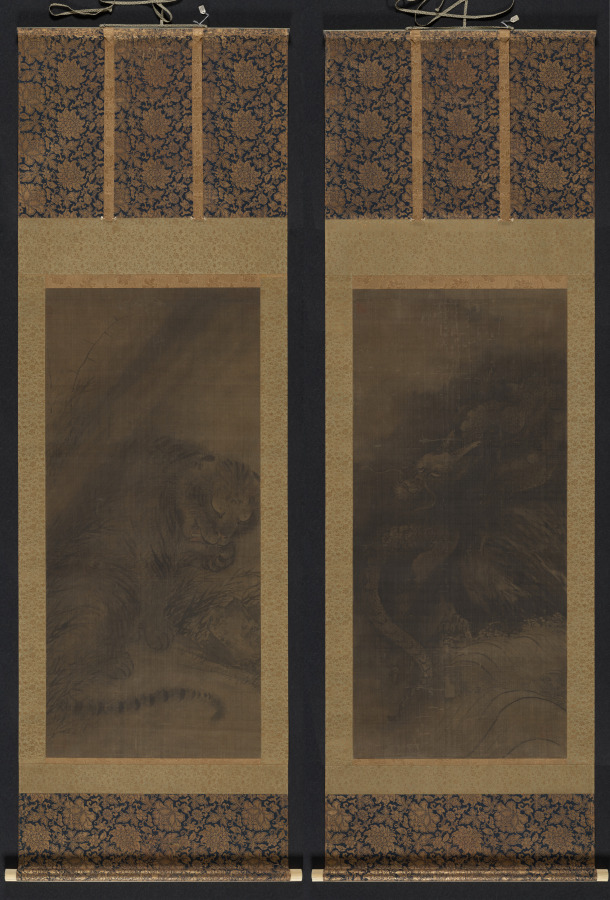
The Imperial Thread: Dragon and Tiger in the Material Legacy of Silk
Provenance and the Weight of Weave
In the hushed ateliers of Savile Row, where cloth is not merely cut but *considered*, there exists a reverence for provenance that borders on the ecclesiastical. We speak of worsteds from Huddersfield, cashmere from Inner Mongolia, and—with a particular, almost reverential lowering of the voice—of silk. Not the ubiquitous, machine-spun variety that drapes the high street, but the *imperial* silk: the dense, lustrous, and impossibly structured fabric that once clothed the Son of Heaven. To handle such a textile is to hold a fragment of statecraft. The legacy of imperial silk weaving is not a footnote in fashion history; it is the very foundation upon which the concept of *luxury as power* was built, and its most potent visual lexicon is the eternal duality of the Dragon and the Tiger.
The imperial workshops of the Ming and Qing dynasties, particularly those of Nanjing, Suzhou, and Hangzhou, were not mere factories. They were bureaucratic institutions of immense complexity, overseen by eunuchs and mandarins who reported directly to the throne. The material itself was a form of currency, a diplomatic tool, and a sumptuary law unto itself. The *kesi* (cut silk) technique, with its painstakingly woven pictorial details, and the *yun jin* (cloud brocade) with its raised, gold-threaded patterns, were not produced for comfort. They were produced for *statement*. The weight of the fabric, the rigidity of the weave, the way light played across the surface—all were engineered to create a presence that was both imposing and divine. This is the cloth of absolute authority, and its motifs were a coded language of that authority.
The Dragon: The Sovereign’s Breath
In the Western imagination, the dragon is a creature of chaos, to be slain. In the Chinese imperial context, the dragon—the *long*—is the embodiment of cosmic order. It is the rain-bringer, the controller of rivers and seas, and the symbol of the Emperor himself. The five-clawed dragon was the exclusive property of the Emperor; four-clawed for princes, three for lesser nobility. This was not mere ornamentation; it was a legal statute woven into the very fibres of the garment. When we examine a surviving imperial dragon robe, or *long pao*, we are not looking at a piece of clothing. We are looking at a map of the cosmos, with the Emperor at its centre.
The materiality of silk is crucial here. The dragon was never simply printed or embroidered onto a flat surface. It was *woven into* the structure of the fabric, its sinuous body formed by the interplay of warp and weft. The use of gold-wrapped thread—a core of silk wrapped in beaten gold leaf—gave the dragon a three-dimensional, sculptural quality. As the Emperor moved, the gold caught the light, making the dragon appear to writhe and breathe. The silk itself, often a deep, almost black blue or a rich imperial yellow, provided the perfect dark, reflective stage for this performance of power. The dragon’s scales were not uniform; they were meticulously rendered to suggest a muscular, reptilian power, a force of nature that had been harnessed and placed upon a throne. To wear this was not to wear a costume; it was to wear the mandate of heaven.
The Tiger: The Martial Counterweight
If the Dragon is the civil and spiritual authority, the Tiger is the martial and temporal force. In the imperial hierarchy, the Tiger was the symbol of the military, the protector of the realm. It appears on the rank badges (*buzi*) of high-ranking military officials, a square of embroidered silk worn on the chest and back. But the Tiger’s role in the silk legacy is more nuanced than mere rank designation. It represents the *yang* to the Dragon’s more complex, often *yin*-associated, cosmic power. The Tiger is the earth-bound force, the raw, untamed energy that the Dragon’s wisdom must direct.
In the context of imperial silk, the Tiger was often rendered with a ferocity that belied the delicacy of its medium. The embroiderers, working with silk floss so fine it could pass through the eye of a needle, would create a Tiger with a snarling maw, its stripes rendered in varying shades of brown, black, and gold to suggest the ripple of muscle beneath the pelt. The contrast is stark and deliberate. The Dragon is fluid, elegant, and abstract in its power. The Tiger is muscular, direct, and visceral. Together, they form a complete statement of sovereignty: the ability to rule through both celestial mandate and terrestrial might. The silk here is not just a canvas; it is a membrane between the spiritual and the physical. The Tiger’s presence on a military leader’s garment was a promise of protection, a talisman woven from the same material that clothed the gods.
The Weave of Power: A Tailoring Legacy
For the modern Savile Row house, the study of these artifacts is not an academic exercise. It is a study in the architecture of authority. The imperial silk weavers understood something that the greatest tailors have always known: that cloth is not a covering, but a structure. It can be engineered to create a silhouette that commands a room. The density of the imperial weave—often with over 100 threads per centimetre—gives the fabric a remarkable body. It does not drape limply; it holds its shape, creating sharp, architectural lines that are the very essence of the Savile Row cut.
When we consider the Dragon and Tiger motifs, we are considering the ultimate expression of bespoke intention. The placement of a dragon on the shoulder, or a tiger at the hem, was a deliberate act of communication. In a modern context, we translate this not through literal replication, but through an understanding of *weight* and *presence*. A silk twill of imperial density, woven in a deep aubergine or a midnight blue, carries the same authoritative weight as the yellow of the Emperor. The subtle sheen of a high-twist silk, catching the light in a darkened boardroom, echoes the gold thread of the *kesi*. The legacy is not in the motif, but in the material’s ability to confer status.
The Dragon and the Tiger, rendered in imperial silk, are the ultimate testament to the power of materiality. They remind us that fabric is never neutral. It is a language, a weapon, and a shield. The legacy of imperial silk weaving is not a relic of a bygone era; it is a living standard of excellence. It informs our understanding of what cloth can do, and what it can say on behalf of the wearer. To commission a garment from such cloth is to participate in a tradition that is thousands of years old—a tradition where the thread is not merely spun, but *wielded*. And in that wielding, one finds the true, enduring cut of power.