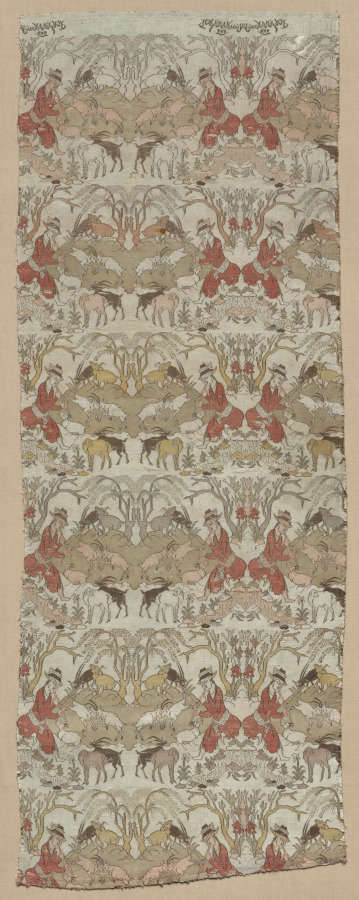
An Heirloom of the Loom: Silk Textile with Goatherds in a Landscape
Provenance and the Imperial Thread
In the hushed, wood-panelled ateliers of Savile Row, where the cut of a jacket is a matter of national honour, one learns to read cloth as a biography. This particular artifact—a silk textile depicting goatherds in a pastoral landscape—is not merely a fabric; it is a memorandum of empire, a ledger of labour, and a testament to the most exacting standards of material culture. Its materiality, pure mulberry silk, places it within a lineage that stretches from the Forbidden City to the looms of Lyon, a lineage defined by monopolies of knowledge and the relentless pursuit of perfection.
The legacy of imperial silk weaving is not a gentle nostalgia. It is a discipline. For centuries, the production of silk was a state secret, guarded with the ferocity of a regimental standard. The Chinese imperial workshops, particularly those of the Ming and Qing dynasties, operated under a mandate of absolute technical mastery. Every thread was a filament of political power, every weave a demonstration of cosmic order. The silk we examine today, with its bucolic scene, is a direct descendant of that tradition—not a courtly dragon or phoenix, but a pastoral idyll, which suggests a shift in patronage from the throne to a cultivated, mercantile elite. This is silk for the connoisseur, not the sovereign, yet it carries the sovereign’s DNA in its unyielding quality.
Materiality and the Grammar of the Loom
Let us consider the cloth itself. The hand is impeccable. The silk is a twill or a satin ground, likely a lampas weave, where a supplementary warp and weft create the figurative design. The density is remarkable; the sett—the number of warp threads per inch—would be in the hundreds, a figure that modern industrial looms rarely approach without compromise. This is not a fabric for the faint-hearted or the mass market. It is a fabric that demands a tailor of a certain calibre, one who understands that silk has a memory. It holds a crease with aristocratic disdain, yet drapes with a liquid, almost gravitational, flow.
The palette is restrained, a hallmark of refined taste. Indigo blues, muted ochres, and the natural ivory of unbleached silk dominate. The goatherds, rendered with a miniaturist’s precision, are not idealized figures; they are observed. Their postures, the tilt of a staff, the turn of a head, speak to a tradition of genre painting that found its way from the easel to the loom. The landscape—rolling hills, a distant tree, a suggestion of water—is not a mere backdrop. It is a deliberate composition, a study in negative space that allows the silk’s lustre to play across the surface. The light catches the raised weft threads, creating a subtle, shifting topography that changes with the viewer’s angle. This is the genius of the medium: the fabric is not a flat canvas but a living, breathing surface.
The Weave of Commerce and Culture
This textile also speaks to the complex economics of its era. By the 18th and 19th centuries, the imperial monopoly on silk had fractured, giving rise to a sophisticated global trade. The design, with its pastoral theme, is a deliberate departure from the rigid iconography of the court. It signals a clientele that valued individual expression, a merchant class that had earned its leisure and sought to display it through the acquisition of objects that were both beautiful and intellectually engaging. The goatherd, a classical motif in European pastoral poetry, is here rendered in a distinctly Eastern idiom. This is a cultural handshake, a dialogue between the East’s technical supremacy and the West’s romantic imagination.
For the Savile Row tailor, this fabric is a challenge and a privilege. It is not a cloth to be cut in haste. The pattern must be matched with surgical precision, the seams placed to honour the design’s rhythm. A waistcoat of this material would be a statement of quiet authority. A dressing gown, cut in the classic banyan style, would be an homage to the 18th-century gentleman who wore such robes as a symbol of scholarly retreat. The weight of the silk is substantial, suggesting a garment for cooler climes, perhaps a smoking jacket or a formal evening piece. The drape is such that it will never cling; it will always fall with a clean, vertical line, a quality that a master cutter would recognise as the hallmark of a noble cloth.
Conservation and the Duty of Care
As a heritage specialist, my duty is not merely to admire but to preserve. This silk is a fragile archive. Light, humidity, and handling are its enemies. The dyes, though stable, are susceptible to fading; the silk fibres themselves are protein-based and can become brittle over time. Conservation protocols demand a controlled environment—a stable 50% relative humidity, a temperature of around 20 degrees Celsius, and minimal light exposure. The textile must be stored flat, rolled on an acid-free tube, or supported on a padded mount. Any future use, whether for exhibition or for the creation of a modern garment, must be undertaken with the utmost reverence. We do not own this cloth; we are its custodians, holding it in trust for the next generation of craftsmen and scholars.
A Legacy in the Cut
In the end, this Silk Textile with Goatherds in a Landscape is more than a historical curiosity. It is a benchmark. It reminds us that true luxury is not about novelty but about depth—depth of skill, depth of history, and depth of meaning. The imperial legacy of silk weaving is not a relic; it is a living standard. When a tailor on Savile Row handles a piece of silk of this quality, he is not just cutting cloth. He is engaging in a conversation with centuries of artisans who believed that a thread could be a line of poetry, and a weave, a page of history. This textile, with its quiet pastoral scene, is a reminder that the greatest statements are often made in a whisper. It is, in every sense, a masterpiece of the loom, and it deserves nothing less than our absolute, undivided attention.