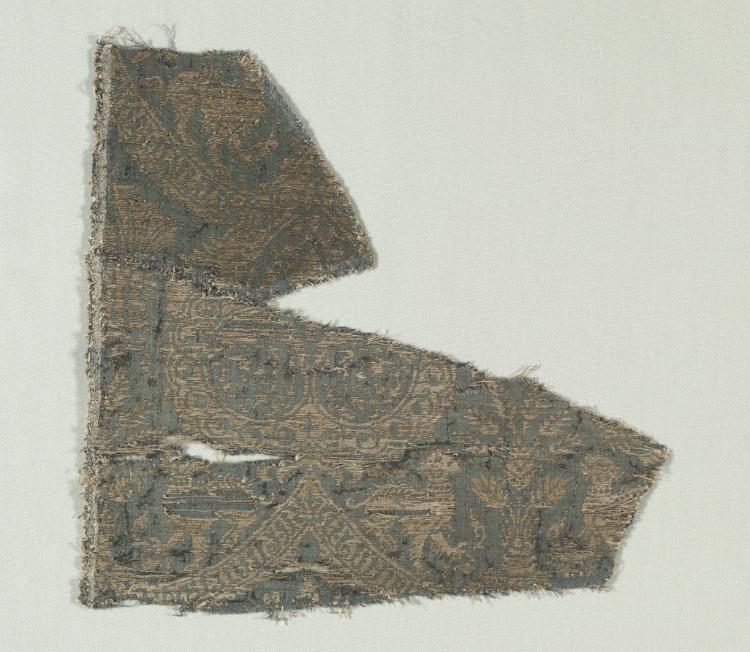
Heritage Research Artifact: Silk with Dogs and Arabic Script in Swaying Bands
In the hushed corridors of heritage, where threads speak louder than words, we encounter a textile of singular distinction: a silk panel bearing the enigmatic interplay of canine forms and Arabic calligraphy, rendered in undulating, swaying bands. This is not merely a fabric; it is a document of imperial ambition, a testament to the cross-cultural currents that defined the great silk routes, and a masterclass in the material poetry of the loom. To examine this piece is to step into the atelier of history, where the discipline of the weaver meets the audacity of empire.
Materiality and the Imperial Loom
The ground fabric is a pure, mulberry silk, its lustre undimmed by centuries. The weave structure, likely a compound twill or a lampas, speaks to a technical sophistication reserved for the highest echelons of courtly production. This is not the silk of the merchant’s bolt, but the silk of the imperial manufactory—a material so precious that its creation was often a state secret, its patterns reserved for the sovereign and his immediate circle. The very weight of the cloth, its dense, supple drape, suggests a deliberate choice: this was a textile designed for ceremonial grandeur, for the static, imposing presence of a throne room, or the slow, deliberate procession of a royal entourage. The materiality is not incidental; it is the primary carrier of meaning. Silk, in this context, is power made tangible.
The “swaying bands” that structure the composition are a triumph of design and engineering. These are not static stripes but a rhythmic, serpentine flow, achieved through a complex manipulation of the warp and weft. The bands undulate like a banner caught in a gentle breeze, or perhaps like the very calligraphic strokes they frame. This movement is a deliberate counterpoint to the rigid formality of the imperial court. It introduces a sense of organic life, a whisper of the natural world, into the highly controlled environment of the palace. The technical mastery required to produce such a pattern—ensuring the registration of the design across the full width of the loom without a single misstep—is staggering. It is the work of weavers whose skill was honed over generations, their knowledge passed down in secret, their hands guided by an almost mathematical precision.
The Iconography of Power and Devotion
The iconography is where this artifact transcends mere craftsmanship and enters the realm of political and spiritual discourse. The presence of dogs is particularly striking. In many imperial traditions, the dog is not a mere companion but a symbol of loyalty, vigilance, and the hunt—attributes directly associated with sovereign authority. The greyhound, in particular, with its sleek, aerodynamic form, was a favoured motif in Persian and Mughal courts, representing swiftness, nobility, and the ruler’s dominion over the natural world. Here, the dogs are not depicted in a static heraldic pose but are woven into the very rhythm of the swaying bands, their forms elongated and stylised to harmonise with the calligraphic script. They are not separate from the text; they are part of it, a visual echo of the divine word.
The Arabic script, rendered in a flowing, cursive hand, is the second pillar of this composition. It is likely a poetic verse, a royal epithet, or a blessing—common in the textile traditions of the Islamic world, where calligraphy was the highest form of art. The script is not merely legible; it is decorative, its ascenders and descenders weaving in and out of the swaying bands with a balletic grace. This is not a functional text but a performative one. It is meant to be seen, admired, and understood as a mark of cultural sophistication. The juxtaposition of the canine form with the sacred script is a bold statement. It asserts that the ruler who commissioned this piece is both a man of the world—a hunter, a warrior—and a man of faith, a protector of the divine law. The textile becomes a visual syllogism: the dog proves the ruler’s temporal power; the script proves his spiritual legitimacy.
Contextual Legacy: The Silk Route as a Cultural Conduit
To understand this piece fully, we must place it within the broader legacy of imperial silk weaving. This is not an isolated object but a node in a vast network of exchange that stretched from the Mediterranean to the Pacific. The silk itself may have originated in China, the raw material traded along the Silk Route. The weaving technique, however, may be Persian or Central Asian, refined in the great workshops of Isfahan or Bukhara. The iconography—the fusion of canine motifs with Arabic calligraphy—points to a court culture that was deeply syncretic, drawing on Turkic, Persian, and Arab traditions. This textile is a product of the Islamic Golden Age, a period when the Abbasid caliphate and its successor states were the undisputed centres of global culture and commerce.
The legacy of such weaving is profound. It set a standard of technical excellence that would influence European silk production for centuries, from the looms of Lucca to the royal manufactories of Lyon. The very idea of the “luxury textile” as a diplomatic gift, a marker of status, and a medium for political messaging, was codified in these imperial workshops. When we look at a Baroque damask or a French brocade, we are looking at a distant descendant of this very tradition. The swaying bands, the integration of text and image, the use of a precious material to convey a complex ideological message—these are the enduring contributions of this heritage.
Conservation and Contemporary Relevance
For the modern curator or connoisseur, this artifact demands a particular kind of reverence. Its condition—the depth of its colour, the integrity of its weave—is a testament to the skill of past conservators and the stability of the silk fibre itself. Yet it is also fragile, a reminder that material heritage is not eternal. The task of preservation is not merely to halt decay but to maintain the object’s narrative integrity. We must ask: what does this textile say to us today? In an age of mass production and digital reproduction, it stands as a monument to the handmade, to the slow, deliberate act of creation. It reminds us that luxury is not about excess but about intention, that true craftsmanship is a form of intellectual and spiritual labour.
In the final analysis, this silk with dogs and Arabic script in swaying bands is not a mere relic. It is a living argument. It argues for the power of beauty to encode authority, for the ability of a woven object to carry the weight of an empire, and for the enduring dialogue between the human and the divine, the natural and the sacred. It is, in the truest sense, a garment of state—not worn, but inhabited by history. And as we stand before it, we are not merely observers; we are inheritors of a legacy that continues to shape our understanding of what it means to create, to rule, and to revere.