← BACK TO ARCHIVES
Silk
Heritage Synthesis: Fragmentary Chasuble with Woven Orphrey Band
Curated on Aug 10, 2026 // Node: LDN-01
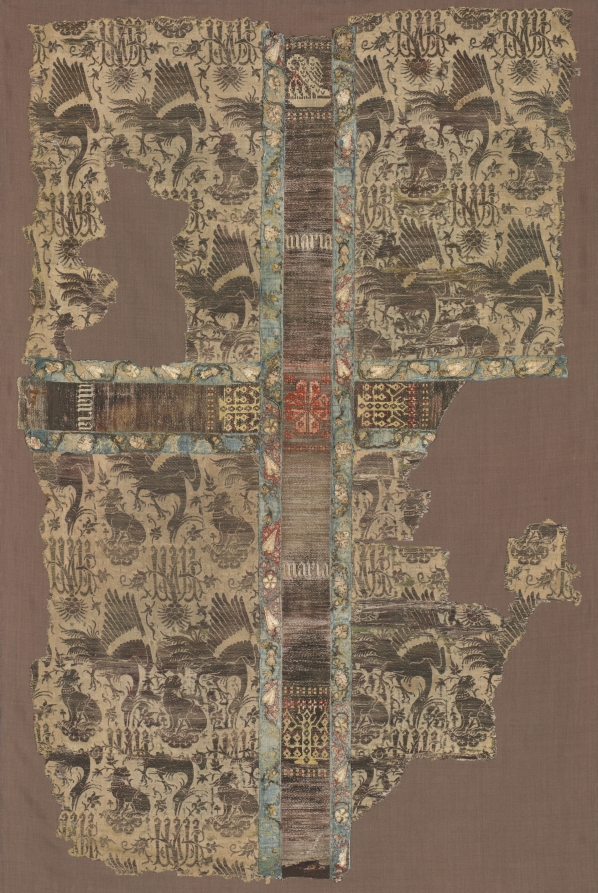
The Fragmentary Chasuble: A Study in Imperial Silk and the Tailor’s Ethos
In the hushed, precise world of Savile Row, where a millimetre can define a legacy, we are accustomed to reading cloth as a language. A bolt of Super 150s speaks of modern aspiration; a length of Harris Tweed speaks of rugged heritage. But there are textiles that speak in a far older, more complex dialect—one of emperors, looms, and liturgical gravity. The Fragmentary Chasuble with Woven Orphrey Band is precisely such an artifact. It is not merely a piece of ecclesiastical vestment; it is a surviving leaf from the ledger of imperial silk weaving, a testament to a supply chain that once stretched from the mulberry groves of the East to the altars of the West, and a reminder that the discipline of construction we prize today has antecedents in the most rarefied of workshops.
Materiality and the Language of Silk
The chasuble’s primary materiality is, of course, silk. But to a discerning eye, the word ‘silk’ is insufficient. This is not the supple, lustrous fabric of a modern tie or a couture gown. This is a silk of a different order—a filament of such fineness and twist that it possesses a structural integrity akin to a fine metal wire. The ground weave, likely a compound twill or a lampas structure, would have been woven on a drawloom, an instrument of staggering complexity that required two operatives: a master weaver and a drawboy perched above, pulling the cords that selected each warp thread according to a pre-punched pattern. The result is a fabric of dense, almost architectural weight, designed to drape in heavy, sculptural folds over the celebrant’s shoulders.
The fragmentary nature of the piece is itself informative. What remains is not a complete vestment but a section—perhaps the front panel or a portion of the back—preserving the central orphrey band. This band, woven *en suite* with the ground, is the artifact’s defining feature. Unlike applied embroidery or a separately attached strip of trim, a woven orphrey is integral to the cloth. The pattern is not stitched upon the silk; it *is* the silk. This distinction is crucial. It speaks to a level of technical ambition where the weaver did not merely produce a field of colour but embedded a narrative—often a sequence of saints, a scene from the Passion, or a repeating heraldic motif—directly into the fabric’s very structure. The precision required is akin to a Savile Row cutter drafting a pattern for a fully canvassed jacket: every thread must be accounted for, every intersection calculated, or the entire composition collapses.
The Imperial Legacy: From Sericulture to Sanctuary
To understand this chasuble, we must understand its provenance in the broader context of imperial silk weaving. For centuries, the finest silks in Christendom were not woven in London, Paris, or even Lyon. They were produced in the great imperial workshops of the Byzantine Empire, and later, in the sophisticated ateliers of Lucca, Venice, and Florence, which inherited and refined the Byzantine techniques. The term ‘imperial’ is not decorative here. In Byzantium, silk production was a state monopoly, a matter of strategic and economic security. The *gynaecea*—the imperial weaving houses—were guarded facilities where the secrets of sericulture and the complex drawloom patterns were held as closely as state secrets. To wear such silk was to wear the empire itself.
The chasuble’s orphrey band, with its likely figural or floral motifs, would have been woven in a workshop that operated under this imperial aegis or its direct successor. The dyes alone—the deep, madder-based reds, the indigo blues, the gold thread wrapped around a silk core—were commodities of immense value, often traded ounce for ounce with silver. The silk itself, imported raw from China along the Silk Road, was re-spun, dyed, and woven in these European centres, transforming a distant, exotic raw material into a distinctly Christian, distinctly European luxury. This is the legacy of imperial weaving: a system of absolute quality control, of patronage that demanded perfection, and of a technical knowledge so closely guarded that its loss in later centuries would be mourned by textile historians.
Construction and the Tailor’s Discipline
For the modern tailor, the chasuble offers a profound lesson in the relationship between cloth and form. The chasuble is, in its most basic form, a poncho-like garment—a circle or an oval of fabric with a hole for the head. But the *fragmentary* nature of this piece reveals a more nuanced reality. The cut is not a simple circle. The surviving seams and the orientation of the orphrey band indicate a carefully shaped garment, with curved side seams and a tailored shoulder line that allowed the heavy silk to fall in controlled, vertical folds rather than billowing awkwardly. This is the same logic that governs a Savile Row shoulder: the fabric must be persuaded, not forced, to follow the body’s line.
The woven orphrey band, running vertically down the centre front and back, acts as a structural spine. Its denser weave and heavier thread count would have given the garment a natural rigidity, a central axis from which the fabric could drape. This is analogous to the role of a chest piece or a canvas in a tailored jacket—an internal architecture that gives the outer cloth its shape and authority. The chasuble’s maker understood that the vestment was not merely a covering but a *structure*, a piece of wearable architecture designed to elevate the wearer and focus the congregation’s gaze.
Preservation and the Modern Gaze
That this fragment survives at all is remarkable. Silk is a protein fibre, susceptible to light, humidity, and the oils of human skin. The fact that we can examine this piece today is due to the conditions of its preservation—likely in a church treasury, wrapped in linen, or perhaps hidden within a later reliquary. Its fragmentary state is a reminder that heritage is not always pristine. It is often broken, faded, and incomplete. Yet, as with a well-worn pair of bench-made shoes or a faded regimental tie, the wear tells a story. The missing sections are as eloquent as the surviving ones, speaking of centuries of use, of liturgical drama, of the slow, inevitable decay that all material things must face.
In the context of the Lauren Fashion Heritage Lab, this chasuble is not a relic to be admired from a distance. It is a research artifact—a primary source document. By studying its weave structure, we can reverse-engineer the drawloom pattern. By analysing its dyes, we can trace trade routes. By examining its cut, we can understand the liturgical tailoring practices of its era. It is a masterclass in materiality, a proof that true luxury is not about surface decoration but about the integrity of the structure beneath.
Conclusion: The Eternal Standard
The Fragmentary Chasuble with Woven Orphrey Band is a quiet, powerful rebuke to the ephemeral. In an age of fast fashion and disposable trends, it stands as a monument to a time when a single garment could take months to weave and was intended to outlive its wearer. Its legacy is not merely that of imperial silk weaving, but of a certain mindset—a mindset that values patience, precision, and permanence. On Savile Row, we speak of a garment being ‘built,’ not ‘made.’ This chasuble was built. Every thread, every weave, every fold was considered and executed with a rigour that would make a master cutter nod in respect. It is a fragment, yes, but a fragment of a standard that we would do well to remember: the standard of cloth as a carrier of meaning, and of construction as a form of reverence.
Heritage Lab Insight
Lab Insight: CMA Silk Archive Node integration.