Category: Silk
The Motif of the Dragon and the Flaming Pearl: A Study in Imperial Materiality
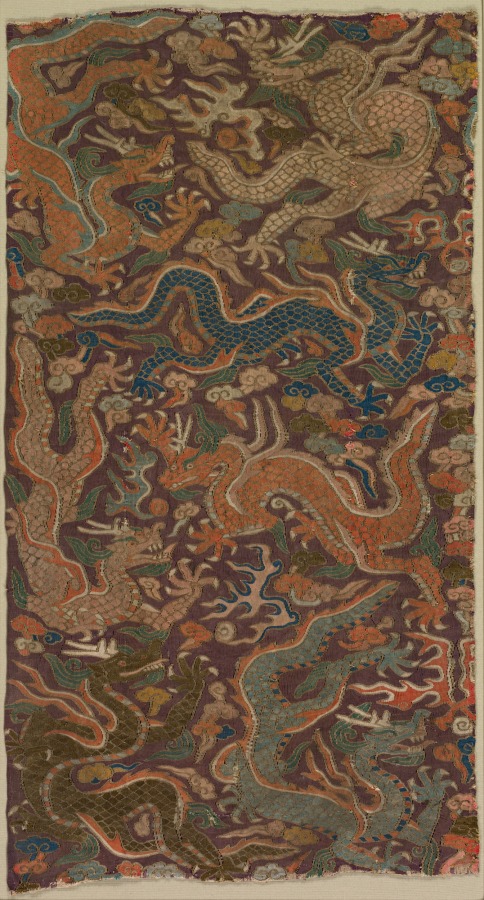
In the hushed ateliers of London’s Savile Row, where the whisper of shears against worsted wool is a sacred liturgy, one rarely encounters the audacious opulence of the Far East. Yet, when a client of discerning taste commissions a piece that transcends mere tailoring, we turn to the archives of the Lauren Fashion Heritage Lab. There, among the swatches and pattern books, lies a subject of profound technical and symbolic weight: the *Dragon Chasing the Flaming Pearl*, rendered in silk. This is not a mere decorative flourish; it is a material testament to imperial power, a complex dialogue between the weaver’s loom and the emperor’s mandate, and a study in the very essence of luxury—rarity, skill, and meaning.
The motif itself is ancient, predating the Han dynasty, but its apotheosis occurred during the Ming (1368–1644) and Qing (1644–1912) dynasties, when imperial silk weaving reached a zenith of technical perfection that remains unsurpassed. The dragon, *long*, was not a fire-breathing beast of Western lore but a benevolent, water-associated deity, a symbol of cosmic energy, transformation, and, most critically, the emperor himself. The flaming pearl, *huozhu*, represents wisdom, spiritual essence, and the sun’s life-giving force. The chase is not one of predation but of pursuit—the emperor’s relentless quest for enlightenment and the harmonious balance of the universe. To wear such a garment was to literally embody the celestial mandate, to drape oneself in the metaphysical architecture of the realm.
Materiality and the Imperial Loom
The materiality of this silk is not a passive backdrop; it is an active participant in the narrative. The silk used in imperial workshops, particularly in Nanjing, Suzhou, and Hangzhou, was not the standard commodity. It was a meticulously cultivated product, harvested from silkworms fed on mulberry leaves from specific groves, spun into threads of such fineness that a single cocoon could yield over a kilometer of filament. The resulting fabric, often a heavy satin (*duan*) or a complex twill (*ling*), possessed a lustrous, almost liquid quality. This was not a cloth for the common man; its very weight and drape signified status. The ground weave, often a deep imperial yellow or a rich azure, was itself a declaration of rank, reserved exclusively for the Son of Heaven and his immediate family.
The execution of the dragon and pearl motif demanded a virtuosity that bordered on the supernatural. The most celebrated technique was *kesi*, or "cut silk," a form of tapestry weaving that eschews the weft thread’s continuous passage. Instead, each colour is woven in small, individual bobbins, creating a fabric where the pattern is structurally integral to the cloth, not merely embroidered upon it. The result is a textile with a remarkable clarity of image on both sides, and a tactile, sculptural quality. For the dragon’s scales, the weaver would employ a technique of varying the twist of the silk thread—alternating between a tight Z-twist and a loose S-twist—to create a subtle, shimmering moiré effect, making the beast appear to ripple and move beneath the light. The flaming pearl, often rendered in a contrasting, luminous white or gold thread, was frequently woven with a raised, padded effect, giving it a three-dimensional presence that seemed to float above the fabric’s surface.
The Legacy of Imperial Silk in Modern Craft
For the modern heritage specialist, the legacy of this imperial silk weaving is not a matter of mere antiquarian interest. It is a benchmark of uncompromising quality, a standard against which all subsequent luxury textiles are measured. The technical challenges of *kesi* are so immense that a single square foot of fabric could take a master weaver months to complete. This is the antithesis of mass production; it is a form of slow, deliberate art that demands a lifetime of apprenticeship. The knowledge required—of dyeing, of loom mechanics, of the precise tension needed for a flawless weave—was a closely guarded state secret, passed down through generations of artisan families. The collapse of the imperial system in 1912 dispersed these workshops, but the techniques survived in a diminished form, and today, a handful of master weavers in China and Japan still practice this art, their output measured in inches, not yards.
When we at the Heritage Lab consider a contemporary commission—perhaps a silk velvet smoking jacket with a discreetly woven dragon motif, or a formal evening scarf in a deep, imperial blue—we are not simply borrowing a pattern. We are engaging with a lineage of material culture that speaks to the very nature of power and patronage. The client who chooses such a piece is not merely selecting a fabric; they are aligning themselves with a tradition that values the invisible labour of the hand, the intellectual rigour of the design, and the profound, almost talismanic power of the symbol. The dragon’s pursuit of the pearl is a metaphor for the wearer’s own ambition—the relentless, disciplined pursuit of excellence. It is a quiet, sartorial declaration that one understands the difference between mere clothing and a garment that carries the weight of history.
In the end, the *Dragon Chasing the Flaming Pearl* in silk is more than a heritage artifact. It is a masterclass in the alchemy of materiality and meaning. It demonstrates that true luxury is not found in ostentation but in the silent, perfect marriage of technique and symbolism. It is a reminder that the finest cloth is not manufactured; it is cultivated, woven, and imbued with intention. And for those who have the privilege to wear it, it serves as a constant, tactile reminder that they, too, are engaged in a noble pursuit—the chase for their own, personal pearl of wisdom and distinction.