Category: Silk
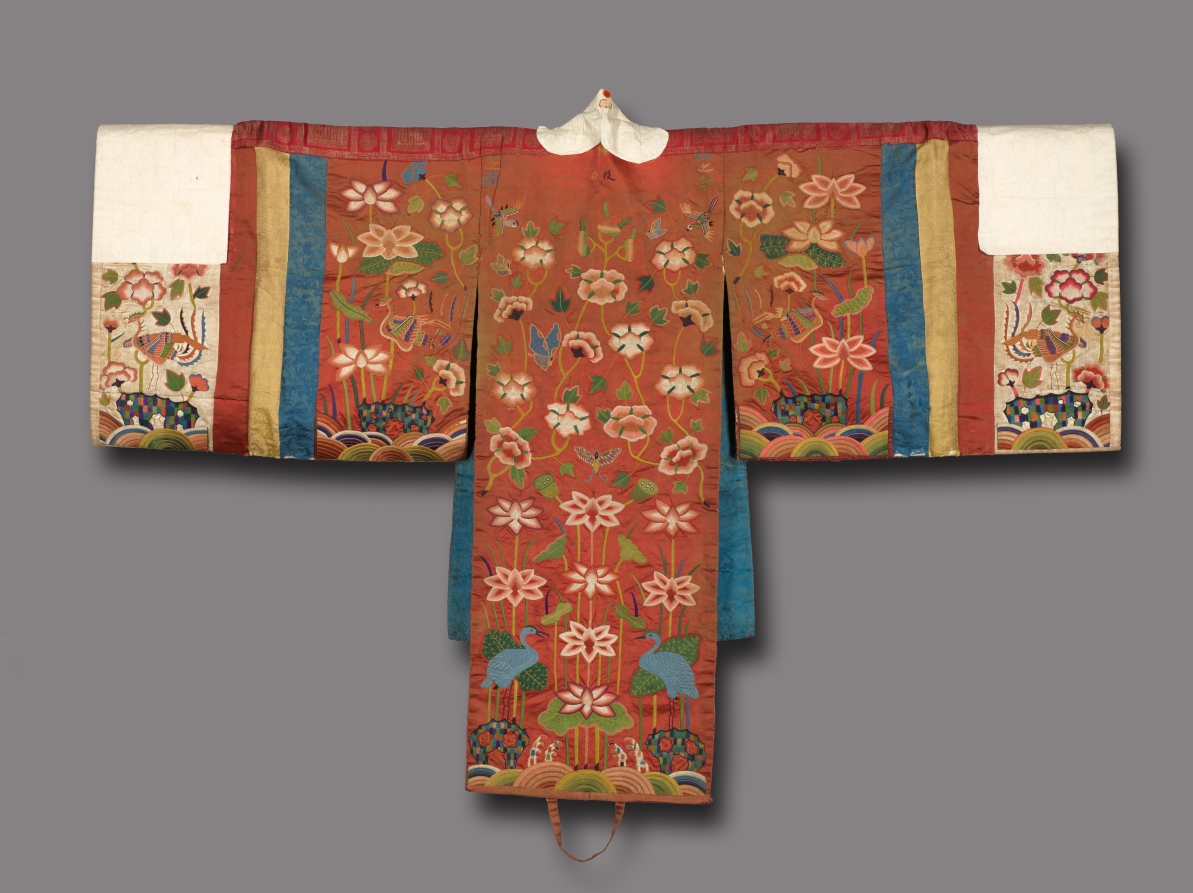
The Hwarot: A Study in Imperial Materiality and the Enduring Language of Silk
In the rarefied atmosphere of heritage preservation, one must approach a garment not merely as cloth, but as a document—a ledger of dynastic power, artisanal mastery, and cultural memory. The Bridal Robe, or *Hwarot*, stands as a singular testament to this principle. To examine it is to read a chapter of Korean royal history, penned not in ink, but in the lustrous, unbroken filament of the silkworm. Within the hallowed walls of the Lauren Fashion Heritage Lab, we treat this artifact with the same reverence afforded a bespoke suit from a master tailor on Savile Row: an understanding that true luxury is not manufactured, but cultivated, measured, and stitched with intent.
The materiality of the Hwarot is its primary text. Silk, in its purest form, is a protein fibre—a continuous, extruded thread produced by the *Bombyx mori* moth. Yet to dismiss it as mere biology is to ignore its imperial weight. In the context of the Korean Joseon dynasty (1392–1897), silk was not a commodity; it was a currency of sovereignty. The imperial silk-weaving workshops, or *Gyeonggigam*, operated under a mandate of absolute precision. These ateliers were the precursors to our own concept of haute couture, yet their output was not for the whims of fashion but for the codified rituals of state. The Hwarot, worn by princesses and queens on their nuptial day, was the apotheosis of this system—a garment whose very fibres were imbued with the mandate of heaven.
The Weave of Power: Construction and Craft
To the uninitiated, the Hwarot may appear as a cascade of embroidered colour. To the trained eye, it is a structural marvel. The base fabric is typically a high-density silk satin or damask, woven on a drawloom requiring two artisans: one to operate the pedals, another to manipulate the pattern harness. This division of labour—a master and an assistant working in silent synchrony—mirrors the hierarchical harmony of the court itself. The weave is not merely a ground; it is a foundation of strength. The tight, warp-faced construction ensures the robe holds its architectural silhouette, a stiff, voluminous form that projects authority rather than softness. This is not the fluid drape of a Parisian evening gown; this is the rigid, ceremonial armour of a bride entering a new dynasty.
The legacy of imperial silk weaving is most profoundly expressed in the Hwarot’s embroidery. Here, the materiality of silk transcends its woven state. The threads are not dyed post-production; rather, the cocoons are sorted for colour, and the filaments are twisted into specific gauges—from gossamer-fine for facial details to a thicker, more robust ply for outlining dragon scales. The palette is dictated by Confucian symbolism: the five cardinal colours—blue, red, yellow, white, and black—each representing a directional guardian and a cosmic principle. The red of the robe’s dominant field signifies good fortune and warding off evil, while the yellow and blue phoenixes, peonies, and butterflies are embroidered in a technique known as *jasu*, using a twisted silk thread that catches light differently from every angle. This creates a subtle, kinetic shimmer—a deliberate effect, akin to the way a well-cut worsted wool suit reveals a hidden striation under a Savile Row fitting light.
Materiality as Memory: The Silk’s Journey
One cannot discuss the Hwarot without acknowledging the arduous journey of its primary material. The cultivation of mulberry trees, the meticulous feeding of silkworms on fresh leaves, and the delicate process of reeling the cocoon in hot water to obtain a single, unbroken filament—potentially up to 900 metres in length—was a seasonal ritual of profound patience. This was not industrial production; it was a pastoral liturgy. The resulting thread, known as *raw silk*, was then degummed to remove the sericin, revealing its signature sheen and softness. In the imperial workshops, this raw material was often further refined through a process of *gokja* (twisting) to increase tensile strength, ensuring the garment could withstand the weight of its own embroidery—some Hwarot are adorned with over a kilogram of silk thread, beads, and gold leaf.
The legacy of this weaving is not merely historical; it is a standard of excellence that persists in contemporary luxury. When we at the Lauren Fashion Heritage Lab examine a Hwarot, we are not looking at a relic. We are observing a dialogue between material and maker. The silk’s natural protein structure allows it to breathe, to regulate temperature, and to absorb dye in a manner that synthetic fibres cannot replicate. This is why a Hwarot, even after centuries, retains a chromatic intensity that is startling. The red is not faded; it is deepened, like a fine Bordeaux. The gold thread, wrapped around a silk core, has not tarnished but has acquired a patina of age that speaks to its authenticity. This is the hallmark of imperial silk: it does not decay; it matures.
Conservation and the Tailor’s Ethos
In our conservation practice, we apply a principle borrowed from the Savile Row tailor: *fit for purpose*. The Hwarot’s silk is delicate, prone to fracturing along the folds where the sericin has been abraded by time. Our approach is not to restore it to a pristine, false state, but to stabilise it. We use a low-tension mounting system, often on a padded, acid-free mannequin, to distribute the garment’s weight evenly—much as a tailor would use a canvas interlining to support a jacket’s lapel. We do not clean the silk aggressively; we use a soft, dry brush and a gentle vacuum to remove surface dust. The embroidery is protected with a fine, sheer silk netting, a transparent barrier that allows viewing without physical contact. This is not preservation for preservation’s sake; it is an act of respect for the material’s inherent dignity.
The Hwarot’s legacy of imperial silk weaving is a lesson in the economics of excellence. It was a garment that required an entire ecosystem—from the sericulturist to the dyer, from the weaver to the embroiderer—to produce a single object of transcendent beauty. In our modern era of fast fashion and synthetic mimicry, the Hwarot stands as a quiet rebuke. It reminds us that true heritage is not a trend; it is a standard. The silk does not shout; it whispers, and in that whisper is the accumulated wisdom of dynasties, the patience of artisans, and the unyielding truth that materiality, when honoured, becomes memory. And memory, like a well-tailored garment, never goes out of style.