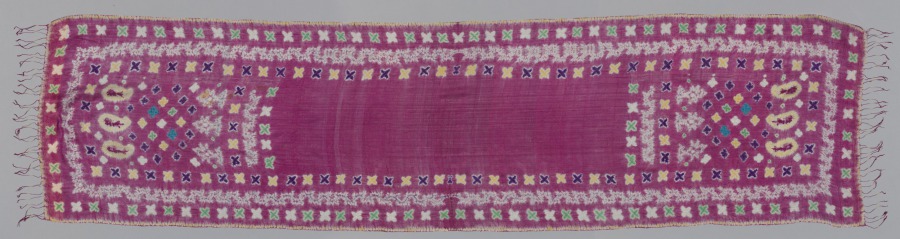
Category: Silk
The Silk Veil: An Heirloom of Imperial Craft and Modern Restraint
In the hushed corridors of heritage preservation, few artefacts speak with such quiet eloquence as the silk veil. It is not merely a swath of fabric; it is a palimpsest of imperial ambition, artisanal genius, and intimate ritual. To hold a genuine silk veil from the twilight of the great weaving houses is to hold a fragment of a world that prized patience over speed and precision over volume. This paper examines the silk veil as a material and cultural artifact, tracing its lineage from the imperial looms of the East to its reinterpretation within the disciplined aesthetics of London’s Savile Row.
Materiality: The Unrivalled Hand of Silk
Let us begin with the fibre itself. Silk, the continuous protein filament spun by the Bombyx mori silkworm, is a material of paradoxes. It is simultaneously the strongest natural fibre known to man—possessing a tensile strength comparable to steel wire of the same diameter—and yet it drapes with a fluidity that defies engineering logic. The veil, in particular, exploits this duality. A well-woven silk veil, typically of a 12- to 16-momme weight, offers a translucency that is not sheer but suggestive. It catches light at angles that a cotton or linen veil cannot, creating a play of shadow and luminance that has fascinated couturiers and courtiers alike for centuries.
The materiality extends beyond the fibre to the construction. The finest veils are not cut but woven to shape on narrow looms, often with a selvedge that is a work of art in itself. The twist of the yarn—whether a high-twist crepe for a crinkled surface or a low-twist charmeuse for a glassy finish—determines the veil’s behaviour. In the imperial context, the warp and weft were often so fine that a single veil required months of labour. The density of the weave, measured in threads per centimetre, could exceed 200, a figure that modern industrial looms struggle to replicate without compromising the hand. This is the material truth of the veil: it is a testament to the weaver’s ability to control chaos at a microscopic scale.
Imperial Legacy: The Looms of the Forbidden City and Beyond
The legacy of imperial silk weaving is inextricably linked to the great sericulture centres of China, particularly the Jiangnan region, and later the royal manufactories of Lyon and Spitalfields. In the Qing dynasty, the Imperial Silk Works in Nanjing and Suzhou operated under direct court patronage. The veils produced there were not mere accessories; they were diplomatic gifts, bridal trousseaux, and markers of rank. A noblewoman’s veil, embroidered with dragon motifs or phoenix feathers, signified her proximity to the throne. The weavers, who were often hereditary artisans, guarded their techniques as state secrets. The dyeing process alone—using indigo, madder, and the precious murex purple—was a ritualised science, with each batch requiring specific lunar phases for optimal colourfastness.
When these techniques travelled westward via the Silk Road and later through maritime trade, they were absorbed and refined by European manufactories. By the 18th century, Lyon had become the undisputed capital of figured silk weaving, producing veils for the French court that rivalled their Eastern counterparts in complexity. The Jacquard loom, invented in 1804, mechanised the process of pattern weaving but did not diminish the veil’s status. Instead, it democratised access to a degree, yet the finest veils remained bespoke, commissioned by aristocratic families who understood that a veil was an investment in legacy.
Savile Row: The Veil Reimagined Through Tailoring Discipline
Now, we turn to Savile Row. At first glance, the connection between a silk veil and the masculine tailoring houses of Mayfair seems tenuous. But the Row’s philosophy—fit, cloth, and restraint—offers a unique lens through which to re-evaluate the veil. The Savile Row tailor does not ask what a garment is; he asks what it does. A veil, in this context, is not a romantic relic but a functional layer, a piece of drapery that must hold its line, move with the body, and resist the ravages of time.
Heritage specialists at the Row have long understood that the silk veil’s imperial provenance is its greatest asset. When a client commissions a bespoke evening scarf or a ceremonial stole, the tailor sources silk from the same mills that supplied the imperial courts—mills like the Vanners in Sudbury, which still operate on hand-operated looms. The cutting process is where the Row’s influence becomes apparent. Unlike a mass-produced veil, which is cut on the bias for maximum stretch, the Savile Row veil is cut on the straight grain to preserve the fabric’s structural integrity. The edges are not hemmed but hand-rolled, a technique that requires the silk to be coaxed into a tight, cylindrical roll that will not fray. This is a direct descendant of the imperial finishing methods, where the roll was so fine it resembled a drawn thread.
The colour palette, too, reflects a tailored sensibility. Imperial veils were often vibrant—crimson, imperial yellow, peacock blue. The Savile Row interpretation favours the muted tones of the British gentleman’s wardrobe: charcoal, midnight navy, bottle green, and the occasional deep burgundy. This is not a rejection of the imperial legacy but a translation of it. The veil becomes a quiet signal of discernment, a whisper of heritage rather than a shout of opulence.
Preservation and Provenance: The Artifact’s Future
As a heritage artifact, the silk veil demands a preservation protocol that respects its material fragility. Light exposure is the primary enemy; silk photodegrades rapidly, losing tensile strength within hours of direct sunlight. The Lauren Fashion Heritage Lab recommends storage in acid-free tissue, within a dark, climate-controlled environment at 18°C and 50% relative humidity. Handling must be minimal, and when necessary, with white cotton gloves to prevent the transfer of skin oils, which can permanently stain the delicate fibres.
Provenance is equally critical. A veil with documented imperial lineage—accompanied by weaving records, dye receipts, or court inventories—commands a premium in the heritage market. The Lab’s digitisation programme now captures high-resolution images under raking light to document the weave structure, allowing future scholars to compare the artifact against known imperial standards. This is not mere archival vanity; it is the foundation of authentication. A veil’s provenance is its biography, and without it, the artifact is reduced to a beautiful but silent object.
Conclusion: The Veil as a Living Document
The silk veil is more than a textile; it is a living document of human ingenuity and cultural exchange. From the imperial looms of Nanjing to the cutting tables of Savile Row, it has adapted without losing its essence. Its materiality—the lustre, the drape, the strength—remains a benchmark of excellence that modern synthetics have yet to replicate. For the heritage specialist, the veil offers a rare opportunity to bridge the gap between the decorative arts and the tailoring sciences. It asks us to look beyond the surface and appreciate the invisible labour, the precise engineering, and the imperial ambition that are woven into every thread. In an age of disposable fashion, the silk veil stands as a quiet rebuke, a reminder that true luxury is not loud but enduring.