← BACK TO ARCHIVES
Silk
Heritage Synthesis: Cloth of gold with felines and eagles
Curated on Aug 11, 2026 // Node: LDN-01
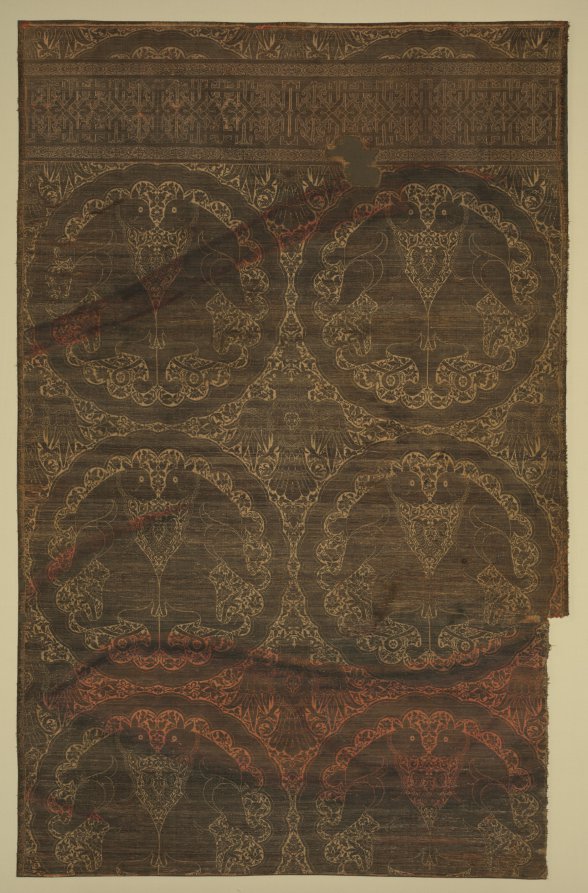
The Imperial Thread: Deconstructing the Cloth of Gold with Felines and Eagles
In the rarefied atmosphere of a Savile Row fitting room, where the light falls with clinical precision upon a bolt of cloth, one learns to read textiles as one reads a ledger—for weight, for drape, for the silent arithmetic of cost. Yet there are fabrics that defy such mercantile scrutiny. The cloth of gold, woven with the intertwined figures of felines and eagles, is not merely a material; it is a document of imperial ambition, a frozen heraldic pronouncement in silk and metal. To handle such a piece is to hold a fragment of statecraft, a whisper of the Byzantine and Sassanian courts that still resonates in the bespoke ateliers of London.
Materiality: The Alchemy of Silk and Gilt
The foundation of this artifact is, of course, the silk itself—a continuous filament of such fineness that it required the patience of generations to master. But the term “cloth of gold” is a deliberate misdirection; the gold is not woven as thread but as a membrane. The weaver would take a strip of animal gut or parchment, gild it with beaten gold leaf, and then slice it into hair-thin lamellae. These were then wound around a core of yellow silk, creating a thread that was at once metallic and supple, capable of being drawn through the warp with the precision of a surgeon’s suture.
The result is a surface of extraordinary optical complexity. When light strikes the cloth, it does not reflect uniformly; it fractures, glinting off the raised gold weft while the silk ground absorbs the shadows. This is not a flat, printed luxury. It is a three-dimensional topography of power. The feline—likely a lion or panther, depending on the dynasty—and the eagle are not merely appliquéd. They are woven into the very structure of the textile, their forms defined by the interplay of metal and fibre. The eagle, with its outstretched wings, often occupies the central medallion, while the felines pace in symmetrical opposition below or flanking. This is a design of deliberate, almost mathematical, hierarchy.
The Legacy of Imperial Silk Weaving: A Genealogy of Power
To understand this cloth, one must abandon the modern notion of fashion as seasonal whim. This is the legacy of imperial silk weaving, a tradition that stretches from the Tang dynasty through the Byzantine *officinae* to the great looms of Lucca and Lyons. In each iteration, the iconography was not decorative but juridical. The eagle, in Roman and Byzantine tradition, was the emblem of Jupiter and, by extension, the Emperor—the earthly vicar of divine authority. The feline, whether the Persian *senmurv* or the lion of Saint Mark, signified royal courage and territorial dominion.
The specific pairing of these two creatures is telling. It suggests a synthesis of powers: the eagle for celestial reach, the feline for terrestrial strength. In the imperial workshops of Constantinople, such cloth was produced under strict state monopoly. The *meticula*—the purple-dyed silk reserved for the sovereign—was forbidden to all but the imperial family. The cloth of gold, while less restricted, was nonetheless a marker of the highest aristocratic echelon. To wear it was to declare one’s proximity to the throne, not through ostentation, but through the very grammar of the weave.
Consider the technical feat. A single panel of this cloth, perhaps two metres in length, could require months of labour. The weaver, working on a drawloom, would have to coordinate hundreds of warp threads, each potentially carrying a different colour of silk or metal. The pattern repeat, with its intricate feline and avian forms, demanded a level of spatial memory that borders on the prodigious. This was not a craft; it was a liturgy. The loom itself was a machine of state, and the weaver a priest of imperial iconography.
From Court to Clientele: The Modern Resonance
How, then, does this artifact translate to the contemporary context of Savile Row? The answer lies not in replication but in principle. The modern tailor, when presented with a cloth of this heritage, is not merely cutting a garment. He is engaging in a dialogue with a thousand years of sartorial jurisprudence. The weight of the cloth—often substantial, with a firm, almost brittle hand—demands a certain architecture. A structured overcoat or a double-breasted dinner jacket, cut with a high armhole and a clean shoulder, honours the fabric’s imperial origins. It does not drape; it stands.
The client who commissions such a piece is not seeking comfort. He is seeking authority. In an era of casualisation, the cloth of gold with felines and eagles is an anachronism by design—a deliberate, almost defiant, assertion of permanence. The felines and eagles, rendered in metallic thread, catch the light of a Mayfair restaurant or a boardroom window with the same intensity they would have caught torchlight in a Byzantine basilica. The message is unchanged: *I am here. I have lineage. I do not yield.*
Yet there is a subtlety that the modern eye must appreciate. The cloth’s beauty is not in its brilliance alone but in its restraint. The gold is not garish; it is burnished, aged, almost sombre. The silk ground, often in deep crimson, midnight blue, or forest green, tempers the metallic glare. This is a luxury that whispers, not shouts. It is the difference between a nouveau-riche gilding and a patrician heirloom.
Preservation and Provenance
For the heritage specialist, the primary concern is not the garment’s future but its past. Each thread of this cloth is a primary source. The dye analysis can reveal the source of the silk—China, Central Asia, or the Mediterranean. The metal content—whether pure gold or an alloy with silver or copper—can date the piece to a specific workshop. The weave structure, whether a samite or a lampas, tells us of the loom technology available. To document this is to reconstruct a trade route, a diplomatic gift, a war trophy.
In the Lauren Fashion Heritage Lab, we treat such artifacts with the reverence of a manuscript. We do not clean them aggressively; we stabilise them. We photograph them under raking light to capture the topography of the weave. We create digital reconstructions that allow a contemporary designer to understand the pattern’s rhythm without risking the original. The goal is not to freeze the cloth in amber but to translate its language for a new generation of makers.
Conclusion: The Tailor’s Imperative
The cloth of gold with felines and eagles is a testament to the enduring power of material culture. It reminds us that fashion is not a superficial pursuit but a repository of memory, power, and identity. For the tailor on Savile Row, it is a challenge: to cut a garment that honours the imperial legacy without becoming a costume. For the client, it is an investment in a narrative that predates them and will outlast them.
In the end, this artifact is not about the gold or the silk. It is about the discipline of the loom and the discipline of the needle. It is about the belief that what we wear is a statement of who we are—and who we aspire to be. When you commission a piece from such cloth, you are not buying a fabric. You are commissioning a coat of arms, woven in metal and filament, ready to be worn into the next century. That, in the final analysis, is the true legacy of imperial silk weaving.
Heritage Lab Insight
Lab Insight: CMA Silk Archive Node integration.