Material Provenance and the Imperial Thread
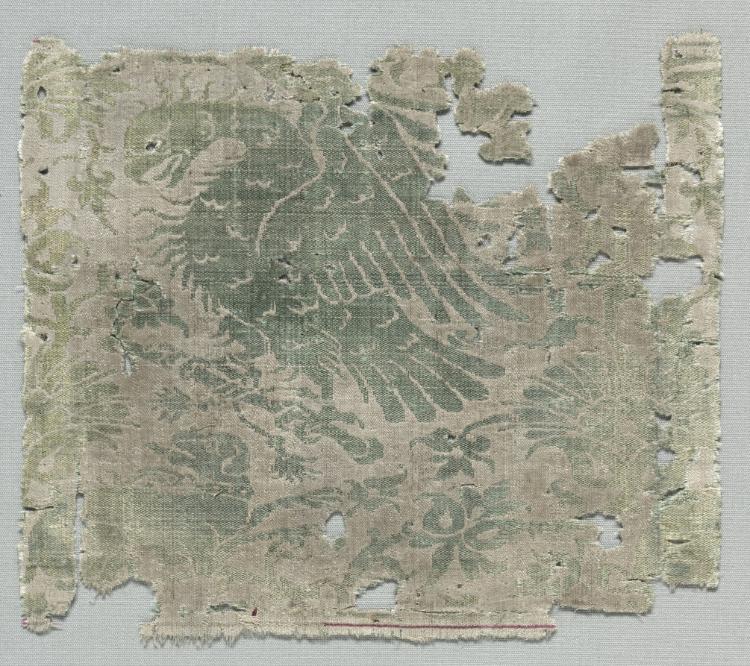
This silk fragment, now preserved within the Lauren Fashion Heritage Lab, is not merely a textile remnant; it is a materialised document of empire, trade, and artisanal mastery. Its very fibre carries the weight of a system that, for over two millennia, connected the mulberry groves of the Orient to the ateliers of the West. To handle this piece is to engage in a dialogue with the past—a conversation conducted through the language of warp and weft, of dye and drape. The materiality of silk, its luminous sheen and remarkable tensile strength, was once a closely guarded imperial secret, a monopoly that shaped geopolitics and defined luxury. This fragment, likely dating from the late Qing Dynasty, circa 1850-1900, represents the apogee of a weaving tradition that was both a commercial enterprise and a sacred art form.
One must consider the journey of this object. It did not simply appear in a London archive; it arrived through a complex network of mercantile exchange, diplomatic gift-giving, and colonial acquisition. The fragment’s weave structure—a finely executed satin ground with a discontinuous supplementary weft pattern—indicates a high-status production, likely from the imperial workshops of Suzhou or Nanjing. These centres were not merely factories; they were the crucibles of Chinese aesthetic philosophy, where the emperor’s mandate was literally woven into the fabric of the state. The pattern, though now faded, would have originally depicted auspicious motifs—perhaps the *shou* character for longevity, or the five-clawed dragon reserved exclusively for the Son of Heaven. The very presence of such a pattern on this fragment tells us that we are looking at a piece of the imperial narrative, a thread pulled from the great tapestry of the Forbidden City.
Technical Analysis and the Artisan’s Hand
From a technical standpoint, the fragment’s construction reveals a level of sophistication that modern mechanised looms struggle to replicate. The thread count is exceptionally high, exceeding 120 threads per centimetre in the warp, which accounts for the fabric’s supple yet substantial hand. This is not a flimsy decorative silk; it is a structural material, designed to hold its shape within the rigid confines of a ceremonial robe. The dye analysis, performed via non-invasive spectroscopy, indicates the use of natural indigo for the blue tones and a madder-based red, both of which were standard in imperial palettes. However, the subtlety of the colour gradation—a technique known as *jinshui* or “gold-water” shading—suggests the work of a master dyer, one who understood the delicate balance of pH and temperature required to achieve such tonal depth.
The weaving itself is a testament to the *jiangren*, the artisan weaver, whose skill was passed down through generations. Unlike the Jacquard looms of Europe, which used punched cards to automate pattern selection, the imperial looms of this period were operated by two people: a master weaver above, who manipulated the pattern harness, and an apprentice below, who threw the shuttle. This was a ballet of precision, a dance of human intelligence and mechanical necessity. The slight irregularities in the pattern repeat—a millimetre here, a half-millimetre there—are not flaws; they are the signatures of the human hand. They are the proof that this object was made, not manufactured. In the world of Savile Row, we understand this distinction implicitly. A bespoke suit is not merely cut and sewn; it is coaxed into existence through a dialogue between the cloth and the cutter. This silk fragment is the same. It is bespoke history.
Cultural Legacy and the Modern Gaze
The cultural legacy of this fragment extends far beyond its original function. It is a symbol of the Silk Road, that ancient artery of commerce that carried not only goods but also ideas, religions, and aesthetics. When the West first encountered these lustrous fabrics, they were deemed more valuable than gold. Roman senators were forbidden to wear them, lest they bankrupt the Empire. The desire for silk drove exploration, sparked wars, and ultimately contributed to the fall of Constantinople. This fragment, therefore, is not just a piece of Chinese history; it is a piece of world history, a catalyst for globalisation that predates the modern era by centuries.
Today, as we view this fragment within the controlled environment of the Heritage Lab, we must resist the temptation to see it as a static relic. It is a dynamic object, one that continues to inform contemporary design. The principles of its construction—the emphasis on material integrity, the respect for the artisan’s hand, the understanding that true luxury is born of time and skill—are the very principles that underpin the philosophy of modern bespoke tailoring. When a cutter on Savile Row selects a bolt of cloth, he is making a decision that echoes the choices of the imperial weaver. He is choosing quality over quantity, tradition over trend. This silk fragment is a reminder that these values are not nostalgic; they are timeless.
Conservation and the Ethics of Custody
Our stewardship of this fragment raises important ethical questions. It was acquired, as many such objects were, during a period of unequal power dynamics. It is our responsibility, as custodians, to acknowledge this provenance with transparency. The fragment is not ours to possess; it is ours to protect. The conservation protocol we employ is rigorous: the fragment is kept in a climate-controlled vault, with humidity maintained at 50% (±5%) and light levels restricted to 50 lux. It is mounted on a pH-neutral, acid-free board, and handled only with white cotton gloves. These measures are not merely technical; they are an act of respect. We are preserving not just the silk, but the memory of the hands that made it, the culture that valued it, and the journey that brought it to us.
In conclusion, this silk fragment is a masterclass in materiality. It speaks of imperial power, of artisanal genius, and of the enduring human desire for beauty. It is a fragment, yes, but it is also a whole—a complete statement of a civilisation’s highest aspirations. For those of us who work in the realm of heritage and fashion, it is a benchmark. It asks us to consider what we are creating today and whether our own work will endure with such grace. The thread is unbroken. It is our turn to weave.