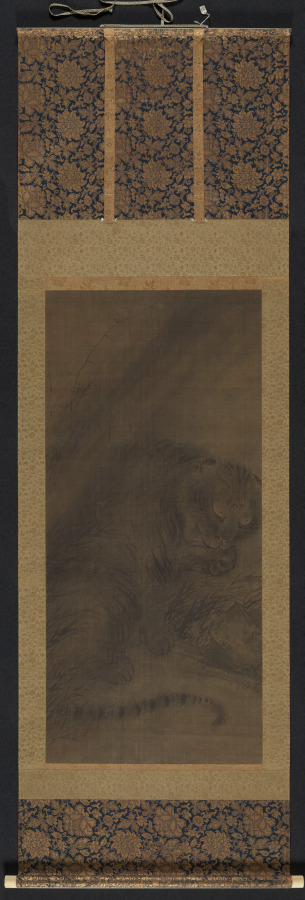
A Discourse on the Imperial Feline: The Tiger in the Grand Tapestry of Silk
To consider the tiger in silk is to engage with a subject of profound material and symbolic consequence. It is not merely the representation of a formidable creature; it is the embodiment of raw, untamed power meticulously translated into the most refined and civilised of mediums. The legacy of imperial silk weaving provides the only fitting context for such a juxtaposition. Here, in the ateliers and manufactories serving dynastic courts, the tiger was not rendered as a beast of mere wilderness, but as a heraldic symbol of authority, a cosmological force, and a testament to the absolute technical supremacy of the loom. The materiality of silk—its luminosity, its fluid drape, its capacity to hold colour with unrivalled depth—was the essential precondition for this translation. Lesser fabrics could suggest the form; only silk could capture the essence.
The Loom as a Tool of Dominion
Imperial silk weaving was, first and foremost, an exercise in controlled magnificence. The complex drawloom, and later the Jacquard apparatus, were mechanisms of breathtaking precision, allowing for the creation of vast, seamless pictorial narratives. When commissioned to depict the tiger, the weaver was tasked with a formidable challenge: to convey dynamic, organic ferocity through a rigid, binary grid of warp and weft. The success of this endeavour stands as a hallmark of the craft. The creature’s pelt, a chaotic map of striations, was systematised into repeating yet subtly varied patterns, each black stripe painstakingly built from thousands of silk threads against grounds of gold, crimson, or deep sapphire. The pile of velvet variants, particularly in Chinese imperial contexts, added a tactile dimension, the nap catching the light to mimic the shifting, luminous quality of fur in motion.
This technical mastery served a deliberate narrative. In the Chinese imperial tradition, the tiger was the emblem of the West, the autumn, and the military—the yin to the dragon’s yang. Its presence on silk robes, court hangings, and ceremonial accoutrements was a direct communication of imperial power. The dragon might rule the heavens, but the tiger governed the earthly domain, its sinewy strength woven into the very fabric of authority. The message was clear: the empire commanded not only the celestial mandate but the formidable forces of the natural world. The silk was the medium, but the subtext was control.
A Bestiary of Power: Symbolic Weft and Political Warp
Beyond technical achievement, the imperial silk tiger operated within a dense web of symbolism. In the Mughal courts of India, the chintz and later the brocaded silks often featured tigers in combat with leopards or elephants, scenes derived from Persian epic poetry and representing the cosmic struggle between order and chaos. These were not decorative whims; they were assertions of the emperor’s role as the restorer of divine order. The silk, often interwoven with metallic threads, would cause these dramatic scenes to shimmer with every movement of the wearer, a living, breathing canvas of mytho-political authority.
Similarly, in Japan, the tiger—frequently paired with the dragon or traversing bamboo forests—was a popular motif on Noh robes and kosode, rendered in exquisite yuzen dyeing or gold-leaf embroidery on silk grounds. The imagery, borrowed from Chinese cosmology but adapted to Japanese aesthetics, spoke of courage and the mastery of the spirit over adversity. The silk’s inherent elegance tempered the tiger’s ferocity, presenting it as a force not of mindless violence, but of focused, noble potency. The material thus acted as a civilising filter, elevating the bestial to the heroic.
The Legacy in the Modern Lexicon of Luxury
The resonance of this heritage in contemporary luxury is neither accidental nor trivial. When a modern design house employs a tiger motif upon a silk twill or jacquard, it is invoking—whether consciously or not—this centuries-old dialogue between untamed nature and supreme craftsmanship. The Savile Row parallel is evident: it is the reconciliation of a powerful, almost wild, silhouette with the most exacting, precise construction. The tiger’s form demands respect; the silk demands admiration for the hand that wrought it.
To commission or acquire such a piece today is to participate in a legacy that understands luxury as a language of nuanced power. It is a rejection of the blatant and an embrace of the coded. The imperial silk weavers did not shout; they conveyed profound statements through the whisper of a loom and the allegory of a beast. The modern inheritor of this tradition, therefore, must treat the motif with a corresponding gravitas. It is not a mere pattern; it is a heraldic charge, carrying the weight of dynastic symbolism and technical ambition.
In conclusion, the tiger in imperial silk is a supreme artifact of calculated contradiction. It represents the apex of a cultural and sartorial ecosystem where art, politics, and technology were seamlessly interwoven. The silk provided the necessary grandeur and permanence, while the imperial context provided the symbolic depth. To study this artifact is to understand that true luxury resides not in the obvious display of wealth, but in the command of a complex vocabulary—a vocabulary where a single, beautifully rendered creature upon a field of silk can speak volumes of authority, cosmology, and an empire’s unwavering confidence in its ability to tame the sublime.