The Shadow of Legacy: Daumier’s Dismay and the 2026 Old Money Silhouette
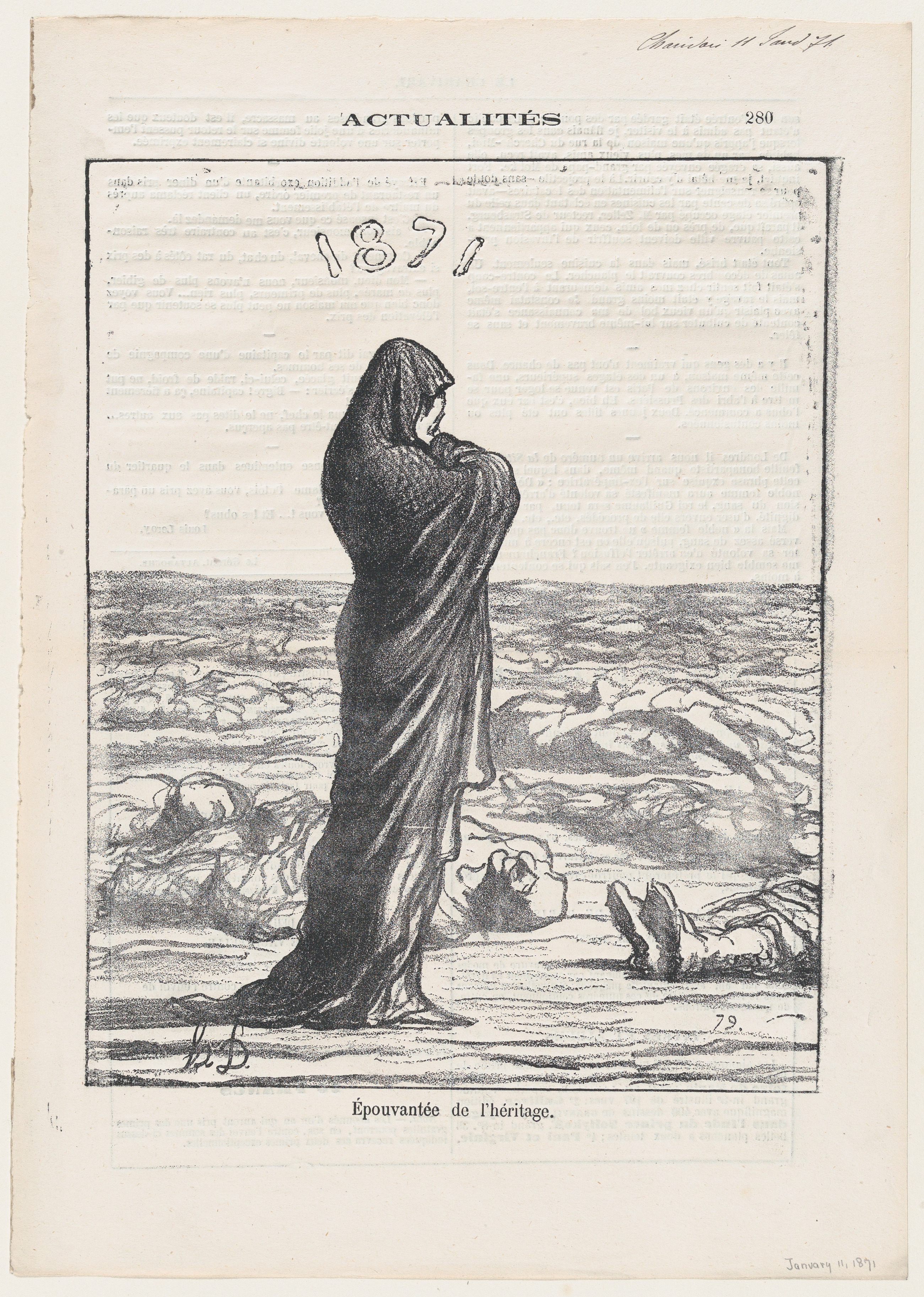
In the meticulous curation of Lauren Fashion’s heritage, we engage not only with objects of beauty but with artifacts of cultural critique. The internal genetic code elucidates a 16th-17th century "Global Baroque," where aesthetics served as a medium for power, curiosity, and cross-cultural translation. This analysis pivots from that early modern dialogue to a pivotal moment of modern disillusionment: Honoré Daumier’s 1871 lithograph, Dismayed with her legacy, from 'News of the day'. This poignant image, created in the wake of the Franco-Prussian War and the Paris Commune, provides a critical lens through which to define the 2026 Old Money silhouette—not as a mere revival of aristocratic dress, but as a sophisticated, somber meditation on inheritance, ruin, and resilient dignity.
Daumier’s Allegory: The Materiality of Decline
Published in Le Charivari on January 11, 1871, Daumier’s work belongs to a nation in trauma. Paris was under siege, the Second Empire had collapsed, and the very foundations of French society were shaken. The lithograph, a second-state proof (Delteil), captures an allegorical France—a female figure embodying the nation or its legacy—confronting the shattered remnants of her own past. The medium itself is telling: lithography on newsprint is ephemeral, democratic, and immediate, a stark contrast to the enduring silks and gold threads of the earlier "Global Baroque." Here, legacy is not woven in glory but sketched in the anxious lines of journalistic commentary.
The figure’s costume is crucial. She is not dressed in peasant rags nor in the extravagant crinolines of the recently deposed Empire. Her attire suggests a faded, respectable bourgeoisie or a nobility stripped of its context. The draping of her shawl, the cut of her dress, and her overall posture communicate a dignity under severe duress. The "legacy" she beholds is comprised of broken symbols—perhaps fragments of sculpture, architecture, or insignia—lying in ruins at her feet. The aesthetic is one of somber reflection and palpable dismay, where the value of the past is weighed against the catastrophe of the present. This is not the "orderly majesty" of the double-headed eagle textile, but its antithesis: a symbol system in deliberate, painful decomposition.
Informing the 2026 Old Money Silhouette: From Ruin to Refinement
The 2026 Old Money silhouette, as informed by Daumier’s vision, transcends nostalgic vintage replication. It embodies what we term “Post-Heritage Dressing.” This silhouette draws its power not from opulent display, but from the emotional and intellectual resonance of Daumier’s allegory—the concept of stewarding a complex, perhaps wounded, inheritance with grace and intelligence.
1. The Silhouette of Austerity and Architecture: The 2026 line will feature structured, elongated lines that echo the dignified drape of Daumier’s figure, but with Lauren’s signature precision. Think of lean, columnar coats, tailored dresses with minimal seaming, and skirts that fall in unbroken planes. This reflects the "dismay" translated into a modern austerity—a conscious rejection of frivolity. The silhouette is architectural, like a steadfast form standing amidst ruin, emphasizing verticality and resilience. It speaks of an Old Money that has witnessed decline and chosen understatement over ostentation.
2. The Palette of Heritage-Black and Ash: Daumier’s lithograph, rendered in the monochromatic spectrum of newsprint, directly inspires a foundational color strategy. Heritage-Black is not a mere black, but a complex, deep tone with hints of charcoal and ash, reminiscent of ink and soot. It is the color of mourning, of documents, of enduring formality. This is complemented by a spectrum of faded tones: stone grey, parchment, and tarnished silver. These colors mirror the weathered fragments of legacy, rejecting brilliant golds and saturated hues in favor of a palette that feels earned, historical, and introspective.
3. Textural Narrative: The Weight of Memory: Where the double-headed eagle textile glorified in metallic brilliance, and the Japanese screen in decorative flatness, the 2026 silhouette finds its texture in materials that tell a story of time. Fabrics will possess a substantial, tactile hand: heavy matte wools, brushed cashmere, faille with a subdued luster, and dense cotton velvets. The focus is on depth and grain over shine, mirroring the textured, cross-hatched shadows of Daumier’s lithographic technique. Embellishment, if present, will be reductive and symbolic—a discreet jet beading that catches light like a lone surviving detail, or a frayed silk selvedge left exposed as a testament to construction and history.
4. The Daumier Detail: Asymmetry and Imperfection: True to the "curious translation" seen in the internal genetic code, the 2026 silhouette will incorporate a deliberate, thoughtful imperfection—a “Daumier Detail.” This could manifest as an asymmetrical closure, a single sleeve treated differently, or a seam left partially unfinished in a manner that is meticulously designed. This detail acknowledges the fragmentation in Daumier’s scene, translating "dismay" into a modern, intellectual design language that rejects sterile perfection. It is the sartorial equivalent of a repaired ceramic bowl (kintsugi), where the break and repair become part of the object’s valued history.
Conclusion: Legacy Recontextualized
Honoré Daumier’s Dismayed with her legacy provides the critical emotional substrate for the 2026 Old Money silhouette. It moves the Lauren heritage narrative from the confident global exchanges of the Baroque to the introspective reckonings of the modern era. The resulting aesthetic is one of sober elegance, intellectual weight, and resilient form. This is Old Money not as it naively celebrates its past, but as it knowingly carries it—with all its complexity, damage, and dignity. In the shadow of Daumier’s lithograph, the 2026 silhouette becomes a powerful exercise in sartorial philosophy: how does one dress an inheritance that is both a burden and a birthright? The answer lies in the architectural cut, the Heritage-Black palette, the weighted textures, and the acknowledging imperfection—a silhouette forged not in the sun of imperial glory, but in the thoughtful, ink-stained twilight of historical consciousness.