← BACK TO ARCHIVES
Silk
Heritage Synthesis: Roundels with Hunters
Curated on Aug 12, 2026 // Node: LDN-01
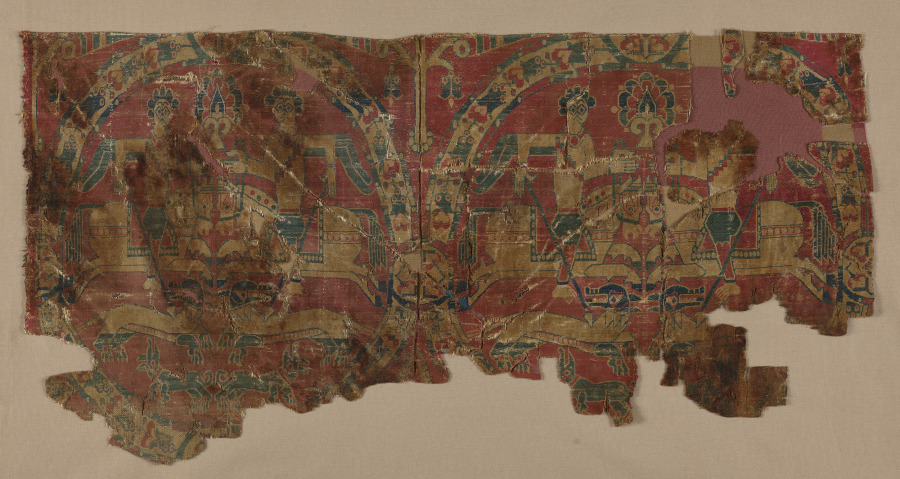
The Persistent Thread: Interpreting the Roundels with Hunters as a Lexicon of Imperial Silk
In the hushed, precise atmosphere of a Savile Row workroom, where a chalk line is a covenant and a seam is a sentence, one learns to read cloth with the same acuity one reads a ledger. Fabric is not merely a substrate; it is a document. Within the Lauren Fashion Heritage Lab, we are custodians of such documents, and few are as eloquent or as demanding as the silk roundels bearing the motif of the hunter. These are not decorative trifles. They are, in the truest sense, a form of woven historiography—a testament to the imperial silk-weaving legacy that defined the economic and aesthetic contours of the ancient world. To handle a fragment of this silk is to hold a conversation with a dynasty.
The materiality of the artifact is our first and most critical interlocutor. Silk, unlike wool or linen, possesses a tensile strength and a chromatic depth that render it uniquely suited to the expression of power. The imperial looms, particularly those of the Byzantine and early Islamic courts, were not merely production facilities; they were instruments of statecraft. The very act of weaving silk was a monopoly, a guarded secret that conferred upon its possessor an almost sacerdotal authority. The roundel format itself—a perfect, bounded circle—is a symbol of cosmic order, of the eternal and the immutable. Within that circle, the hunter is depicted not in a moment of mundane pursuit, but in a frozen, hieratic tableau. The animals—lions, stags, or mythical griffins—are rendered with a stylized ferocity, their bodies contorted into heraldic poses that speak less of the chase and more of the triumph of order over chaos.
This is the essential paradox of the imperial silk aesthetic. We are not looking at a naturalistic scene. We are looking at a political manifesto. The hunter, often depicted as a sovereign figure, is the embodiment of *basileia*—the divine right of rule. His victory over the beast is a metaphor for the emperor’s victory over his enemies, over heresy, and over the untamed forces of the periphery. The silk, therefore, functioned as a portable propaganda. When a Byzantine emperor gifted a cloak or a hanging bearing this motif to a foreign dignitary, he was not simply offering a luxury good. He was exporting a cosmology, a statement of hierarchical supremacy that the recipient would wear upon his shoulders, literally and figuratively.
The technical execution of these roundels demands our profound respect. The weaver, working on a drawloom, was a mathematician as much as an artist. The symmetry of the roundel is not accidental; it is the product of a complex system of pattern repeats that required the coordination of hundreds of warp threads. The use of multiple weft colors—often a deep, imperial purple derived from murex shells, alongside gold thread and a spectrum of jewel tones—was a logistical triumph. The gold, often gilded silver or gold leaf wrapped around a silk core, was not merely decorative. It was a statement of bullion wealth, a direct translation of fiscal power into wearable form. The weight of the fabric, its drape, its ability to catch light and cast shadows—these were all calculated elements in a performance of authority.
As we trace the legacy of these roundels, we see their influence migrating westward and eastward. The motif of the hunter in a circular frame did not die with the fall of a particular empire. It was absorbed, reinterpreted, and re-coded. The Sasanian Persians, the great rivals of Byzantium, produced their own iterations, and the motif subsequently travelled along the Silk Road, appearing in the textiles of Tang Dynasty China. In each context, the materiality of the silk remained constant, but the semiotics shifted. For the Chinese court, the hunter might represent the mandate of heaven; for a Western European noble, it might signify chivalric virtue. This adaptability is the hallmark of a truly great design lexicon. It is not a static image but a flexible grammar.
For the contemporary designer, the Roundels with Hunters offer a masterclass in the integration of narrative and structure. The challenge is not to copy the motif, but to understand its underlying principles. The principle of the *enclosed narrative*—a story told within a strict, geometric boundary—is a powerful tool for creating garments that are both graphic and sophisticated. The principle of *material authority*—the idea that the fabric itself must carry the weight of the design—is a lesson in restraint. A modern interpretation might not use gold thread, but it must use a silk of exceptional quality, a weave that has a presence. The silhouette of a Savile Row jacket, with its structured shoulder and clean line, is a natural heir to the discipline of the roundel. The jacket provides the frame; the fabric provides the narrative.
In our lab, we do not view these artifacts as relics to be preserved under glass. We view them as source code. The hunter’s gaze, fixed and unyielding, challenges us to consider what authority means in a modern context. The roundel’s perfect circle reminds us that great design is always a negotiation between chaos and control. The silk itself, with its enduring luster, whispers of a time when cloth was mightier than the sword. To wear a garment inspired by this heritage is not to dress in costume. It is to participate in a lineage of power, to understand that true elegance is never merely aesthetic—it is always, at its core, a statement of intent. The thread is unbroken, and it is our privilege to continue the weave.
Heritage Lab Insight
Lab Insight: CMA Silk Archive Node integration.