← BACK TO ARCHIVES
Heritage-Black
Heritage Synthesis: Terracotta fragment of a kylix (drinking cup)
Curated on Aug 12, 2026 // Node: LDN-01
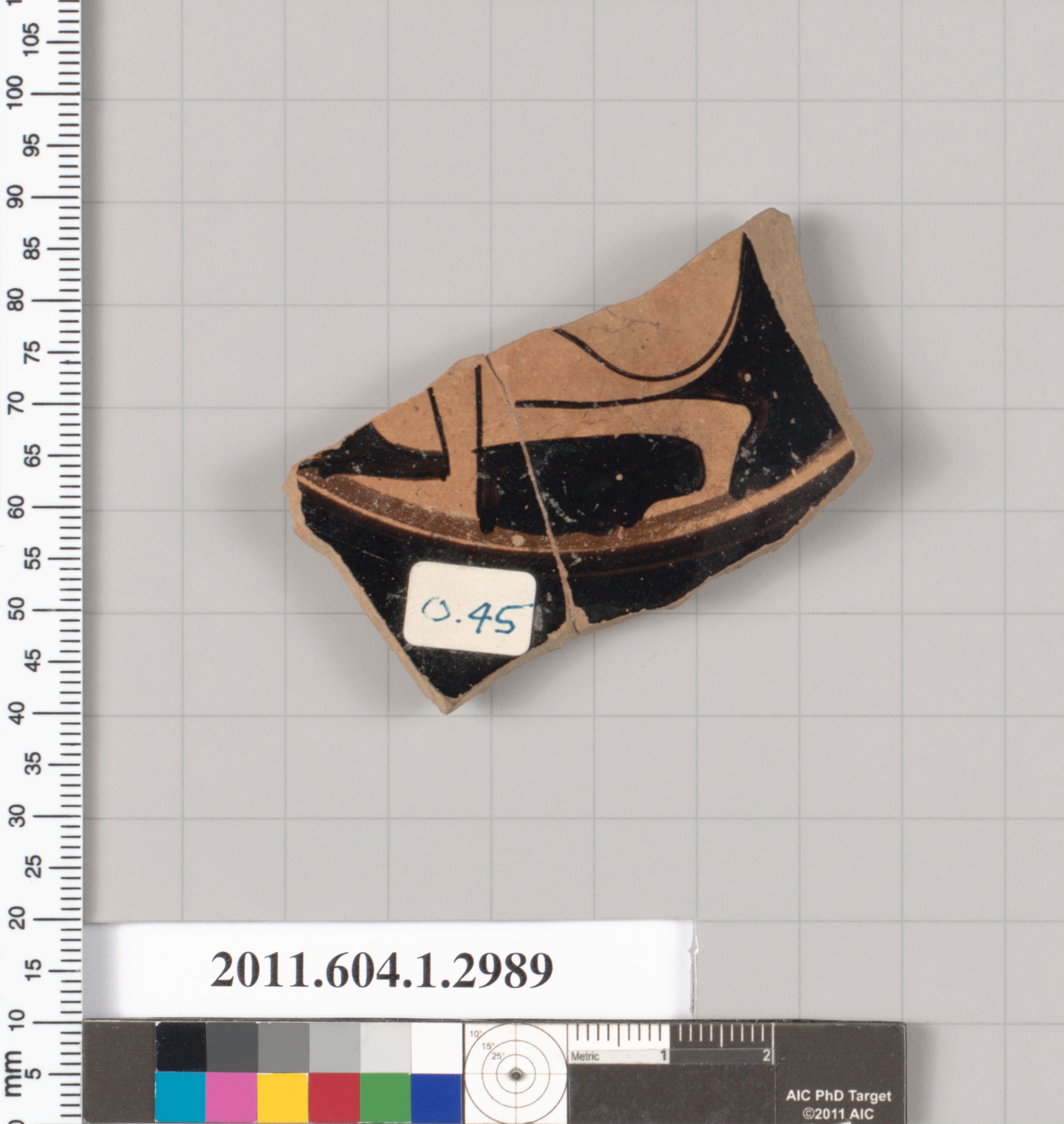
From Attic Clay to Old Money: The Terracotta Kylix as a Dialectical Blueprint for 2026
The museum artifact before us—a terracotta fragment of an Attic kylix—is not merely a shard of ancient drinking culture. It is a palimpsest of philosophical tension, a material witness to the very paradox that Lauren Fashion Heritage Lab has long identified as the genetic code of enduring luxury: the coexistence of the ephemeral and the eternal. When we place this Greek fragment alongside our internal archive—particularly the dialectic between the silent, wave-etched Meiping vase and the narrative explosion of David’s *Death of Socrates*—we uncover a profound architectural principle for the 2026 Old Money silhouette. This is not a study in revivalism; it is a study in structural metaphysics applied to cloth.
I. The Kylix Fragment: A Frozen Gesture
The kylix, in its original form, was an instrument of symposia—a vessel for wine, dialogue, and the fleeting intoxication of civic life. Yet this fragment, severed from its whole, speaks a different language. Its terracotta body, fired to a deep, unglazed umber, carries the trace of a potter’s wheel that stopped spinning millennia ago. The painted figures—likely a portion of a symposium scene or a mythological chase—are now incomplete, their gestures amputated by time. Here, we encounter the Meiping paradox in reverse: the Greek vessel does not freeze a natural phenomenon like waves; it freezes a social event, a moment of human conviviality. But the fragment’s broken edge performs a violent act of de-narrativization. It strips the event of its conclusion, leaving only a suspended, unresolved gesture.
This is the crucial insight for our 2026 design philosophy. The kylix fragment teaches us that *incompletion is not absence but presence*. The Old Money aesthetic has long been misread as a mere exercise in restraint—a quiet beige coat, a discreet pearl. But the fragment reveals a deeper truth: true heritage is not about finishing a story; it is about preserving the *tension* of an unfinished one. The 2026 silhouette must therefore not be a seamless, polished shell. It must carry the structural memory of a break, a seam that suggests a larger whole, a hem that does not resolve but suspends.
II. The Dialectical Inheritance: Meiping’s Silence and Socrates’ Scream
Our internal archive’s first principle—the Meiping’s *wu-xing* (物性) time—posits that the vase achieves eternity by silencing narrative. The waves carved into its ceramic skin are a compression of motion into stillness, a denial of temporality. The second principle—David’s theatrical martyrdom—explodes time into a single, moralized instant. The kylix fragment occupies a third, synthetic position: it is neither fully silent nor fully narrative. Its painted figures gesture toward a story, but its broken form denies that story’s completion. It is, in essence, a *dialectical object*—a synthesis of the Meiping’s stillness and Socrates’ urgency.
For the 2026 Old Money silhouette, this synthesis translates into a garment that does not shout but *implies*. Consider the construction of a tailored overcoat. The Meiping approach would yield a perfectly smooth, unstructured drape—no lapels, no buttons, no interruption. The Socratic approach would yield a theatrical, sculpted piece with exaggerated shoulders and a cape-like volume. The kylix-informed approach, however, demands a hybrid: a coat with a clean, uninterrupted back (Meiping’s silence), but with a sharply cut, asymmetric front seam that *suggests* a rupture (the kylix’s break). The garment’s narrative is not told; it is *withheld*. The wearer becomes a walking fragment—an aristocrat whose story is implied by the very absence of its telling.
III. Materiality as Time: Terracotta’s Tactile Philosophy
The terracotta’s surface—rough, porous, unglazed—offers a direct challenge to the high-gloss finishes of contemporary luxury. In 2026, we must embrace a material vocabulary that mimics this *tactile historicity*. Wool, our primary medium for Old Money tailoring, must be treated not as a pristine canvas but as a *sedimented surface*. We propose a new finishing technique: a subtle, irregular napping that mimics the potter’s fingerprints, a slight variation in dye absorption that recalls the kiln’s uneven heat. This is not a distressed or grunge aesthetic; it is a *stratigraphic* aesthetic. The fabric must feel like it has endured—not through artificial aging, but through a deliberate acknowledgment of material memory.
The kylix’s terracotta hue—a deep, burnt sienna with undertones of umber and ash—becomes our foundational palette for 2026. This is not the warm beige of bourgeois comfort; it is the color of *fired earth*, of transformation through violence. We pair this with a deep, ink-black (our Heritage-Black category) for structural elements—the seams, the linings, the hidden buttons. The black is not a void; it is the *shadow of the broken edge*, the negative space that gives the fragment its form. In this pairing, we achieve the Meiping’s *wu-xing*: the black provides the eternal ground, while the terracotta provides the transient figure.
IV. The 2026 Silhouette: A Fragmentary Whole
Concretely, the 2026 Old Money silhouette is defined by three architectural principles derived from the kylix:
1. **The Asymmetric Closure**: Jackets and coats will feature a single, off-center closure—a hidden placket that does not align with the garment’s center line. This creates a visual *fracture*, echoing the kylix’s broken rim. The wearer’s body is not framed by symmetry but by a deliberate imbalance that suggests a larger, unseen composition.
2. **The Suspended Hem**: Trousers and skirts will end in a hem that is not cleanly finished but *left open*—a raw edge, a visible stitch, a deliberate unhemmed line. This is not casualness; it is a nod to the kylix’s unfinished figures. The garment’s terminus is a question, not an answer.
3. **The Weighted Shoulder**: Unlike the exaggerated shoulder of Socratic drama, the 2026 shoulder is *weighted*—a subtle padding that pulls the fabric downward, creating a gravitational tension. This references the terracotta’s density, its physical heaviness. The wearer does not float; they *sink* into their own presence.
V. Conclusion: The Fragment as the New Eternal
The kylix fragment, in its broken glory, resolves the dialectic of our archive. It tells us that eternity is not found in the unbroken surface (the Meiping) nor in the climactic moment (Socrates), but in the *persistence of the break*. The 2026 Old Money silhouette is not a return to aristocratic polish; it is a philosophical embrace of the fragmentary. It acknowledges that all heritage is, by definition, a collection of shards—of lost wholes, of interrupted gestures, of stories that refuse to conclude. By wearing this silhouette, the individual does not display wealth or status; they display *time itself*—not as a linear progression, but as a layered, broken, and yet enduring presence.
In the terracotta’s rough surface, we see the future of luxury: not the denial of decay, but the *aestheticization of endurance*. The 2026 wearer is not a finished portrait; they are a fragment of a larger, unknowable narrative. And in that incompletion, they achieve the only eternity available to the human condition—the eternity of the pause, the silence between the waves, the breath before the poison is drunk. This is the heritage of the broken cup, and it will define our next season.
Heritage Lab Insight
Genetic Bridge: Archive node focusing on Heritage-Black craftsmanship.