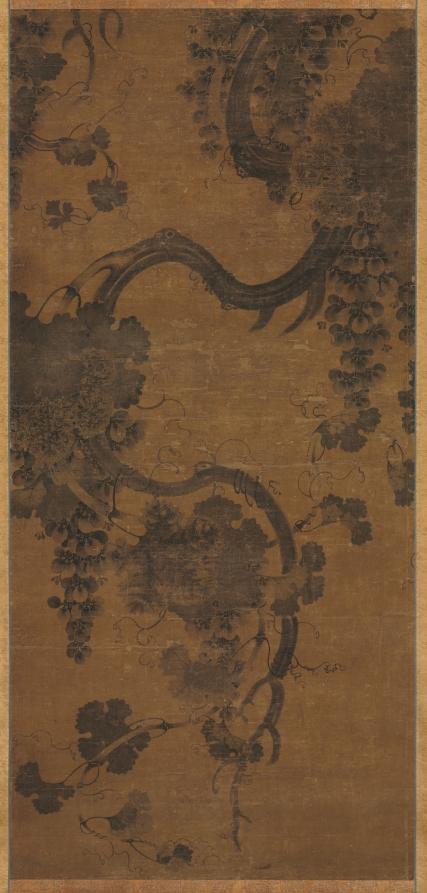
The Vine and the Loom: Grapes as an Enduring Motif in Imperial Silk Weaving
Introduction: A Legacy Woven in Gold and Mulberry
In the hallowed ateliers of Savile Row, where cloth is not merely cut but composed, one learns to read the language of thread. There is no fabric that speaks with greater authority, nor with a more complex historical grammar, than silk. Within its lustrous surface lies the chronicle of empires, the ingenuity of artisans, and the silent diplomacy of trade routes that stretched from the Forbidden City to the courts of Europe. Among the pantheon of motifs that have graced imperial silk—the dragon, the phoenix, the cloud collar—the grape stands as a singular and sophisticated protagonist. It is a symbol of abundance, yes, but also of cultural synthesis, a botanical immigrant that found its most opulent expression in the warp and weft of China’s most prestigious looms. This artifact examines the materiality of silk and the iconography of the grape, tracing a lineage that informs our contemporary understanding of luxury and heritage.
The Materiality of Silk: A Fabric of Imperial Prerogative
To appreciate the grape’s journey on silk, one must first understand the medium itself. Silk is not a mere textile; it is a biological marvel, the product of the Bombyx mori silkworm, whose cultivation was for millennia a state secret of the Chinese empire. The materiality of imperial silk—specifically the heavy, compound weaves known as kesi (cut silk tapestry) and satin damask—was engineered for grandeur. The warp threads were often dyed with madder and indigo, while the weft, frequently wrapped in gold leaf, was beaten down so densely that the fabric achieved a rigidity that could stand on its own. This was not a cloth for the faint-hearted; it was a textile of state, designed to catch candlelight in throne rooms and to whisper authority as the wearer moved.
The imperial workshops, particularly those of the Ming (1368–1644) and Qing (1644–1912) dynasties, operated under a rigorous system of quality control. Patterns were dictated by the Neiwufu (Imperial Household Department), and the technical execution required a mastery that bordered on the obsessive. A single kesi panel could take months to complete, with the weaver manipulating individual silk threads to create pictorial scenes that rivaled painting. In this context, the grape motif was not a casual embellishment. Its rendering demanded a precise understanding of tonal gradation—the deep aubergine of the fruit, the translucent green of the leaf, the sinuous curve of the tendril—all achieved through the interplay of dyed silk and gilded thread. The materiality of the fabric thus elevated the motif from mere decoration to a demonstration of technical and economic power.
The Grape Motif: A Botanical Narrative of the Silk Road
The grape (putao in Chinese) is not indigenous to the Central Plains of China. Its introduction is a testament to the cosmopolitan nature of the Silk Road, arriving from the Hellenistic kingdoms of Central Asia—likely via the Fergana Valley—during the Han Dynasty (206 BCE–220 CE). This provenance is crucial. When the grape appears on imperial silk, it is not simply a depiction of a fruit; it is a coded reference to the exotic, the foreign, and the conquered. The Tang Dynasty (618–907 CE), in particular, embraced this motif with fervor. Tang emperors, who maintained diplomatic and martial ties with the Western Regions, saw the grape as a symbol of their own expansive reach. The famous "grape and pomegranate" pattern, often woven into the roundels of court robes, signified not only fertility and abundance but also the empire’s ability to absorb and domesticate the foreign.
However, the motif’s meaning evolved with the dynasties. In the Ming and Qing periods, the grape became more deeply sinicized, often combined with the auspicious bat (bianfu) to create a rebus for "blessings and prosperity" (fu). The grape’s many seeds (zi) also lent itself to a wish for numerous offspring, a critical concern for imperial lineage. Thus, the motif moved from a marker of geopolitical conquest to a domestic talisman of dynastic continuity. The weavers of Suzhou and Nanjing, who supplied the court, rendered these grapes with a naturalism that was both botanical and symbolic. The leaves were often depicted in a stylized, symmetrical form, while the fruit clusters hung with a weighted elegance, suggesting the very heft of the silk itself.
Technical Mastery: Weaving the Vine
The execution of the grape motif on imperial silk required a specific set of technical innovations. In kesi, the weaver uses a technique of "split" or "cut" tapestry, where each color area is woven separately, leaving small slits that are later sewn together. To render a grape cluster, the weaver would need to manage dozens of these slits within a single square inch, creating a mosaic of color that, from a distance, appears as a painterly whole. The use of gold-wrapped thread—a core of silk twisted with a strip of gilded paper—was particularly effective for the highlights on the grape skins, giving them a lustrous, almost liquid quality.
In contrast, the satin damasks of the Qing court employed a float weave technique, where the warp threads are allowed to "float" over the weft to create a smooth, reflective surface. The grape pattern would be woven in a contrasting color—perhaps a celadon green on a deep sapphire ground—so that the motif appeared to be embossed upon the fabric. This technique was favored for formal court robes (chaofu), where the interplay of light and shadow across the satin’s surface was as important as the motif itself. The result was a fabric that demanded to be seen in motion, its grapes shimmering with each step of the wearer.
Heritage and the Contemporary Eye
For the modern connoisseur, the grape on imperial silk is more than a historical curiosity. It is a benchmark of quality and a narrative of cultural exchange. When we at Lauren Fashion Heritage Lab examine a fragment of Qing-dynasty silk, we are not merely cataloging a pattern; we are decoding a system of value. The density of the weave, the purity of the gold thread, the accuracy of the botanical rendering—all speak to the patron’s status and the weaver’s skill. This is a standard that informs our own approach to luxury. The grape motif, with its dual heritage of foreign exoticism and domestic auspiciousness, reminds us that true heritage is not static. It is a living dialogue between the past and the present, between the loom and the lapel.
In the context of Savile Row, where bespoke tailoring is a ritual of personal narrative, the grape motif offers a profound connection to this legacy. To commission a silk jacket with a woven grape pattern is to wear a piece of imperial history, adapted for a modern silhouette. It is to acknowledge that the language of cloth is universal, and that the vine, once carried along the Silk Road, has found a new home in the discerning wardrobes of today.
Conclusion: The Enduring Vine
The grape’s journey from the Hellenistic world to the looms of imperial China, and thence to the cutting tables of London, is a testament to the enduring power of material culture. Silk, with its luminous materiality, provided the perfect canvas for this botanical narrative. The motif’s evolution—from a symbol of conquest to a talisman of prosperity—reflects the adaptability of Chinese aesthetics and the deep intelligence embedded in its craft. As we continue to study and reinterpret these artifacts, we do not simply preserve the past; we weave it into the future. The vine, it seems, is perennial.