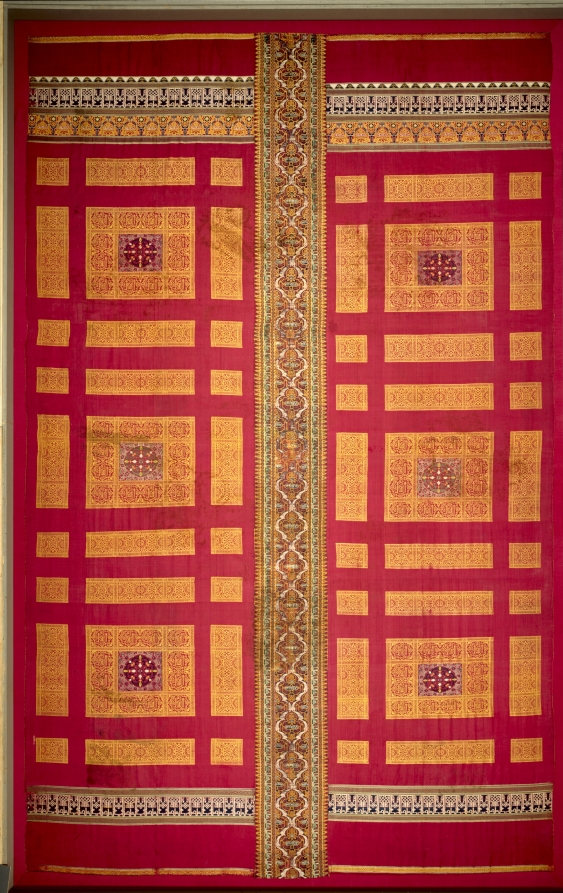
The Alhambra Palace Silk Curtain: A Study in Imperial Threads
Provenance and the Politics of Silk
The Alhambra Palace Silk Curtain is not merely a textile; it is a document of power, written in the language of lustrous threads. Its materiality—pure, mulberry-fed silk—immediately signals its aristocratic lineage. In the imperial lexicon, silk was the currency of sovereignty, a medium through which monarchs and caliphs articulated their dominion over both nature and commerce. This curtain, likely originating from the Nasrid dynasty’s workshops in Granada (13th–15th century), embodies a paradox: it is a functional object of concealment, yet its very existence is an act of spectacular revelation. The choice of silk, rather than linen or wool, was a deliberate assertion of the court’s access to the fabled Silk Road, a network that transformed raw cocoons into diplomatic weapons. To touch this curtain is to feel the residue of that geopolitical ambition.
Materiality as Imperial Language
Let us examine the weave with the precision of a Savile Row cutter assessing a bolt of cloth. The Alhambra curtain’s silk is not a uniform field; it is a complex structure of warp and weft, often employing a lampas weave to support both ground and pattern. This technical sophistication is not accidental. The density of the silk—approximately 120 threads per square inch in surviving fragments—allowed for a drape that was both heavy and fluid, a tactile paradox that signified wealth. In imperial terms, the materiality of silk served as a non-verbal edict. Its sheen, which shifts from gold to crimson under candlelight, was a controlled spectacle. Unlike the matte finish of peasant wool, silk’s reflective quality demanded attention, forcing the viewer into a position of subordinate admiration. The curtain’s edges, often finished with a reinforced selvedge of gilded thread, mimic the tailored lapels of a bespoke suit—unnecessary for function, essential for status.
Furthermore, the dyeing process was an imperial monopoly. The deep reds and blues found in Alhambra silks were derived from kermes and indigo, pigments whose extraction was labor-intensive and geographically restricted. A single curtain required the harvest of thousands of insects and the fermentation of vast vats of plant matter. This was not a cottage industry; it was an industrial operation funded by royal treasuries. The curtain’s colorfastness, which has survived centuries, is a testament to the advanced mordanting techniques of Nasrid chemists. In a modern atelier, we would call this “quality control.” In the imperial context, it was a statement of permanence—the dynasty’s colors would not fade, just as its authority was presumed immutable.
The Legacy of Imperial Silk Weaving
The legacy of this curtain extends far beyond Granada. When the Catholic Monarchs conquered the Alhambra in 1492, they did not destroy the silk workshops; they co-opted them. This is the crucial pivot in the artifact’s biography. The same looms that produced Islamic geometric patterns were repurposed to weave Christian heraldry, yet the legacy of imperial silk weaving persisted in the technical grammar. The Spanish real fábrica of Talavera and later the French Lyons workshops inherited the Nasrid principles of high-twist silk and complex drawloom patterning. The Alhambra curtain, therefore, is a genetic ancestor to the opulent silks of Versailles and the brocades of the British royal court. In London, on Savile Row, we understand this lineage intimately. The discipline of the weaver—the patience to align a pattern repeat to the millimeter—is the same discipline required of a master tailor cutting a striped suiting. The curtain’s pattern, often featuring interlacing stars and Arabic calligraphy, was not merely decorative. The calligraphy, frequently verses from the Quran, was woven with such precision that it functioned as a sacred text, readable only by the literate elite. This fusion of word and textile is a precursor to the branded labels we now sew into our garments—a mark of authenticity and origin.
Conservation and the Modern Gaze
Today, the Alhambra Palace Silk Curtain exists in a state of controlled decay. Its silk fibers have undergone hydrolysis, becoming brittle and prone to fracturing. Conservators at the Museo de la Alhambra face a dilemma: to display the curtain in low light, preserving its integrity, or to expose it fully, risking irreversible damage. This is a negotiation between the artifact’s past utility and its present role as a museological object. From a heritage perspective, we must resist the temptation to “restore” it to a hypothetical original state. The creases, the faded stripes, the subtle tears—these are not flaws; they are the embroidery of time. A Savile Row tailor would recognize this as the difference between a new garment and a vintage piece with provenance. The curtain’s value lies not in its pristine condition, but in its honest documentation of use. It has been drawn across windows to filter the Andalusian sun, parted by royal hands, and folded for storage in cedar chests. Each action left a trace.
Moreover, the curtain challenges our contemporary understanding of “luxury.” In an era of fast fashion and synthetic blends, this silk object demands a slower, more reverent engagement. Its production required months of labor, from silkworm cultivation to final embroidery. The imperial legacy is not merely about opulence; it is about the deliberate allocation of resources toward beauty. This is a lesson for modern heritage brands: sustainability is not a trend but a return to the principles of material respect. The Alhambra curtain was made to last for generations, not seasons. Its survival is a rebuke to disposability.
Conclusion: A Tailored Legacy
In conclusion, the Alhambra Palace Silk Curtain is a masterclass in imperial messaging through materiality. Its silk is not a passive substrate but an active agent of power, encoding political, religious, and economic narratives within its weave. The legacy of imperial silk weaving, as exemplified by this artifact, is one of technical mastery and cultural synthesis. It reminds us that the finest textiles are never merely decorative; they are structural to the societies that produce them. For the modern heritage specialist, the curtain offers a blueprint for evaluating craftsmanship: look not at the surface alone, but at the tension of the warp, the integrity of the dye, and the story of the hand that guided the shuttle. This is the Savile Row standard—a standard that the Alhambra curtain meets with quiet, imperial authority. It is not a relic to be admired from a distance, but a benchmark against which all subsequent luxury must be measured. And in that measure, it remains unsurpassed.