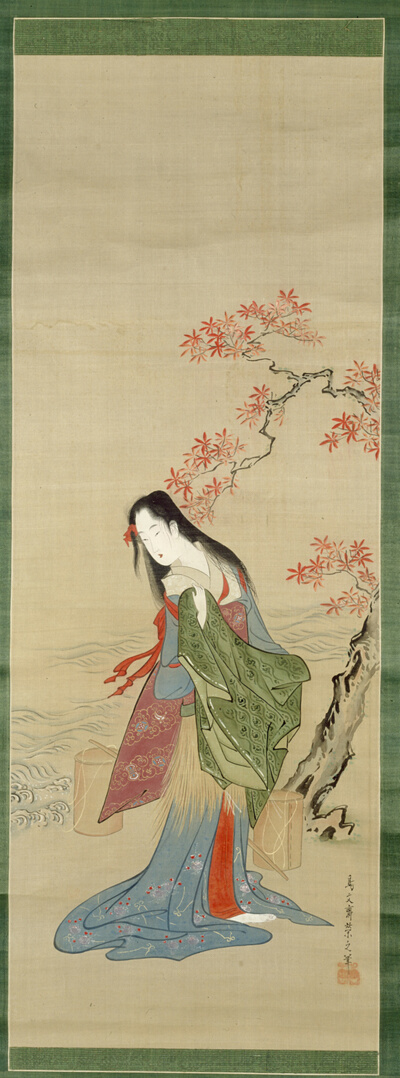
The Salt Maidens: An Exegesis in Silk and Line
To engage with the hanging scroll depicting Matsukaze with Yukihira's Coat is not merely to observe an image; it is to undertake a forensic examination of a masterclass in applied aesthetics. The subject—the Heian-period salt maiden Matsukaze, caught in the poignant act of draping herself in the courtly robes left by her departed lover, the nobleman Ariwara no Yukihira—is, in itself, a profound study in layered meaning. Yet, it is through the material execution, the very facture of the piece, that this narrative of memory, longing, and social transgression achieves its resonant clarity. We are presented not with a simple illustration, but with a constructed artifact where medium, technique, and motif engage in a dialogue of the highest order.
The Ground: Silk as a Field of Expression
Let us first address the foundation: the silk ground. This is not a passive receptacle for pigment, but an active participant in the visual discourse. The choice of a finely woven, lustrous silk—the very substrate of the Heian aristocracy’s most prized garments—is a deliberate, ironic counterpoint. It elevates the humble salt maiden to the plane of her noble lover, even as the narrative underscores the impossibility of their union. The silk’s inherent sheen performs a critical function; it possesses a latent luminosity that interacts with the applied ink and colours, granting them a depth and vitality unattainable on paper or lesser cloth. Under controlled light, the surface does not simply reflect but breathes, allowing the subtle modulations of wash and line to emerge with a soft, interior glow. This is a ground that confers status and demands a commensurate level of craftsmanship.
The Drapery: A Treatise on Fluid Elegance
The central, transformative action—Matsukaze enveloping herself in Yukihira’s oversized court robe—is where the artist’s command of line and wash achieves a state of fluid elegance. This is not the stiff, heraldic drapery of iconography, but a study in weighted, animate fabric. The lines describing the robe’s folds are executed with a brushwork that is at once supremely confident and exquisitely sensitive. They possess a tensile strength, a sense of architectural integrity, yet flow with a rhythmic, calligraphic grace that suggests the robe’s movement in the coastal breeze and the maiden’s tentative, embracing gesture.
The colour application here is paramount. The robes’ hues, likely derived from mineral pigments and subtle vegetable dyes, are built up in translucent layers. This technique, a hallmark of the finest silk painting, allows the silk’s texture and tone to subtly influence the final colour, creating a richness that is organic and complex. The contrast between the robe’s formal, patterned elegance and Matsukaze’s own simple, work-worn garments is rendered not through harsh opposition, but through a masterful disparity in textural rendering and chromatic saturation. The robe dominates the visual field, a spectral presence that is both a comfort and a haunting.
The Figure and the Environment: A Psychology of Space
Matsukaze herself is rendered with a psychological acuity that transcends mere portraiture. Her posture, her averted gaze, the delicate rendering of her hands clutching the alien fabric—all speak of a profound interiority. The artist employs a palette of muted, naturalistic tones for her figure, allowing the borrowed splendour of the robe to highlight her own poignant reality. The environment, often suggested by mere hints of shoreline, a gnarled pine, or the faintest wash indicating sea mist, is executed with an economy that borders on the abstract. This spatial restraint is a strategic choice. It compresses the psychological space, focusing the viewer’s entire attention on the symbiotic relationship between figure and garment. The emptiness becomes a visual metaphor for her isolation and the vast, echoing absence of Yukihira.
Construction and Legacy: The Unseen Artifice
True appreciation demands consideration of the unseen. The mounting of such a scroll—the selection of the silks for the borders, the precision of the lining, the balance of the rollers—is a bespoke art in itself, framing the central image with a quiet authority that respects its content. Every element, from the density of the woven ground to the final knot of the cord, contributes to the artifact’s enduring presence.
In conclusion, this rendering of Matsukaze with Yukihira's Coat stands as a peerless example of how material intelligence serves narrative depth. The silk ground provides a dignifying luminosity, the brushwork articulates a poetry of form and emotion, and the layered colours breathe life into a tale of timeless pathos. It is a garment story, yes, but more profoundly, it is a story through garment, executed on the very material that constitutes the tale’s central object of desire and despair. The result is not a picture of longing; it is, in its crafted entirety, the manifest embodiment of longing itself. A legacy piece, then, in the truest sense: where every thread and every stroke is tailored to convey an eternal, and eternally human, sentiment.