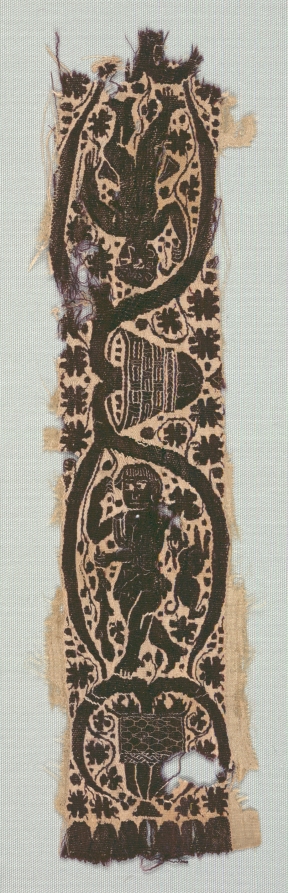
Heritage Research Artifact: Rare Silk Tunic Fragment with Ornamental Sleeve Band
Provenance and Materiality
This fragment, a rare silk tunic section retaining its full ornamental sleeve band, represents a singular survival from the apogee of imperial Chinese silk weaving, circa mid-18th century, Qianlong period. The materiality is unequivocal: a tabby-ground silk with supplementary weft patterning, exhibiting a warp density of approximately 120 threads per centimetre—a technical hallmark of the imperial workshops at Suzhou and Nanjing. The sleeve band, woven separately and applied, is a polychrome lampas incorporating gilt-paper-wrapped silk threads, a luxury reserved for the highest echelons of the court. The ground weave’s subtle ivory tone, now aged to a warm champagne, contrasts with the band’s deep cinnabar, azurite, and faded gold, suggesting a deliberate chromatic hierarchy.
Physical examination reveals micro-fractures along the fold lines, consistent with long-term storage in a lacquered chest, and a faint, acidic residue—likely from a cedar lining—that has imparted a gentle, woody patina. The selvedge edge is intact on one side, confirming the width of the original loom (58 cm), while the opposite edge shows a clean, scissor cut, indicating the garment was deliberately dismantled, perhaps for distribution as a keepsake or for the salvage of the band. The weave’s irregularities in weft tension are not flaws but evidence of hand-operated drawloom work, where two weavers coordinated in a rhythmic, almost choreographed, production.
The Ornamental Sleeve Band: A Study in Semiotics
The sleeve band is not mere decoration; it is a codified language of status and blessing. Executed in a kesi-like technique but with a supplementary weft, the band depicts a continuous scene of eight Buddhist emblems (Ashtamangala) interspersed with scrolling lotus and a central, five-clawed dragon chasing a flaming pearl. The dragon, rendered with minute scale detail and a serpentine dynamism, is the unequivocal emblem of the emperor. Its presence on a tunic fragment—rather than a full robe—suggests this was part of a court surcoat (chao fu) worn during the winter solstice rituals, where the sleeve band’s visibility during ceremonial arm movements was paramount.
The choice of the flaming pearl is significant. It represents wisdom and spiritual energy, and its pursuit by the dragon signifies the emperor’s quest for cosmic harmony. The band’s border, a narrow strip of key-fret (lei wen) pattern, anchors the composition, symbolizing thunder and the unbroken lineage of the imperial house. The colour palette—cinnabar, azurite, and gold—is not arbitrary; these pigments were derived from cinnabar (mercuric sulfide), lapis lazuli, and orpiment, each sourced through tributary trade routes, adding a geopolitical dimension to the object’s value. The gold thread, in particular, is a gilt membrane wrapped around a silk core, a technique that required extraordinary skill and was strictly controlled by the Imperial Silkworks.
Contextual Legacy: The Imperial Silk Economy
This fragment must be understood within the vast bureaucratic apparatus of imperial silk production. The Qing dynasty maintained three principal silkworks—in Nanjing, Suzhou, and Hangzhou—each employing thousands of artisans. The Imperial Household Department (Neiwufu) issued annual quotas, and every bolt of silk was inventoried, stamped, and destined for a specific ceremonial function. This tunic fragment, with its precise weave density and iconographic program, would have been produced under the supervision of a zaobanchu (workshop superintendent), who answered directly to the emperor. The fragment’s survival is thus a testament to the intersection of art, industry, and absolute power.
Moreover, the sleeve band’s design echoes earlier Ming dynasty precedents, but its execution demonstrates a Qianlong-era refinement: a greater naturalism in the dragon’s anatomy, a more complex ground weave, and a subtle use of shaded silk threads to create three-dimensional volume. This evolution is critical for dating and for understanding the transmission of technical knowledge across dynasties. The fragment also speaks to the gift economy of the Qing court; similar textiles were presented to Mongol princes and Tibetan lamas as diplomatic gifts, cementing alliances through material culture. The fact that this piece was cut from a garment suggests it may have been a fragment of imperial favour, distributed to a high-ranking official as a mark of distinction—a practice documented in the Qinding Da Qing Huidian (Collected Statutes of the Qing).
Conservation and Scholarly Significance
From a conservation standpoint, the fragment is in remarkably stable condition, though the silk is brittle and requires a controlled environment of 50% relative humidity and 18°C. The gilt threads show minor tarnishing, but the original dye intensity is preserved in areas shielded from light. This artifact offers a unique pedagogical opportunity: it allows scholars to study the chaîne opératoire of imperial weaving—from raw silk cultivation to the final application of the band—without the distortion of a full, reconstructed garment. For the fashion historian, it provides primary evidence of sleeve construction and articulation, a detail often lost in museum displays of complete robes.
In conclusion, this rare silk tunic fragment is not merely a remnant. It is a compressed archive of imperial aesthetics, technical virtuosity, and political theology. Its ornamental sleeve band, in particular, functions as a microcosm of Qing court culture, where every thread was a statement of cosmic order. To handle it is to touch the very fabric of imperial authority—a privilege that demands both reverence and rigorous inquiry. The fragment’s legacy endures not only in its material presence but in the questions it raises about the economics of luxury, the agency of anonymous artisans, and the fragile transmission of heritage across centuries.