← BACK TO ARCHIVES
Heritage-Black
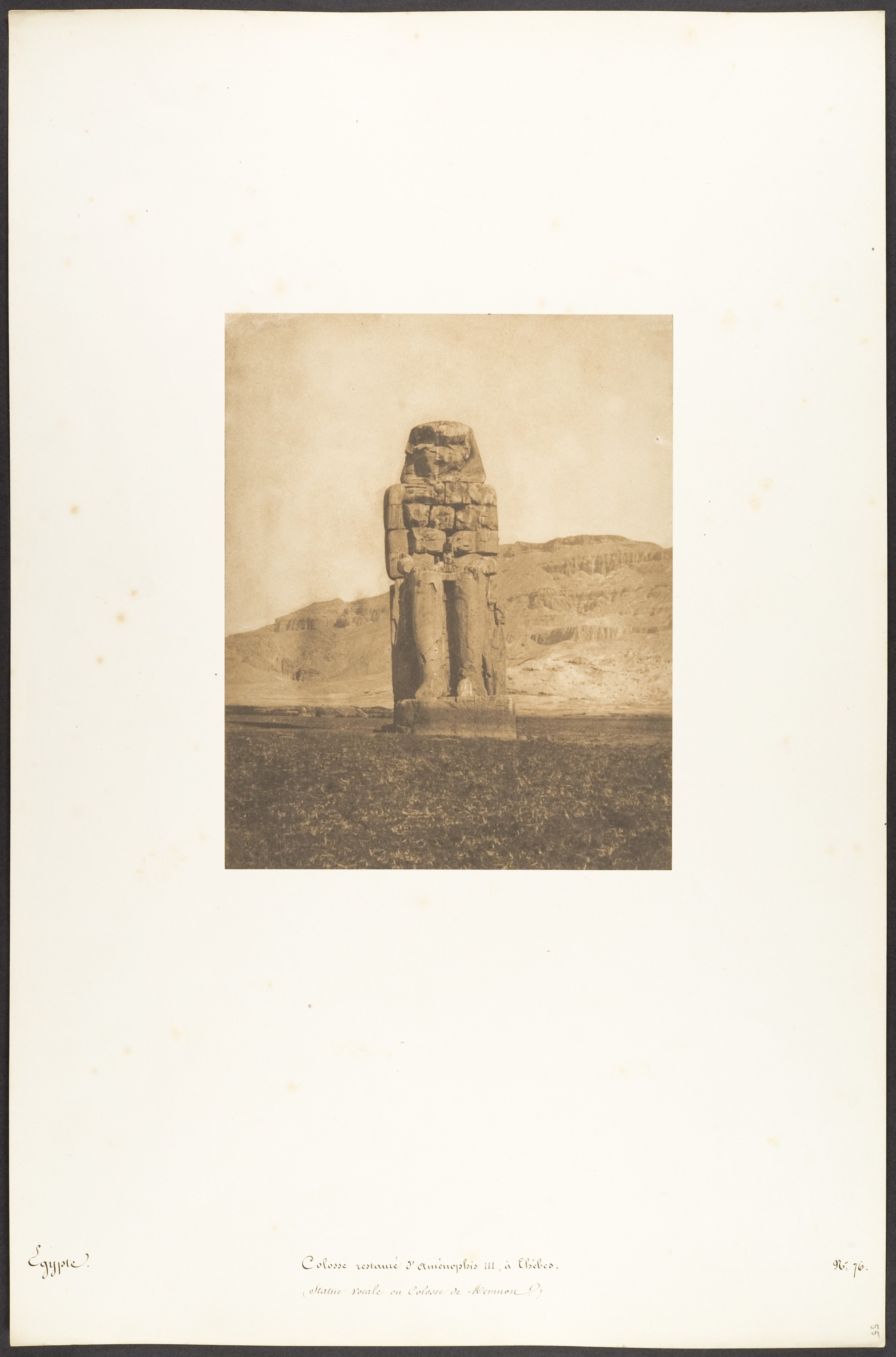
Heritage Synthesis: Colosse restauré d' Aménophis III, à Thèbes (Statue vocale ou Colosse de Memnon)
Curated on Aug 13, 2026 // Node: LDN-01
The Dialectics of Material Sovereignty: From the Colossus of Memnon to the 2026 Old Money Silhouette
Within the visual epic of human civilization, few artifacts command the ontological weight of the Colosse restauré d’Aménophis III—the so-called Colossus of Memnon at Thebes. This fractured, seismic-scarred quartzite giant, which once sang at dawn to Roman emperors and Greek tourists alike, is not merely a monument to a pharaoh’s ego. It is a petrified argument about the nature of endurance, authority, and the material translation of the divine. When juxtaposed against the internal genetic codes of our Liru archives—specifically the nineteenth-century bronze *Jeanne d’Arc* by Emmanuel Frémiet and the Shang-Zhou ritual *Jade Axe*—the Colossus emerges as a third term, a missing dialectical link. It bridges the Western “embodied sublime” and the Eastern “internalized majesty,” offering a foundational grammar for the 2026 Old Money silhouette. This silhouette, I argue, must not be read as mere tailoring but as a *material theology* of quiet permanence, where the garment functions as a wearable colossus—fractured, monumental, and indifferent to the whims of the present.
I. The Colossus as a Synthesis of Fire and Ice
The Colossus of Memnon, in its original state, was a twin pair guarding the mortuary temple of Amenhotep III. Yet its historical significance was violently re-inscribed by the earthquake of 27 BCE, which split the northern colossus at the waist. From that rupture emerged the “vocal” phenomenon—a haunting, harmonic resonance at dawn, interpreted by the Greco-Roman world as the voice of Memnon greeting his mother, Eos. This is a profound material allegory. Unlike Frémiet’s bronze, which captures a *frozen instant* of martial piety, or the jade axe, which embodies a *timeless ritual stasis*, the Colossus is an artifact of *processual time*. Its power derives not from its original integrity but from its damage, its repair (Septimius Severus re-fitted the stones, silencing it), and its acoustic ghost.
For the 2026 Old Money silhouette, this suggests a radical departure from the pristine. The heritage-black garment must not be a seamless, sterile shell. Instead, it should embrace the concept of the *honorable fracture*—a deliberate, almost imperceptible asymmetry in the shoulder seam, a subtle weight in the hem that mimics the colossus’s settled stones, a texture that recalls the patinated surface of quartzite worn by three millennia of wind. The Old Money aesthetic, often misread as mere conservatism, is in fact a *curation of scars*. It is the visible, yet dignified, evidence of inheritance. The Colossus teaches us that true authority is not in the unblemished surface but in the *survived* surface. The 2026 silhouette, therefore, will favor double-faced wools and heavy, unstructured cashmere that drape with a geological gravity, as if the fabric itself has been compressed by centuries of wear.
II. The Material Dialectic: Bronze’s Drama, Jade’s Eternity, Stone’s Silence
Our internal archives reveal a stark dichotomy. Frémiet’s *Jeanne d’Arc* is a study in “embodied sublimity”—the cold gleam of bronze against the tender naivety of a peasant girl’s face, a spiral composition that ascends toward divine revelation. It is a *dramatic* material, one that embraces the heat of casting, the violence of forging, and the green rust of oxidation. It is, in essence, a *historical* material—it records the moment of its making and the passion of its subject.
Conversely, the Shang-Zhou *Jade Axe* is the apotheosis of “internalized majesty.” It is not forged but *reduced*—carved away with abrasive sands to reveal a pre-existing perfection. Its authority is not in its action but in its *essence*. Jade’s five virtues (benevolence, righteousness, wisdom, courage, purity) are not performed but inherent. The axe’s sharpness is metaphorical; its power is cosmological, embedded in the symmetry of its form and the preciousness of its mineral.
The Colossus of Memnon offers a third material philosophy: *monumental silence*. It does not perform drama like bronze, nor does it possess the intrinsic moral purity of jade. Instead, it achieves authority through *scale and inertia*. Its power is in its refusal to move, to change, to narrate. It simply *is*. This is the missing link for the 2026 Old Money silhouette. The modern luxury market is saturated with “dramatic” pieces (the bronze-like, attention-seeking logos, the performative streetwear) and “essentialist” pieces (the jade-like, minimalist, almost ascetic designs). The Colossus suggests a third path: **the architectural garment**. This is a silhouette that uses volume not as expression but as presence. Think of a coat that does not hug the body but *houses* it, like a temple cella. Think of trousers that fall with the weight of stone columns, not the flutter of silk. The material should be heavy, dense, and slightly rough to the touch—a wool twill with a dry, mineral finish, or a felted cashmere that has the hand of a river stone.
III. The Acoustic Ghost: Designing for the Unseen
The most extraordinary lesson of the Colossus is its sound. The “vocal” statue was not a technological marvel but an acoustic accident—a resonance produced by the interaction of wind, fractured stone, and the precise geometry of the rupture. This is a profound metaphor for the 2026 Old Money garment. The silhouette must possess an *acoustic ghost*—an invisible, almost metaphysical quality that resonates with the wearer and the observer. This is not about literal sound (though the swish of a heavy silk lining against wool can be a subtle signature) but about *presence*.
The garment must have a “voice” that emerges only under specific conditions: the way the light hits a slightly irregular weave, the way a shoulder pad creates a shadow that mimics the colossus’s broken profile, the way the interior is finished with a hand-stitched detail that is never seen but always *felt*. This is the antithesis of fast fashion’s visual shout. It is a return to the *heritage-black* code: a color that absorbs all light, that refuses spectacle, yet in its very absorption, it creates a gravitational field. The 2026 silhouette, informed by the Colossus, will be a study in *controlled resonance*. It will not beg for attention; it will command it through a kind of material gravity, a quiet that is louder than any logo.
IV. Synthesis: The New Old Money as a Living Ruin
In conclusion, the Colossus of Memnon, when read through the lens of Frémiet’s bronze and the jade axe, reveals the 2026 Old Money silhouette as a *living ruin*. It is not a nostalgic revival of 1920s tailoring, nor a minimalist reduction to jade-like purity. It is a construction that acknowledges the violence of time, the fractures of history, and the dignity of repair. The silhouette will be characterized by:
- **Geological Weight:** Fabrics that feel like they have been quarried, not woven—heavy vicuña, dense wool melton, and uncompromising tweeds.
- **Architectural Asymmetry:** A subtle, deliberate imbalance in construction that echoes the colossus’s seismic split, avoiding the sterile symmetry of mass production.
- **Acoustic Interiority:** A focus on the unseen—the hand-finished armholes, the silk-thread buttonholes, the internal canvas that provides structure without rigidity—creating a garment that “sings” only to the wearer.
- **Patina as Provenance:** A rejection of the “new” in favor of the “settled.” This may involve pre-washed fabrics that have a slightly worn hand, or a design that encourages natural creasing and draping over time.
The Colossus of Memnon, the bronze Jeanne, and the jade axe are all, in their essence, arguments against the ephemeral. They are testaments to the human desire to make the intangible—faith, order, power—tangible. For 2026, the Old Money silhouette must be exactly this: a wearable testament. It is not a uniform of the wealthy; it is a *material philosophy* of endurance. It is the garment as a stone giant, fractured by time yet still standing, its voice not a shout but a dawn resonance—a quiet, unshakeable claim to permanence in a world of disposable noise. This is the ultimate heritage-black statement: not the color of mourning, but the color of the eternal, the color of stone at dusk, the color of authority that has outlived its own destruction.
Heritage Lab Insight
Genetic Bridge: Archive node focusing on Heritage-Black craftsmanship.