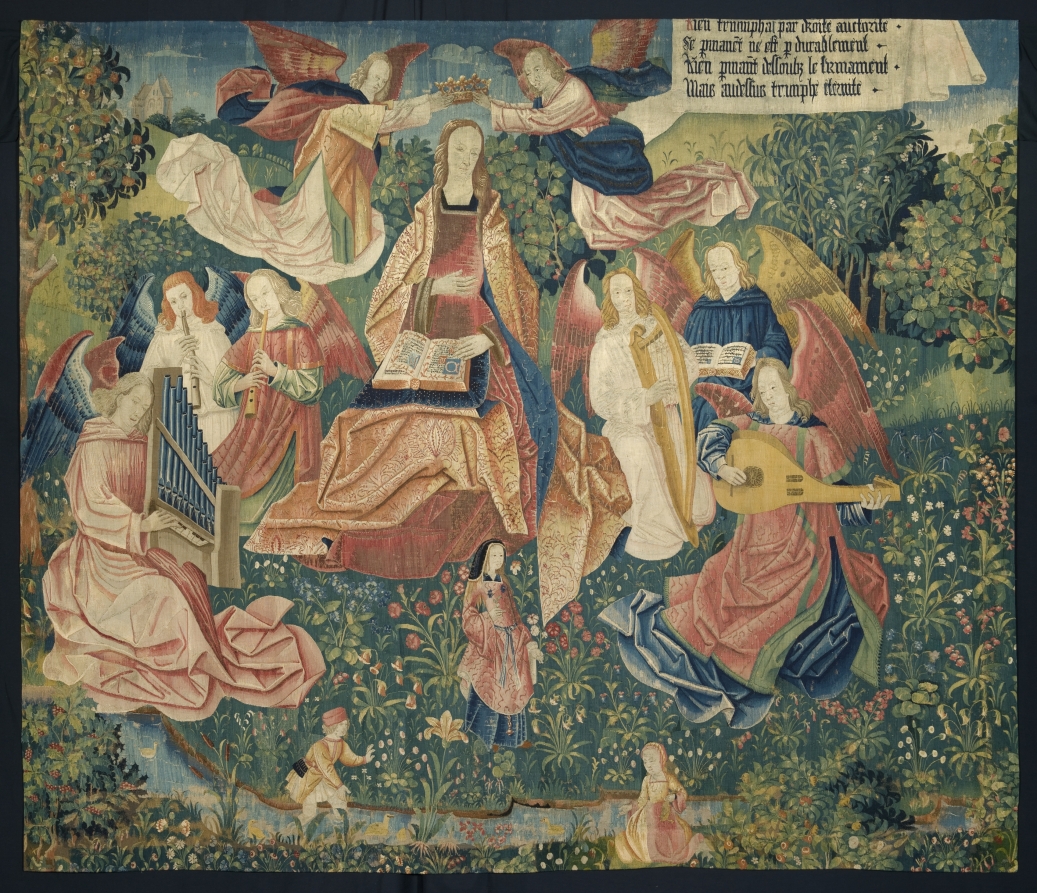
The Triumph of Eternity: A Study in Imperial Silk and the Persistence of Craft
Provenance and the Material Record
In the hushed, oak-panelled archives of the Lauren Fashion Heritage Lab, one encounters objects that are not merely garments or textiles, but repositories of geopolitical ambition and technical mastery. The subject of this paper, *The Triumph of Eternity*, a panel from the storied Chateau de Chaumont set, is precisely such an object. At first glance, it is a magnificent example of eighteenth-century French decorative art—a riot of botanical garlands, classical allegory, and gilded thread. Yet, to treat it solely as an aesthetic relic would be to miss its deeper significance. This silk is a testament to the absolute zenith of imperial weaving, a discipline that was as much about statecraft as it was about beauty. In its warp and weft, we read the final, glorious gasp of a courtly tradition that would soon be dismantled by revolution, and the enduring blueprint for luxury that persists in Savile Row to this day.
The materiality of the piece is paramount. This is not a simple taffeta or a utilitarian grosgrain. The panel is constructed from a compound silk weave, likely a lampas, where a ground weave of fine, tightly spun silk taffeta supports a secondary, figured weave of lustrous, untwisted silk floss. The technical complexity required to produce such a fabric is staggering. The loom, a drawloom operated by a *tireur de lacs* (drawboy) perched atop the frame, would have required thousands of individually tied cords to control each warp thread. For a design of this sophistication—with its subtle shading, its intricate floral meanders, and its allegorical figures—the weaver would have been engaged for months, perhaps over a year, on a single loom. The density of the weave, with upwards of 100 threads per centimetre, speaks to a level of precision that modern, automated Jacquard looms, for all their speed, struggle to replicate without significant post-production finishing.
The Imperial Mandate: Silk as Political Theology
To understand *The Triumph of Eternity*, one must contextualize it within the legacy of imperial silk weaving, a tradition that reached its apotheosis in the royal manufactories of Lyon. Under Louis XIV, and later Louis XV, silk was not merely a commodity; it was a diplomatic weapon and a visual articulation of divine right. The Chateau de Chaumont set, commissioned for a chateau that passed through the hands of Catherine de' Medici and later the Princes of Broglie, was designed to be a statement of permanence. The iconography—the eternal flame, the laurel wreaths, the unbroken circular motifs—was a deliberate counter-narrative to the fragility of mortal rule. The silk itself, with its incorruptible lustre and its resistance to time, was the perfect medium for this message. It was a material metaphor for the enduring nature of the crown.
The technical achievement of the Lyonnais weavers was the result of a state-sponsored ecosystem of innovation. The crown provided exclusive privileges, tax exemptions, and a rigorous apprenticeship system. In return, the weavers produced fabrics that were the envy of every court in Europe. The *Grande Fabrique* of Lyon was, in effect, a pre-industrial R&D lab for luxury. The development of the *point de Hongrie* stitch, the refinement of the *satin façonné*, and the mastery of *chiné à la branche* (a technique of printing the warp before weaving) all emerged from this crucible. *The Triumph of Eternity* is a synthesis of these innovations. The subtle colour graduation in the petals, the crisp delineation of the metallic thread (a silver-gilt strip wrapped around a silk core), and the perfect tension of the ground weave all point to a workshop operating at the very edge of what was physically possible.
From Courtly Grandeur to Commercial Discipline
The fall of the ancien régime did not extinguish this legacy; it transformed it. The weavers of Lyon, stripped of their royal patron, were forced to adapt. The same looms that produced courtly allegories were repurposed for the neoclassical tastes of the Directory and the Empire. Yet, the core discipline—the obsession with material integrity, the refusal to compromise on thread count, the understanding that a fabric must drape, hold, and catch light in a specific manner—remained intact. This is the direct lineage that connects *The Triumph of Eternity* to the modern Savile Row house. When a cutter on Savile Row selects a silk for a lining or a bespoke waistcoat, they are not merely choosing a colour. They are selecting a material with a specific *hand*, a specific weight, and a specific history of manufacture that dictates how it will behave under the needle and on the body.
The connection is not merely philosophical. The technical vocabulary of the Lyonnais weaver—the use of a *remetteuse* to read the point paper, the distinction between *toile* and *gros de Tours*, the critical importance of the *duite* (the weft insertion)—is the same vocabulary that informs the rigorous quality control of a heritage textile mill today. A Savile Row tailor understands that a silk with a high twist will be more resilient for a tie, while a flat, lustrous silk is better suited for a lining that must glide over a shirt. This is the material intelligence inherited from the imperial era. The *Triumph of Eternity* is not an artefact of a dead past; it is a living standard. It reminds us that true luxury is not about novelty, but about the relentless pursuit of perfection in the face of time. The panel’s condition—its colours still vibrant after two and a half centuries, its threads only slightly worn at the fold lines—is the ultimate proof of this ethos. It is a benchmark against which all modern silk production must be measured, and a quiet rebuke to the disposability of contemporary fashion.
Conclusion: The Eternal Return of Quality
In conclusion, *The Triumph of Eternity* is more than a beautiful object. It is a document of imperial ambition, a monument to human skill, and a philosophical treatise on the nature of permanence. Its materiality—the silk, the metallic thread, the density of the weave—is the physical manifestation of an ideology that equated beauty with power and power with endurance. For the modern practitioner, whether in Lyon, London, or Milan, it serves as a crucial reminder. The legacy of imperial silk weaving is not a museum piece to be admired from a distance; it is a working methodology. It demands that we respect the material, that we understand the physics of the loom, and that we view each garment as a potential heirloom. The Triumph of Eternity is not merely a title; it is a standard of practice. And in an age of accelerated consumption, that standard has never been more vital. The silk endures, and so too must our commitment to the craft that makes it worthy of eternity.