Category: Silk
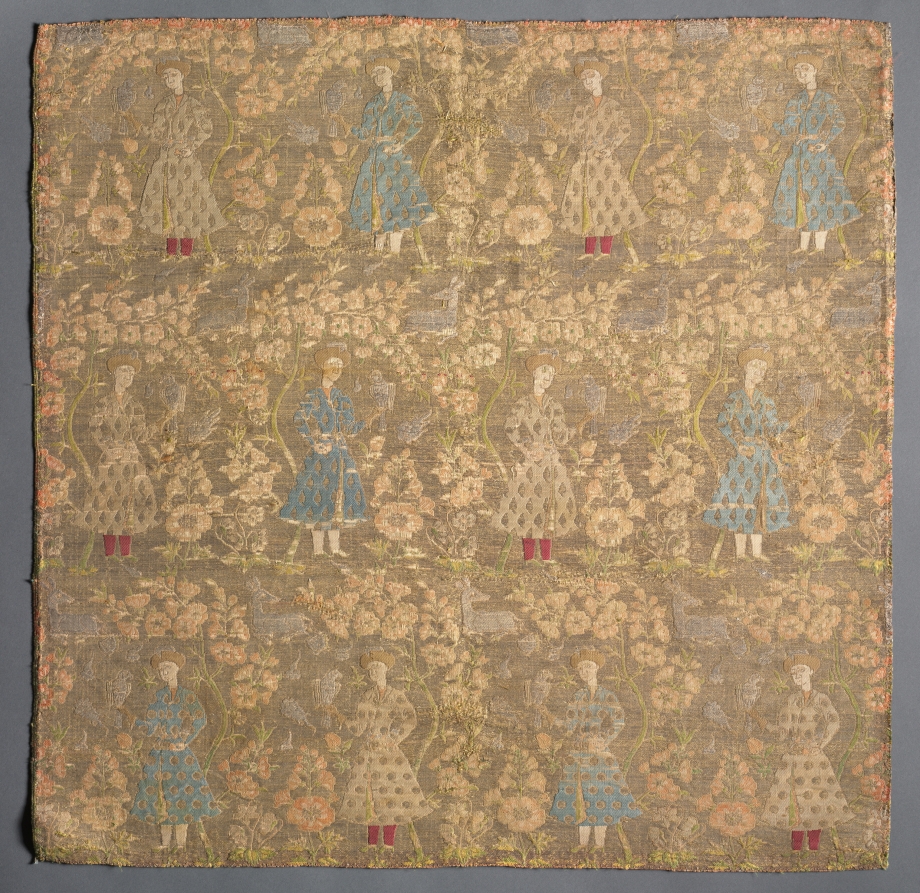
An Heirloom of the Loom: The Section of Silk Fabric with Falconers Amid Rose Bushes
In the hushed, wood-panelled ateliers of Savile Row, where the tape measure is a sceptre and the chalk mark a signature, we speak of cloth not merely as covering, but as chronicle. The bolt of fabric is a manuscript; the pattern, a dialect. And when we encounter a fragment such as the Section of Silk Fabric with Falconers Amid Rose Bushes, we are not examining a textile. We are reading a dispatch from the very heart of imperial power, a document woven in lustrous thread that speaks of dominion, artistry, and the relentless pursuit of perfection.
This is not a cloth for a morning coat or a summer lounge suit. This is a relic of a system where silk was the currency of sovereignty, and the loom was a instrument of state. To understand its materiality—the cool, supple hand of the mulberry silk, the infinitesimal gauge of the warp and weft—is to understand the absolute mastery required to produce such a piece. The silk itself, likely cultivated in the shadow of the Imperial Palace, was not a commodity; it was a tribute. Its very fibre carries the memory of a thousand silkworms fed on the choicest mulberry leaves, their cocoons boiled and reeled into filaments of extraordinary length and uniformity. The resulting thread, with its natural lustre and remarkable tensile strength, was the foundation upon which an entire aesthetic empire was built.
The design, a meticulously rendered tableau of falconers amid rose bushes, is not a mere decorative fancy. It is a heraldic statement. The falcon, a creature of the hunt and the sky, was the emblem of the nobility, a symbol of martial prowess and keen vision. The rose, in its layered complexity, signified prosperity, beauty, and the cyclical nature of imperial rule. To place the falconer—the human agent of control—within this botanical framework is to depict a world in perfect order. The hunter is at ease; the roses are in full bloom. This is the iconography of a stable, confident dynasty, a visual assertion that the empire, like the garden, is tended and fruitful.
Yet, the true genius of this artifact lies not in its iconography alone, but in the technical bravura required to execute it. We must consider the loom. This is not a simple tabby weave. This is a compound weave, likely a lampas or a damask, where multiple warp and weft systems interlace to create the ground and the pattern independently. The weaver, working on a drawloom—a machine of such complexity that it required a second operative, the drawboy, to manipulate the hundreds of heddles—was a master of choreography. Each pick of the weft, each lift of the harness, was a calculated step in a dance that could take months to complete. The density of the weave, the crispness of the falconer’s profile, the subtle shading of the rose petals—these are not accidents. They are the result of a design process that was as rigorous as any architectural blueprint, and a weaving process that demanded an almost inhuman level of patience and precision.
Consider the palette. The dyes, derived from natural sources—indigo for the blues, madder for the reds, and a spectrum of yellows from plants and minerals—were fixed with mordants in a process that was as much alchemy as chemistry. The resulting colours are not flat; they possess a depth and a vibrancy that modern synthetic dyes struggle to replicate. The ground, likely a deep, resonant tone, provides a dramatic counterpoint to the lighter, more luminous threads of the pattern. This interplay of light and shadow, of figure and ground, gives the fabric a sculptural quality. It is not merely seen; it is felt. When the light catches the raised weft of the falconer’s tunic, the silk seems to breathe.
In the context of the legacy of imperial silk weaving, this section is a pivotal chapter. It represents the apogee of a tradition that stretched back millennia. The technical innovations that made this piece possible—the drawloom, the sophisticated compound weaves, the mastery of natural dyes—were state secrets, guarded as fiercely as any military strategy. The workshops that produced such cloth were not factories; they were academies, where skills were passed from master to apprentice over decades. The output was not for the market; it was for the court, for diplomatic gifts, and for the ceremonial robes of the highest echelons of power. To wear such a fabric was to be clothed in the very idea of the state.
For the contemporary tailor, for the discerning gentleman of the Row, this artifact offers a profound lesson in standard and provenance. We are accustomed to the crisp, predictable roll of a Super 150s worsted, the precise, machine-made repeat of a jacquard. But this silk challenges our definition of quality. It reminds us that true luxury is not about uniformity, but about the subtle, human irregularities that betray the hand of the maker. The slight variation in the thickness of a thread, the infinitesimal pause in the pattern repeat—these are not flaws. They are the fingerprints of the artisan, the proof of a process that was slow, deliberate, and utterly bespoke.
This section of silk is not a remnant. It is a testament. It is a reminder that the finest cloth is not manufactured; it is cultivated. It is a conversation between the silkworm, the dyer, the designer, and the weaver, a conversation that spans centuries and speaks a language of power, beauty, and unyielding craft. To hold it is to hold a piece of history that is not static, but alive—a legacy that continues to inform our understanding of what cloth can be when it is made with the intention of enduring. It is, in the truest sense, a garment for the ages, even if it never graces a shoulder. Its purpose was to be a standard, and it remains, to this day, an impeccable one.