← BACK TO ARCHIVES
Silk
Heritage Synthesis: Tiger
Curated on Aug 13, 2026 // Node: LDN-01
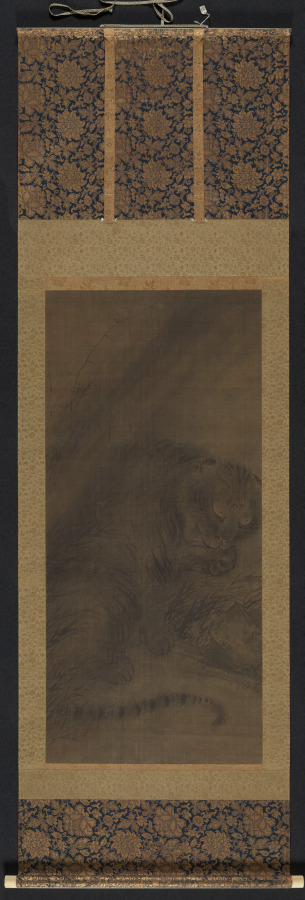
The Tiger in Silk: A Study of Imperial Authority and the Weaver’s Art
In the hushed, precise atmosphere of a Savile Row workroom, where a millimetre of seam allowance is a matter of honour, one learns to respect material. Cloth speaks. It carries memory, weight, and intent. Yet there is a fabric that transcends tailoring entirely—a material that was never merely worn, but *deployed*. I refer, of course, to imperial silk, and to one of its most potent and fearsome motifs: the tiger. To examine the tiger in silk is to examine the very architecture of dynastic power, rendered not in stone, but in lustrous, unbroken thread.
The Material Imperative: Why Silk for the Sovereign?
Let us begin with the substrate itself. Silk, unlike wool or linen, is not simply a textile; it is a biological marvel. The continuous filament of the *Bombyx mori* cocoon, sometimes extending over a kilometre, allows for a thread of extraordinary tensile strength and a surface that refracts light with a liquid, almost metallic sheen. For the imperial courts of China, particularly during the Ming and Qing dynasties, this was not incidental. The emperor’s body was the axis of the cosmos; his garments were the visible manifestation of celestial order. Wool, with its earthy, fibrous irregularity, belonged to the pastoral and the provincial. Silk, with its flawless, uninterrupted length, symbolised the unbroken lineage of the throne and the seamless governance of the realm. To weave silk was to weave the state itself.
The imperial workshops—the *Jiangnan* silk bureaus in Nanjing, Suzhou, and Hangzhou—were not factories in the modern sense. They were ateliers of the highest order, staffed by hereditary artisans whose skills were passed down through generations. These were men who could, with a single glance, assess the tension of a warp thread or the density of a weft. Their output was governed by sumptuary laws of staggering complexity. Certain colours—imperial yellow, for instance—were reserved exclusively for the emperor and his immediate family. The use of specific motifs was equally codified. The dragon, of course, was the paramount symbol of imperial power. But the tiger, in this hierarchy, held a distinct and formidable place.
The Tiger’s Semiotics: Beyond the Beast
In Western tailoring, we speak of the "power suit"—a garment designed to project authority through structure and shoulder line. The imperial tiger robe operated on a different principle: authority through *apotropaic* symbolism. The tiger was not merely a decorative animal; it was the *baihu*, the White Tiger of the West, one of the Four Celestial Guardians. In Daoist cosmology, the White Tiger governed the autumn, the element of metal, and the martial virtues of courage and protection. To wear a tiger was to invoke the strength of the West, to guard against malevolent spirits, and to signal a martial readiness that was both physical and metaphysical.
The iconography was rendered with a precision that would humble a Savile Row cutter. Consider the tiger’s stripes. In the finest examples of *kesi* (slit-tapestry weaving), the stripes are not printed or embroidered over the ground fabric; they are woven *into* the structure itself. The weaver would use small, coloured shuttles, each one manipulated by hand to create the illusion of fur that ripples and shifts with the wearer’s movement. The tiger’s eye, often rendered in a contrasting silk or even a hint of gold-wrapped thread, would catch the lamplight of a palace hall, creating a disconcerting sense of living presence. This was not decoration; it was a statement of ontological fact. The emperor did not merely wear a tiger; he *became* the tiger, a predator at the apex of the human and spiritual food chain.
The Weaving of Legacy: Technique as Testament
The legacy of imperial silk weaving is not merely a matter of iconography; it is a legacy of technique that borders on the miraculous. The *kesi* method, which reached its apogee during the Song and Ming dynasties, is the most demanding of all silk techniques. Unlike a standard woven textile where the weft passes across the full width of the loom, *kesi* employs a "slit" technique. Each colour area is woven separately, with the weft threads turning back before meeting the adjacent colour block, leaving a tiny, deliberate gap. These gaps are then meticulously sewn together by hand, creating a tapestry-like surface that is identical on both sides—a feat of engineering that no machine has ever replicated with equal finesse.
For a tiger robe of the highest rank, a single garment could take a team of weavers over a year to complete. The loom itself was a massive, horizontal structure, often requiring two operators—one to throw the shuttle, another to beat the weft into place with a comb of polished ivory. The pattern was not drawn on the cloth; it existed only in the weaver’s mind, guided by a cartoon (a full-scale drawing) placed beneath the warp threads. Every single pass of the shuttle was a decision. A single error in tension could cause the entire panel to pucker, rendering it worthless. This is the antithesis of mass production. It is the apotheosis of slow, deliberate, and reverent craft.
The Modern Resonance: Tailoring the Past into the Present
What, then, does this legacy mean for the contemporary practitioner on Savile Row? It is a lesson in the power of *restraint and intent*. The modern suit, for all its technical sophistication, often suffers from a surfeit of detail—a superfluous button, a decorative stitch that serves no structural purpose. The imperial silk weaver understood that true luxury is the elimination of the unnecessary. Every thread, every colour, every stripe of the tiger had a purpose, a meaning, a place in a larger cosmic narrative.
When we handle a modern silk tie or a bespoke silk lining, we are handling a distant echo of that imperial standard. The material still carries its ancient charge—its luminosity, its strength, its refusal to crease easily. To cut into silk is to enter into a dialogue with a thousand years of history. The tiger, in this context, becomes a metaphor for the tailor’s own discipline. We must hunt our seams with the same ferocity that the White Tiger hunts its prey. We must be precise, patient, and utterly without mercy for error.
The legacy of imperial silk weaving is not a museum piece. It is a living standard. It whispers to us that cloth is never just cloth. It is power, memory, and identity, woven into a single, unbroken thread. And when we drape that thread over a client’s shoulders, we are not merely fitting a garment. We are fitting them for the role they wish to play in the world—a role that, for a few luminous moments, carries the ferocity and grace of the tiger itself.
Heritage Lab Insight
Lab Insight: CMA Silk Archive Node integration.