← BACK TO ARCHIVES
Silk
Heritage Synthesis: Portrait of a Family Playing Music
Curated on Aug 13, 2026 // Node: LDN-01
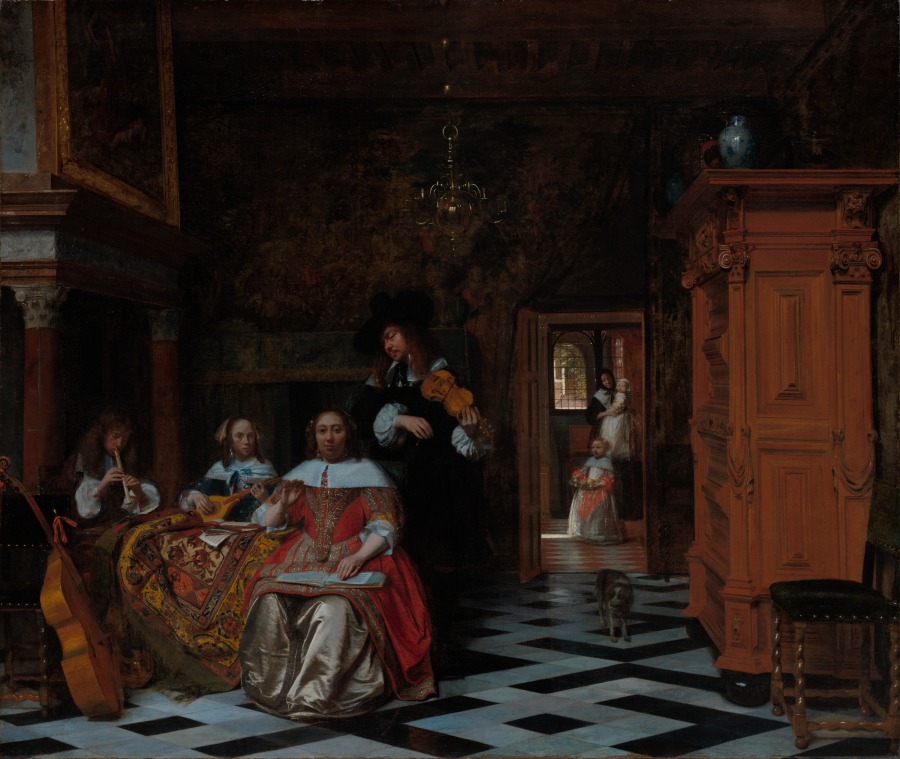
An Heirloom in Thread: Deconstructing the Portrait of a Family Playing Music
In the hushed, wood-panelled ateliers of Savile Row, we speak of cloth not as mere covering, but as biography. A bolt of worsted carries the memory of the flock, the weaver’s tension, the cutter’s nerve. This same reverence must be applied to the *Portrait of a Family Playing Music*, a silk artifact that is less a painting and more a woven ledger of imperial ambition, domestic harmony, and the quiet, formidable power of the loom. To examine this piece is to read a family’s standing not in gold, but in the tensile strength of its filaments.
The Material Testament: Silk as Social Currency
Let us first address the substrate. This is not a canvas of linen or a panel of oak. It is silk—and not merely silk, but the specific, lustrous product of an imperial weaving tradition that traces its lineage to the mulberry groves of the East and the state-sponsored manufactories of the Ming and Qing dynasties. The materiality here is deliberate. Silk, in this context, was the ultimate signifier of rank. Its production was a closely guarded state secret, its distribution a matter of sumptuary law. By commissioning a family portrait on this ground, the patriarch is not simply preserving an image; he is declaring that his household operates at the very apex of the economic and political hierarchy.
The weave itself is the first voice. A close inspection reveals a warp-faced satin, its surface so smooth and reflective that it mimics the polished lacquer of a ceremonial cabinet. This is not a sturdy, utilitarian taffeta. This is a ground designed for light-play, where the figures seem to float upon a pool of liquid sheen. The choice of a satin weave over a twill or plain weave is a technical assertion of luxury. Satin requires a higher density of warp threads, demanding more raw silk and more hours at the loom. The result is a surface that catches the candlelight of a private concert hall with the same brilliance as it would the sun in a formal garden. The family is not merely depicted; they are *illuminated* by the very medium of their portrait.
The Imperial Loom: Weaving Status into Every Thread
The legacy of imperial silk weaving is not a distant, romantic notion; it is a practical discipline that informs every structural decision in this artifact. Consider the technical mastery required to render the scene. The portrait depicts a family of four—a father at a guqin, a mother with a dizi flute, and two children, one with a small pipa, the other listening intently. The figures are not painted on top of the silk; they are *woven into* it. This is a tapestry-woven technique, likely executed on a drawloom, a machine so complex it required two operators: a master weaver and a "draw boy" who manipulated the pattern harness above.
The precision of this process is staggering. To create the subtle gradations of skin tone in the mother’s face, the weaver would have had to switch between dozens of weft threads of varying hues—pale ivory, warm peach, faint rose—each one passed by hand through the shed. A single error in the sequence would create a visual flaw, a permanent blemish in the family’s recorded history. This is the legacy of the imperial workshops: a culture of perfectionism where the weaver was not an artist but a technician of the highest order, bound by the same codes of precision as a court calligrapher. The portrait’s survival in pristine condition is a testament to that discipline.
The colour palette further anchors the piece in imperial vocabulary. The background is a deep, resonant aubergine—a shade achieved through multiple dye baths of madder and indigo, a process that would have taken weeks. This is not a passive backdrop; it is a deliberate foil. Against this dark, saturated ground, the figures’ robes emerge in brilliant contrast: the father in a deep azure, the mother in a muted cinnabar, the children in soft celadon and pale gold. These are not arbitrary choices. Azure was associated with the heavens and the emperor’s own ceremonial robes. Cinnabar, derived from mercury sulphide, was a pigment of immense cost and permanence. The family is dressing themselves in the visual grammar of the court, even in the intimacy of their own music room.
Music as Metaphor: The Harmony of the Household
The subject matter—a family playing music—is not incidental. In the Confucian tradition that underpinned imperial society, music was not mere entertainment; it was a moral and cosmological force. The *Yueji* (Record of Music) states that music reflects the harmony of the state and the virtue of its rulers. By portraying themselves in the act of making music, this family is making a profound statement: they are a microcosm of a well-ordered realm. The father’s guqin, with its seven strings, symbolises the seven celestial bodies and the principles of cosmic order. The mother’s dizi, a bamboo flute, represents the voice of the people, pure and unadorned. The children’s instruments, smaller and simpler, signify the continuation of this harmony into the next generation.
The composition reinforces this message. The figures are arranged in a gentle arc, their gazes directed not at the viewer but at one another, creating a closed circuit of shared attention. The father’s hands hover over the strings, the mother’s lips are parted mid-breath, the children’s heads are tilted in listening. It is a frozen moment of perfect synchronicity. The silk, with its ability to capture the minutest detail of a fold in a sleeve or the curve of a finger, makes this moment feel achingly alive. The material does not just hold the image; it *performs* the image, its shimmering surface suggesting the vibration of the music itself.
Conservation and Legacy: A Tailor’s Duty
From a conservation perspective, this artifact demands the same respect we afford a bespoke suit of a deceased client. The silk is fragile, susceptible to light damage, humidity, and the natural degradation of its protein fibres. The fact that it has survived for centuries is a miracle of careful stewardship. The original owner would have stored it rolled in a cedar chest, wrapped in acid-free tissue (or its historical equivalent of soft cotton), and brought it out only for special occasions—a family festival, a visit from a high-ranking official. This was not a daily object; it was a ceremonial one, reserved for moments when the family wished to project its full, polished image.
Today, our duty is to preserve not just the image but the *knowledge* embedded in the weave. Each thread is a data point: the type of silk worm (likely *Bombyx mori*, the domesticated mulberry silkworm), the twist of the yarn, the density of the warp, the specific dyes used. By analysing these elements, we can trace the artifact to a specific regional workshop, perhaps in Suzhou or Nanjing, and date it with remarkable accuracy. This is the forensic science of heritage. It is the same meticulous attention to detail that a Savile Row cutter applies when examining the drape of a cloth—understanding the weight, the handle, the memory of the fabric.
In conclusion, the *Portrait of a Family Playing Music* is not a painting. It is a woven document, a material contract between a family and their legacy. The silk is not the support; it is the subject. It speaks of imperial power, of technical mastery, of domestic virtue, and of the enduring human desire to freeze a perfect moment in the most precious medium available. To look at it is to hear the faint, silken rustle of history—a sound that, once heard, is never forgotten. And it is our privilege, and our solemn duty, to ensure that this thread of history never breaks.
Heritage Lab Insight
Lab Insight: CMA Silk Archive Node integration.