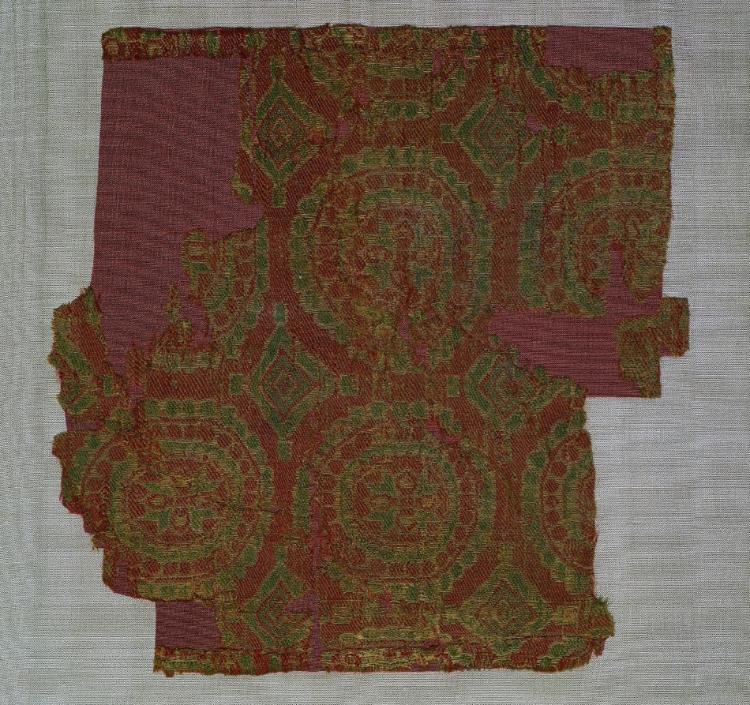
The Enduring Thread: Deconstructing the Samite with Roundels of Rosettes
Introduction: A Fabric of Power, Reconsidered
In the hushed, precise world of Savile Row, where a bolt of cloth is scrutinised with the same intensity as a balance sheet, the term ‘heritage’ is often overused. Yet, there exist textiles that transcend mere provenance. The samite with roundels of rosettes is one such artifact. It is not simply a piece of silk; it is a codified language of imperial ambition, a technical marvel that predates the industrial loom, and a benchmark against which modern luxury must measure its own integrity. This paper examines the materiality of this specific silk, tracing its lineage from the warps of Late Antiquity to the contemporary ateliers that still seek to replicate its singular lustre.
Materiality: The Anatomy of a Masterpiece
To understand the samite, one must first abandon the modern notion of silk as a delicate, passive substrate. This is a structural textile, engineered for permanence. The term ‘samite’ derives from the Old French *samit*, itself rooted in the Byzantine Greek *hexamiton*—literally ‘six threads.’ This is not a poetic flourish; it is a precise specification. The weave structure is a compound twill, typically employing a warp-faced ground with a supplementary weft that creates the figurative design. In the case of our roundel specimen, the ground is a deep, undyed or naturally hued silk, while the rosettes are rendered in a contrasting, often jewel-toned weft.
The critical materiality lies in the silk filament itself. Unlike the short-staple fibres of cotton or wool, silk is a continuous protein filament, extruded by the *Bombyx mori* silkworm. In imperial workshops, this filament was not spun but thrown—twisted to increase tensile strength—and then woven on a drawloom. The result is a fabric with a unique optical property: the weft floats across the surface, catching light in a manner that shifts with the viewer’s angle. This is not a printed pattern; it is a sculpted topography of light and shadow. The roundels, often arranged in staggered rows, are not mere decoration. They are a demonstration of technical control—a proof that the weaver could manipulate hundreds of warp threads to create a mathematically perfect circle, a feat that required immense skill and time.
The Imperial Legacy: Weaving as Statecraft
The context of this textile is inseparable from the machinery of empire. From the Tang Dynasty’s workshops to the Byzantine *gynaecea* and the later Sicilian *Tiraz* factories, silk weaving was a state monopoly. The roundel motif, specifically, was not an aesthetic choice but a semiotic one. The rosette—a stylised, multi-petaled flower—represented cosmic order, cyclical renewal, and the divine right of the ruler. To wear or display such a fabric was to participate in a visual hierarchy that reinforced political authority.
Consider the technical implications of the drawloom, which required two operators: a weaver and a drawboy who manually lifted the warp threads according to a complex pattern. This was a pre-industrial form of binary coding, with the pattern dictated by a series of cords. The production of a single yard of this samite could take weeks. This scarcity was the point. The value was not merely in the raw silk, which was traded along the Silk Roads at exorbitant cost, but in the *labour* and *knowledge* embedded within it. The Byzantine Empire, for instance, guarded its sericulture and weaving techniques as state secrets, punishing export of the technology with death. Thus, the samite with roundels became a diplomatic currency—a gift to foreign dignitaries that simultaneously displayed wealth and signalled technological superiority.
Comparative Analysis: The Savile Row Lens
From a contemporary tailoring perspective, the samite presents a paradox. Modern luxury fabrics, such as a 150s Merino wool or a high-twist cotton, are prized for their lightness and drape. The samite, by contrast, is a heavy, dense fabric with a substantial hand. It does not flow; it *stands*. This is a fabric designed for ceremony, not casual comfort. Its stiffness, however, is not a flaw but a feature. In a structured garment—a ceremonial robe, a cope, a banner—the samite holds its shape with architectural precision. The roundels, when positioned over the chest or shoulders, create a focal point that draws the eye upward, emphasising the wearer’s stature.
Furthermore, the samite challenges the modern obsession with ‘softness.’ The lustre of the silk weft, combined with the twill structure, produces a surface that is almost metallic in its sheen. This is a fabric that demands to be seen in low, directional light—candlelight, torchlight—where the rosettes appear to float above the ground. In this, it shares a kinship with the iridescent qualities of a fine worsted suiting, but it achieves this through a far more complex and labour-intensive process. The modern tailor who encounters a reproduction of this samite must adapt their technique: sharper needles, stronger thread, and a willingness to let the fabric dictate the silhouette rather than the reverse.
Legacy and Contemporary Resonance
The legacy of the samite is not confined to museum vitrines. Its DNA persists in the opulent jacquards used for evening wear and in the ecclesiastical vestments that still employ similar weave structures. However, the industrial revolution and the advent of synthetic fibres have fundamentally altered our relationship with such textiles. We now expect speed, uniformity, and affordability. The samite represents the antithesis of these values. It is a reminder that true luxury is not about the price tag but about the *time*—the weeks of skilled labour, the generations of accumulated knowledge, and the intentionality of every single thread.
For the modern heritage house, the samite offers a critical lesson in authenticity. It cannot be replicated by a digital print or a chemical finish. Its value is intrinsic to its construction. To claim a connection to this legacy, one must be willing to invest in the same slow, deliberate processes. The roundels of rosettes are not a pattern; they are a signature of a civilisation that understood that cloth could be a form of power. In an era of fast fashion and disposable luxury, the samite stands as a quiet, formidable rebuke—a reminder that the most enduring statement is not the loudest, but the one woven with the most precise and patient hand.
Conclusion: The Weight of History
In conclusion, the samite with roundels of rosettes is a masterclass in material integrity. Its silk is not merely a fibre but a vessel for imperial ideology, technical prowess, and aesthetic sophistication. For the discerning practitioner, it is a benchmark that separates the merely expensive from the genuinely significant. To handle a piece of this cloth is to feel the weight of history—not as a burden, but as a standard. And in the quiet, measured world of bespoke tailoring, that standard remains the ultimate luxury.