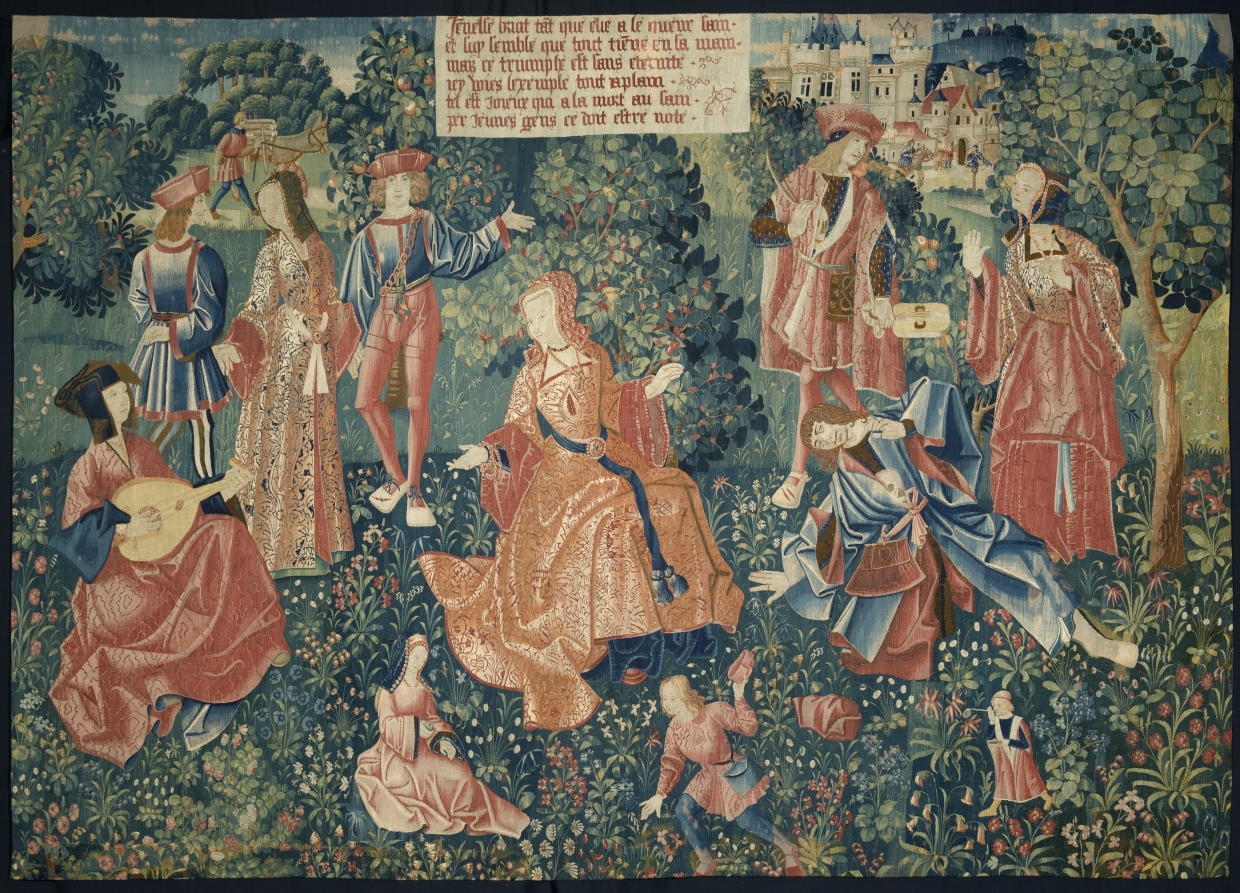
Heritage Research Artifact: The Youth of Chateau de Chaumont
Category: Silk
In the hushed corridors of heritage fashion, where provenance is whispered rather than proclaimed, there exists a singular textile artifact—the *Youth* panel from the Chateau de Chaumont set. This is not merely a fabric; it is a document of imperial ambition, a testament to the extraordinary discipline of silk weaving at its zenith. To handle this piece is to understand the profound distance between mere cloth and woven patrimony.
The materiality of *Youth* is, first and foremost, silk—but not the silk of commerce or casual luxury. This is the silk of the grand ateliers, the looms of Lyon and the royal manufactories that served the courts of Europe. The filament is of a fineness that defies modern reproduction, a thread drawn from the cocoon of *Bombyx mori* with a precision that speaks to centuries of sericultural mastery. The warp and weft are so tightly interlaced that the surface possesses a glassy, almost liquid sheen, a characteristic achieved only through the use of the highest-grade raw silk and the most exacting tension on the loom. The touch is cool, firm, and yielding—a paradox that only the finest silk can reconcile.
The Imperial Weaving Legacy
The Chateau de Chaumont set, of which *Youth* forms an integral part, is a relic of a period when silk was not merely a textile but a political instrument. The legacy of imperial silk weaving—from the Byzantine workshops to the French royal manufactories—was one of controlled opulence. The weaver was not an artist in the modern sense; he was a technician of statecraft, translating the monarch’s vision into a tangible language of power. The *Youth* panel, with its allegorical subject matter, would have been commissioned for a specific interior—likely a salon or a private cabinet—where its presence would reinforce the cultural authority of its owner.
The technical execution is staggering. The weave structure, likely a compound satin or a damask with supplementary brocading, demonstrates a mastery of the drawloom that is now all but lost. Each pass of the shuttle was guided by a complex system of cords and patterns, requiring a weaver and a drawboy to work in perfect synchrony. The result is a fabric that is not printed or painted but *built*—thread by thread—into a pictorial narrative. The *Youth* motif, depicting a figure in a pastoral or allegorical pose, is rendered with a painterly subtlety that belies the rigid mechanics of the loom. The shading, achieved through the careful juxtaposition of different silk tints, creates a three-dimensionality that is almost sculptural.
This is the legacy of the imperial silk weaver: the ability to transform a biological filament into a carrier of cultural memory. The silk of *Youth* is not merely decorative; it is a repository of technique, a physical archive of the weaver’s knowledge. The fineness of the thread, the density of the weave, the precision of the pattern—all speak to a standard of excellence that was enforced by royal decree and maintained by guild discipline. To hold this fabric is to hold a fragment of that system, a tangible link to an era when silk was the ultimate currency of taste.
Materiality and the Savile Row Lens
From the perspective of Savile Row—that bastion of tailoring where cloth is the final arbiter of character—the *Youth* panel demands a particular reverence. A tailor of the Row would not see a mere furnishing fabric; he would see a challenge to his own craft. The silk’s crisp yet supple handle suggests a fabric that could, in another life, have been cut into a waistcoat or a formal coat. The density of the weave would provide a substantial drape, while the lustrous surface would catch the light in a manner that flatters the wearer. Yet, the *Youth* panel is not a tailoring cloth; it is a decorative textile, and its materiality must be understood within that context.
The weight of the fabric is significant—a testament to the high twist of the silk thread and the tightness of the weave. This is not a flimsy silk that would crush or crease easily; it is a robust, architectural textile. The colour palette, likely dominated by deep ivories, muted golds, and verdant greens, is one of quiet luxury, a deliberate departure from the garish excesses of later periods. The *Youth* panel eschews ostentation for a more restrained, intellectual elegance—a quality that aligns perfectly with the understated codes of the Row.
Furthermore, the condition of the silk is a study in preservation. The absence of significant fraying or splitting suggests that the fabric was either carefully stored or used in a low-traffic environment. The surface retains its original lustre, indicating that it has not been subjected to harsh light or chemical cleaning. This is a textile that has been respected, a survivor of the vicissitudes of time. For a heritage specialist, such condition is a gift—it allows for a detailed analysis of the original weaving techniques without the obfuscation of damage.
Conclusion: A Woven Testament
The *Youth* panel from the Chateau de Chaumont set is more than a beautiful object; it is a moral and technical exemplar. It represents the apogee of imperial silk weaving, a craft that was both an art and a science, a servant of power and a repository of beauty. Its materiality—the silk, the weave, the colour, the weight—is a language that speaks of discipline, patience, and an unyielding commitment to quality. For those of us who study heritage, it is a reminder that true luxury is not about novelty but about permanence, not about excess but about precision.
In the world of Savile Row, where the cut is king but the cloth is the kingdom, the *Youth* panel stands as a silent rebuke to the ephemeral. It is a fabric that has outlived its original purpose, yet it retains a profound relevance. It teaches us that the best textiles are not merely made; they are *achieved*. And in that achievement, we find a standard against which all subsequent silk—and indeed, all subsequent craft—must be measured. This is the legacy of the imperial weaver, and it is preserved, thread by thread, in the enduring materiality of *Youth*.