← BACK TO ARCHIVES
Silk
Heritage Synthesis: Lampas with dancers and musicians
Curated on Aug 14, 2026 // Node: LDN-01
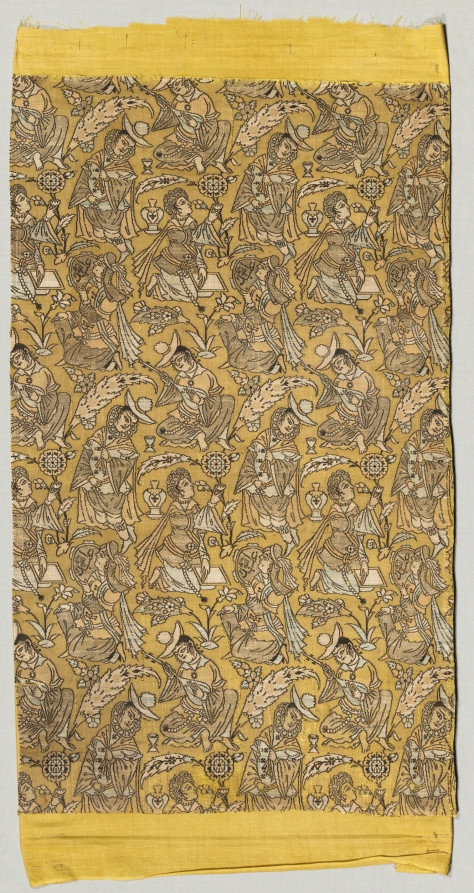
The Imperial Thread: Deconstructing the Lampas with Dancers and Musicians
In the hushed, wood-panelled ateliers of Savile Row, where cloth is not merely measured but interrogated, we speak of provenance with the same reverence reserved for a vintage Bordeaux. Yet, the true connoisseur knows that the most compelling narratives are not woven in Yorkshire or Como, but in the lost looms of empires. Today, we examine a singular artifact: a lampas of silk, populated by dancers and musicians. This is not a mere textile; it is a frozen orchestra, a diplomatic dispatch in filament, and a testament to the absolute, unrivalled hegemony of imperial silk weaving.
Materiality and the Language of the Loom
Let us first address the cloth itself. The term *lampas* denotes a figured weave in which a ground warp and a pattern warp are employed, creating a structure of extraordinary complexity. Unlike a simple brocade where supplementary threads float freely on the reverse, a lampas is a compound cloth, fully reversible in its integrity, if not its aesthetic. The ground is typically a satin or taffeta, while the pattern is introduced via a twill or another binding system. This is not a fabric for the impatient; a single repeat can require hundreds of warp threads and a sophisticated drawloom operated by a master weaver and his apprentice, working in perfect, silent synchrony.
The materiality of this specific lampas is pure, unadulterated silk. Not the weighted, slubby silks of modern commerce, but the lustrous, high-twist filament of *Bombyx mori*, cultivated in the mulberry groves of the imperial provinces. The tactile quality is paramount. Run your hand across the surface, and you feel the cool, almost metallic precision of the ground, punctuated by the raised, plush relief of the pattern. The silk’s natural lustre is not a mere decorative afterthought; it is a functional element. It catches the candlelight of a courtly hall, animating the dancers woven into its surface, creating a kinetic illusion of movement that belies the fabric’s static nature. The colour—often a deep, resonant ground of madder red, indigo, or a profound sapphire—serves as a dramatic stage, against which the gold and silver thread (often gilt membrane wrapped around a silk core) of the figures performs its silent ballet.
Iconography: The Choreography of Power
The iconography of dancers and musicians is not a frivolous choice. In the lexicon of imperial silk, this motif is a deliberate, coded message of prosperity, harmony, and cosmic order. The dancer, often depicted with swirling scarves and a dynamic, contrapposto stance, is not merely an entertainer. She is an embodiment of *Anahita*, the goddess of water and fertility, or a celestial *Apsara*, whose movements sustain the universe. The musicians, with their lutes, harps, and flutes, are not playing for human ears alone; they are orchestrating the music of the spheres, a divine symphony that ensures the continued favour of the heavens upon the throne.
Consider the composition. The figures are rarely static. They are arranged in rhythmic, repeating friezes, their limbs and instruments interlocking in a visual cadence. This is not accidental. The weaver, following the cartoon of a court painter, has translated the fluidity of a dance into the rigid geometry of the loom. The result is a tension between the organic and the structural, a paradox that defines the very essence of imperial luxury. The pattern is a statement of control: the empire controls the silkworm, the loom, the artisan, and, by extension, the very representation of joy and divine favour. To possess such a fabric was to possess a fragment of that celestial mandate.
The Legacy of Imperial Silk Weaving
The legacy of imperial silk weaving is not a story of mere craftsmanship; it is a chronicle of statecraft. From the Tang Dynasty’s cosmopolitan workshops to the Safavid looms of Isfahan and the grand *Manufacture des Gobelins* in France, the production of figured silks was a royal prerogative. These workshops were not commercial enterprises; they were extensions of the court, producing diplomatic gifts, ecclesiastical vestments, and the ceremonial raiment of the nobility. The lampas we examine today, likely originating from the Safavid or early Ottoman imperial looms, would have been a gift of immense political weight, a material ambassador carrying the prestige of its sovereign.
The technical knowledge required to produce such a cloth was a state secret, guarded as fiercely as any military strategy. The migration of weavers—from Persia to Italy, from Italy to France—was a catalyst for cultural and economic transformation. The lampas, therefore, is not a static object but a node in a vast network of exchange. It carries within its threads the whispers of the Silk Road, the ambitions of dynasties, and the silent labour of generations of artisans whose names have been lost to history, but whose genius is preserved in every perfect warp and weft.
Conservation and Contemporary Relevance
For the modern collector or the discerning heritage professional, this lampas is a masterclass in material integrity. Its conservation demands an understanding of its composite nature: the silk ground is susceptible to light damage and desiccation, while the metallic threads are prone to tarnishing and embrittlement. It must be stored flat, in a climate-controlled environment, away from the polluting acids of untreated wood or cardboard. Handling requires white cotton gloves and a steady hand; the fabric is a document, and every crease is a potential erasure.
Yet, its relevance extends beyond the museum vitrine. For the contemporary designer on Savile Row, this lampas is a provocation. It challenges the modern obsession with minimalism and speed. It reminds us that true luxury is not about novelty, but about depth—the depth of a weave, the depth of a history, the depth of a story that can be felt in the hand and read in the light. To commission a modern interpretation of this lampas is not to copy it, but to engage in a dialogue with a master. It is to acknowledge that the pinnacle of textile art was reached centuries ago, and that our task is not to surpass it, but to understand, honour, and, perhaps, to reanimate its spirit for a new era. The dancers and musicians of this imperial silk are not silent; they are waiting for a new audience, a new patron, and a new performance.
Heritage Lab Insight
Lab Insight: CMA Silk Archive Node integration.