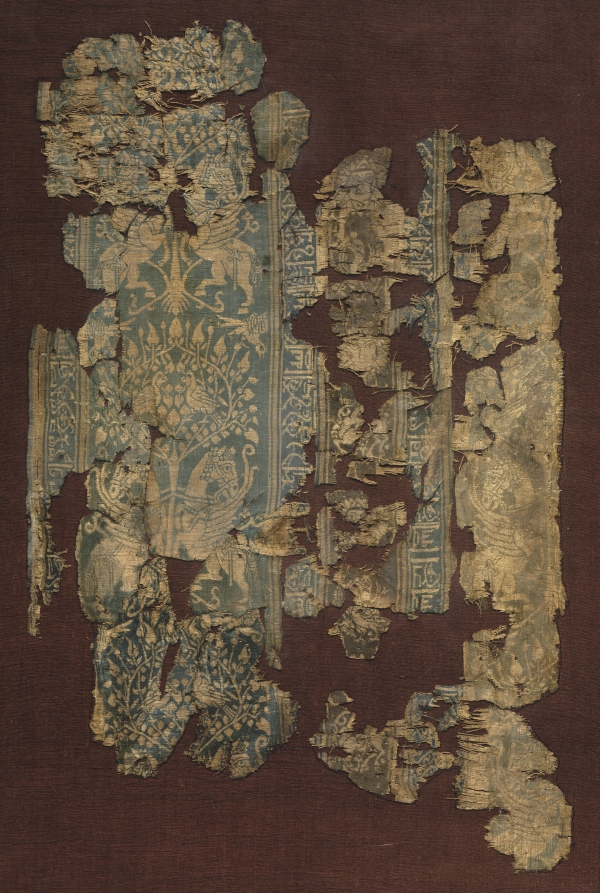
Category: Silk
The Imperial Thread: A Materialist Reading of a Silk Fragment
In the hushed, wood-panelled offices of Savile Row, where the cut of a lapel is debated with the gravity of a treaty negotiation, we seldom pause to consider the provenance of the very cloth that drapes our clients. We speak of Super 150s worsted, of cashmere from the Mongolian plateau, but the silk fragment before us—a whisper of lustrous, honey-toned weave, no larger than a gentleman’s pocket square—demands a different lexicon. It is not merely a textile; it is a legal document, a diplomatic cable, and a work of art, all folded into a few square inches of protein fibre. This fragment, bearing the unmistakable density and irregular selvage of imperial looms, is a silent testament to a system of production that predates our bespoke ateliers by two millennia and, in its own way, set the standard for the exacting standards we uphold today.
Let us first attend to the materiality. This is not the machine-reeled, mercerised silk of modern commerce, which possesses a sterile, glassy uniformity. The yarn here is slightly uneven, a hallmark of hand-reeling from the cocoon of the Bombyx mori silkworm, fed on the finest mulberry leaves of a specific terroir. The weave is a plain tabby, yet the density is extraordinary—a thread count that speaks of a loom tensioned with obsessive precision. When held to the light, the fragment reveals a subtle, undulating sheen, a moiré effect born of the slight irregularity in the filament. This is not a flaw; it is a signature. It is the difference between a Savile Row suit and a ready-to-wear garment: the former possesses a living, breathing quality, the latter a sterile perfection. The weight is substantial, a drape that falls with a deliberate, liquid grace, suggesting a fabric intended not for a summer waistcoat but for a ceremonial robe, a garment of state designed to command a room before a single word was spoken.
The Imperial Atelier: A Precedent for Precision
To understand this fragment, we must place it within the context of the imperial silk workshops, the Ningshu and Jiangnan weaving bureaus that operated under the direct patronage of the Chinese court. These were not factories in the industrial sense; they were ateliers of staggering scale and hierarchical discipline. Master weavers, whose families had held the craft for generations, oversaw teams of apprentices, each with a specific, codified role—the warper, the dyer, the loom-setter. The production was governed by a bureaucratic calendar that dictated not only the design motifs (the five-clawed dragon for the emperor, the phoenix for the empress) but the very colour palette, which was tied to the cosmological calendar and the emperor’s ritual duties. A fragment of this honeyed gold, for instance, would have been reserved for a specific rank of official or a particular seasonal ceremony. The colour was not a matter of aesthetic preference; it was a matter of legal and cosmic propriety.
This system of codified precision is the direct spiritual ancestor of the Savile Row method. Our own craft is built upon a similar, albeit secular, hierarchy of knowledge. The cutter who drafts a pattern from a client’s measurements is the heir to the master weaver who calculated the warp and weft counts to achieve a specific drape. The tailor who executes a hand-finished buttonhole, with its 108 stitches, is performing a ritual of precision that mirrors the weaver’s meticulous repair of a broken filament. The imperial system demanded that a single bolt of silk, perhaps fifty yards long, be woven without a single flaw. The penalty for a dropped stitch or a misaligned thread was not merely financial ruin; it was a loss of face, a disruption of cosmic harmony. In our own way, we in the Row understand this. A lapel that rolls imperfectly, a shoulder that does not sit cleanly—these are not merely technical errors; they are breaches of an unspoken contract with the client, a violation of the esprit de corps that defines our profession.
The Fragment as a Document of Trade and Power
Beyond its technical mastery, this fragment is a document of global commerce. Silk was not merely a luxury good; it was the currency of empire, a strategic asset more valuable than gold. The Silk Road, that network of caravan routes and maritime lanes, was not a romantic highway of cultural exchange but a high-stakes logistics corridor, policed by empires and plied by merchants who risked everything for a bale of this precious fibre. The very existence of this fragment in a Western collection is a testament to that trade. It may have arrived as a diplomatic gift, a tribute payment, or a piece of contraband smuggled out of the imperial workshops. Its presence here, in London, speaks to a history of exchange that is both collaborative and exploitative, a complex tapestry of desire, appropriation, and admiration.
Consider the parallel with our own trade. Savile Row has long been an exporter of a different kind of luxury: the intangible asset of bespoke tailoring. We do not sell cloth; we sell a process, a relationship, a promise of permanence in a disposable world. The imperial silk weavers understood this. They were not selling fabric; they were selling authority, legitimacy, and a connection to the divine. When a client commissions a suit from us, they are not merely purchasing a garment; they are purchasing a piece of that same authority, a bespoke armour for the modern battlefield of commerce and society. The fragment, in its silent way, reminds us that our craft is not an island. It is part of a continuum of excellence that stretches back to the looms of the Forbidden City, a lineage of artisans who understood that true luxury is not about ostentation but about the quiet, unassailable confidence that comes from wearing something made with absolute, uncompromising intent.
In the end, this small piece of silk is a mirror. It reflects not only the skill of its makers but the aspirations of its wearers. It is a reminder that the finest things in life are not mass-produced but are the result of patience, skill, and a profound respect for the material. As we handle it, we are handling history. And in doing so, we are reminded that our own work, however modern, is but a continuation of a very old and very noble story.