← BACK TO ARCHIVES
Heritage-Black
Heritage Synthesis: Terracotta fragment of a stemless kylix (drinking cup)
Curated on Aug 14, 2026 // Node: LDN-01
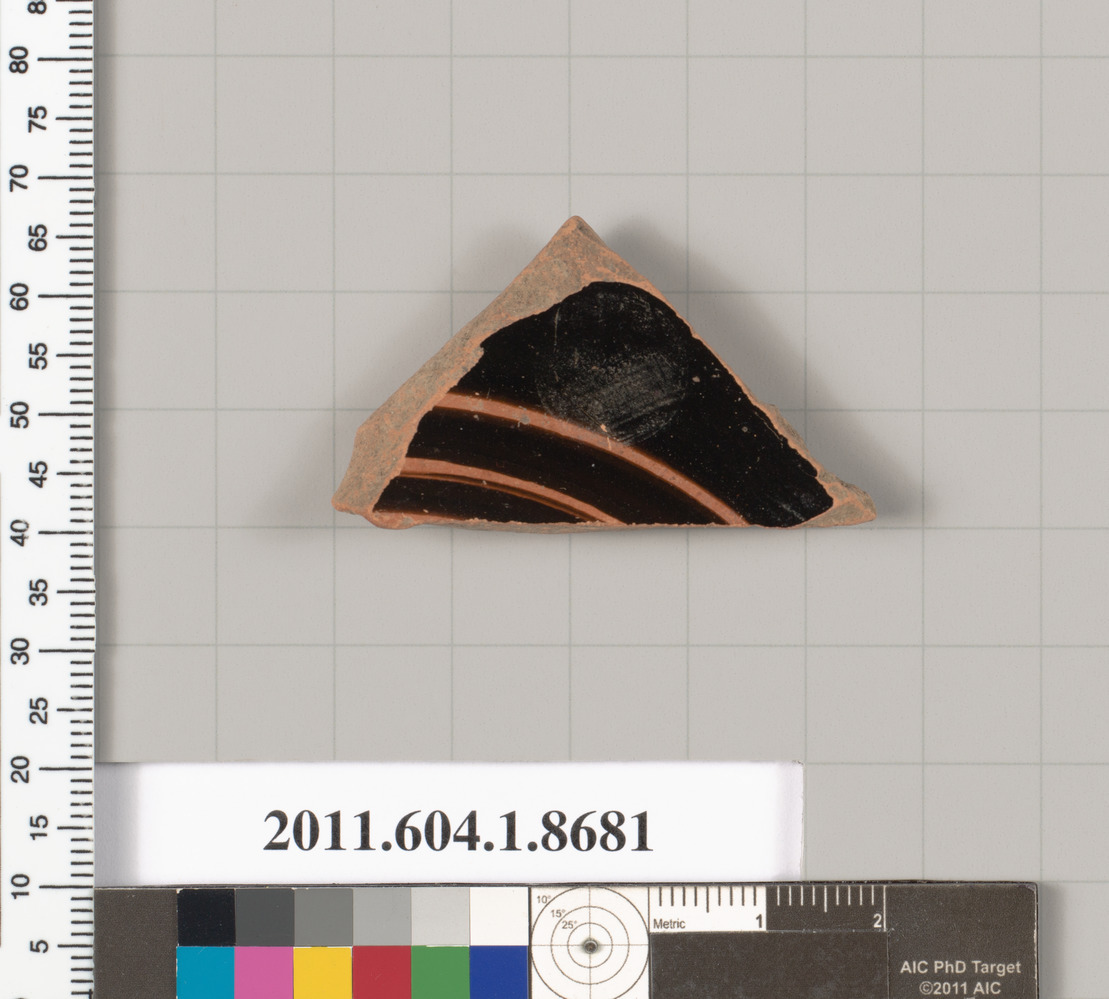
The Dialectics of Containment: Terracotta Fragments and the 2026 Old Money Silhouette
The study of heritage is never a linear retrieval of the past, but a dialectical engagement between artifact and actuality. Within the Lauren Fashion Heritage Lab, we do not merely preserve; we interrogate. Today, we turn our gaze to a seemingly incongruous object: a terracotta fragment of a stemless kylix from Attic Greece. At first glance, a shattered drinking cup bears little relation to the tailored austerity of the 2026 Old Money silhouette. Yet, when filtered through the internal genetic code of our aesthetic philosophy—specifically the dialectic between “空性” (emptiness) and “实在” (substance), and the principle of “器以载道” (the vessel carries the Way)—this fragment becomes a profound blueprint. It speaks not of ornament, but of restraint; not of abundance, but of the eloquent void. This analysis posits that the kylix fragment, in its brokenness and its geometric clarity, directly informs the coming season’s focus on architectural shoulders, suppressed waists, and the luxurious weight of negative space.
The Kylix as a Study in Contained Energy
The stemless kylix, a vessel for symposia, was designed for the hand. Its shallow bowl and two horizontal handles create a horizontal axis of tension, a line of energy that is both grounded and expansive. The terracotta fragment we hold—likely a section of the bowl’s rim and a handle root—reveals the essential grammar of the form: a clean, unbroken curve meeting a sharp, functional projection. There is no superfluous flourish. The beauty lies in the *tension* between the concave emptiness of the bowl and the convex solidity of its walls. This is not a passive container; it is a structure that *performs* containment.
In the 2026 Old Money silhouette, this translates directly to the shoulder. We move away from the soft, drooping shoulder of previous years toward a more defined, almost architectural line. The “kylix shoulder” is not a padded, aggressive power shoulder, but a precise, tailored seam that creates a horizontal visual anchor. It is the handle of the cup—a discrete, functional extension that suggests strength without shouting. The jacket’s shoulder becomes a point of structural integrity, a place where the fabric (be it a dense wool or a fluid cashmere) is held in perfect tension, echoing the potter’s controlled curve. The emptiness beneath the shoulder—the drape of the sleeve—is as crucial as the structure itself. It is the “空” that allows the “实” of the silhouette to breathe.
Fragmentary Aesthetics: The Power of the Incomplete
The fragment’s power lies in its incompleteness. We do not see the whole cup; we see a part that implies a whole. Our mind completes the circle, fills in the missing scenes of revelry or myth. This act of imaginative completion is central to the Old Money ethos. It is an aesthetic of implication, not declaration. The 2026 silhouette embraces this through the principle of *strategic reduction*. It is not about minimalism as a lack, but about minimalism as a concentration of meaning.
Consider the rise of the high, closed neckline or the elongated, unbroken line of a coat. These garments do not reveal; they suggest. They create a “fragment” of the body, focusing the eye on the face, the hands, the posture. The garment itself becomes a shard of a larger, more complete persona—one that is private, self-assured, and indifferent to external validation. This is the antithesis of the “loud” luxury of logos and maximalist prints. Instead, we see the “quiet” luxury of a perfectly executed seam, the subtle sheen of a silk lining glimpsed only in motion, the heavy, tactile fall of a wool crepe. These are the details that, like the potter’s fingerprint on the terracotta, speak of the human hand and the passage of time. The 2026 Old Money garment is a fragment of a legacy, not a complete, disposable statement.
From Sacred Plaque to Secular Vessel: A Shared Grammar
Our internal archives draw a parallel between the kylix and the two Eastern artifacts referenced in our genetic code: the *Udonge* temple plaque and the painted garment chest. The temple plaque, with its carved flower of the *Udumbara*, is a study in the “rare made constant.” The kylix, in its fragmentary state, is the “constant made rare.” The plaque’s flower is eternally in a state of “about to bloom”; the kylix’s form is eternally in a state of “about to be held.” Both exist in a liminal space, a suspension between potential and actuality. This is the very essence of the 2026 Old Money attitude: a life lived in poised anticipation, never in frantic pursuit.
The garment chest, conversely, is a vessel of *visible* abundance—painted with flowers and scenes. Yet its purpose is to *hide* its contents. Its exterior is a celebration, but its interior is a private sanctum. The kylix, in its original state, was also a vessel of display, but its display was ephemeral—the wine drunk, the cup passed. The fragment, however, has inverted this. It now displays only its own structural truth. This is the ultimate lesson for 2026: the most sophisticated form of display is the revelation of structure itself. The Old Money silhouette, therefore, will favor garments that reveal their own construction—a visible pick-stitch on a lapel, a precisely aligned plaid, a hand-finished buttonhole. These are the “terracotta fragments” of the sartorial world: small, broken pieces of perfection that attest to a larger, unseen whole.
Materiality and the Weight of Time
Finally, the terracotta fragment grounds us in materiality. It is earth, fired and hardened. It has survived millennia, not despite its fragility, but because of its honest materiality. This informs the 2026 fabric story. We will see a return to substantive, “honest” textiles: heavy, felted wools, raw silks with a slubby texture, and dense, compacted cashmeres. These are not fabrics that float; they are fabrics that *fall* with intention, creating the vertical, grounded line that the kylix’s horizontal handles counterbalance. The color palette will echo the terracotta’s earthy tones—not the bright, sun-baked orange, but the deeper, shadowed umber, the grey-brown of aged clay, and the black of the fired core. These are the “Heritage-Black” tones of our category: not a funereal black, but a black that contains the memory of fire and earth, a black that is a presence, not an absence.
In conclusion, the terracotta kylix fragment is not a decorative inspiration for the 2026 Old Money silhouette; it is a philosophical one. It teaches us that true luxury is found in structural integrity, in the eloquent power of the incomplete, and in the quiet confidence of material honesty. As we design for the coming season, we do not look to the past to copy it, but to excavate its foundational principles. We hold the shard of the cup, and in its broken curve, we see the perfect shoulder of a coat, the disciplined fall of a skirt, and the profound silence of a well-made garment. The flower on the temple plaque and the painted chest may speak of eternity and daily life, but the kylix fragment speaks of the eternal *structure* that contains both. It is the vessel that holds the void, and in that void, we find the space for a new, enduring elegance.
Heritage Lab Insight
Genetic Bridge: Archive node focusing on Heritage-Black craftsmanship.