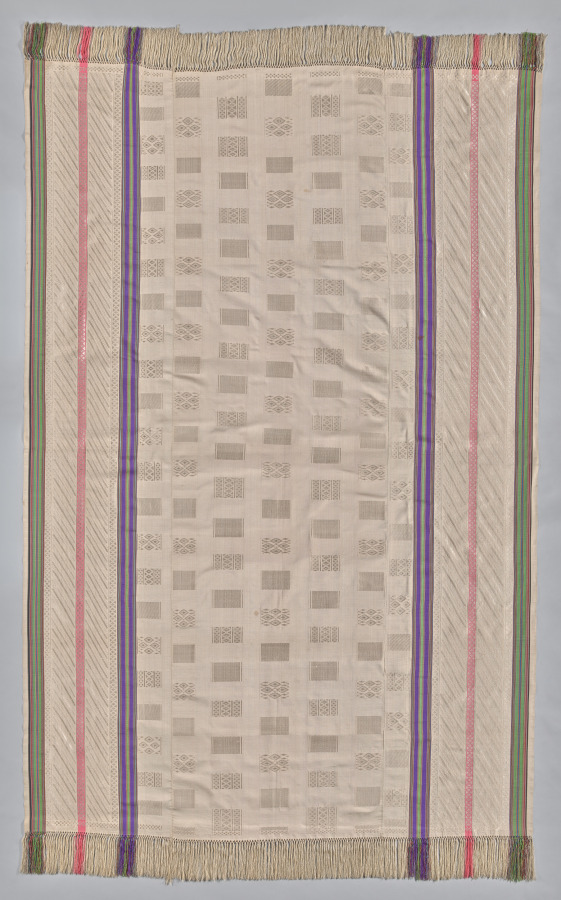
The Wrapper (Lamba Akotifahana): A Study in Imperial Silk and the Art of Restrained Opulence
Provenance and the Imperial Loom
In the rarefied world of textile connoisseurship, where provenance is paramount and the hand of the maker is revered, the Lamba Akotifahana stands as a singular masterpiece. This is not merely a garment; it is a document of imperial ambition, a testament to the extraordinary technical mastery of the Merina court of 19th-century Madagascar. For the discerning eye, accustomed to the bespoke tailoring of Savile Row, this wrapper offers a profound study in the relationship between material, power, and the enduring language of luxury.
The Akotifahana, literally meaning "woven silk," represents the apogee of a weaving tradition that was, for a time, the exclusive preserve of the Andriana—the noble class. Its creation was not a commercial enterprise but a state-sponsored act of cultural and political expression. The silk itself, often a wild variety indigenous to the island, was painstakingly reeled and spun, a process demanding immense patience and skill. The resulting cloth, typically measuring several metres in length, was designed to be draped around the body, a full-length wrapper that conferred upon its wearer an aura of unassailable authority. It is the direct analogue, in its sartorial significance, to the tailored frock coat or the perfectly cut morning suit—garments that signal not just taste, but a specific, elevated station in life.
Materiality and the Art of the Loom
The materiality of the Akotifahana is its primary language. Unlike the heavy, brocaded silks of the European courts, this textile is celebrated for its luminosity and diaphanous quality. The weave, typically a plain or twill construction, is executed with a fineness that rivals the best of Lyons or Spitalfields. Yet, its true genius lies in the supplementary weft patterns. These are not woven in a single pass; rather, the weaver, working on a horizontal ground loom, would insert discontinuous threads of contrasting colours—often vibrant reds, deep indigos, and golden yellows—to create intricate geometric and floral motifs. This technique, known as lambahoany in its patterned form, produces a fabric that is simultaneously structural and ethereal.
Consider the drape. When worn, the Akotifahana does not cling; it flows. The silk’s natural lustre catches the light, creating a subtle, shifting play of shadow and sheen that is far more compelling than any overt embellishment. This is the essence of understated luxury. The pattern, often featuring stylised rosettes, diamonds, and zigzag lines, is not printed or embroidered but is integral to the cloth itself. It is a woven architecture, a testament to the weaver’s ability to control thousands of individual threads to create a cohesive, harmonious whole. For the tailor, this is akin to the perfect basted fitting—every element is deliberate, every seam a considered decision.
Context: The Legacy of Imperial Silk Weaving
The legacy of this imperial silk weaving is inextricably linked to the political ascendancy of King Radama I in the early 19th century. Eager to modernise his kingdom and consolidate power, Radama engaged with European missionaries and traders, not only for military technology but also for artistic and technical knowledge. It was during this period that the Akotifahana evolved from simpler, monochrome cloths into the polychrome masterpieces we revere today. The introduction of new aniline dyes from Europe expanded the weaver’s palette, while the traditional motifs were refined and codified. This was not a passive adoption of foreign aesthetics, but a deliberate, sophisticated synthesis. The Merina weavers took the technical possibilities offered by new materials and bent them to their own, distinctly Malagasy, artistic vision.
The cloth became a form of diplomatic currency. Gifts of Akotifahana were presented to foreign dignitaries, serving as a tangible demonstration of the kingdom’s wealth, sophistication, and sovereign independence. To wear one was to be part of an exclusive, powerful circle. The cloth’s production was strictly controlled, and the patterns often held specific symbolic meanings, accessible only to those within the court. In this sense, the Akotifahana functioned as a kind of sartorial cipher—a silent, elegant assertion of identity and rank. It is a powerful reminder that luxury, at its most potent, is often about the communication of knowledge and belonging, not just the display of cost.
Contemporary Relevance and the Savile Row Parallel
Why should the modern connoisseur, accustomed to the crisp lines of a Huntsman suit or the soft shoulder of an Anderson & Sheppard jacket, look to a 19th-century Malagasy wrapper? The answer lies in the shared philosophy of construction. Both the Savile Row suit and the Akotifahana are founded on the principle of bespoke perfection. They are not off-the-rack commodities; they are made to measure, tailored to the individual and the occasion. The Akotifahana’s hand-woven silk, with its subtle irregularities and unique character, mirrors the hand-stitched lapel or the hand-finished buttonhole. It is the antithesis of mass production.
Furthermore, the Akotifahana challenges our Western-centric notions of tailoring. It demonstrates that the pinnacle of dress need not be a structured, fitted garment. The art of the drape, so central to this textile, is a different kind of mastery—one that relies on the fabric’s own integrity and the wearer’s carriage. It is a lesson in restraint. The beauty is not shouted; it is whispered. The pattern is not loud; it is intricate and intimate, revealing itself only upon close inspection. This is the quiet confidence of true connoisseurship.
In an era of fast fashion and disposable trends, the Lamba Akotifahana stands as a monument to patience, skill, and the enduring power of material. It is a heritage artifact that speaks to a universal language of quality. For the collector, it is a treasure. For the student of dress, it is an essential chapter in the global history of silk. And for those who appreciate the finest things in life, it is a reminder that true luxury is not about what you wear, but how it was made, and the story it tells. It is, in every sense, a garment of consequence.