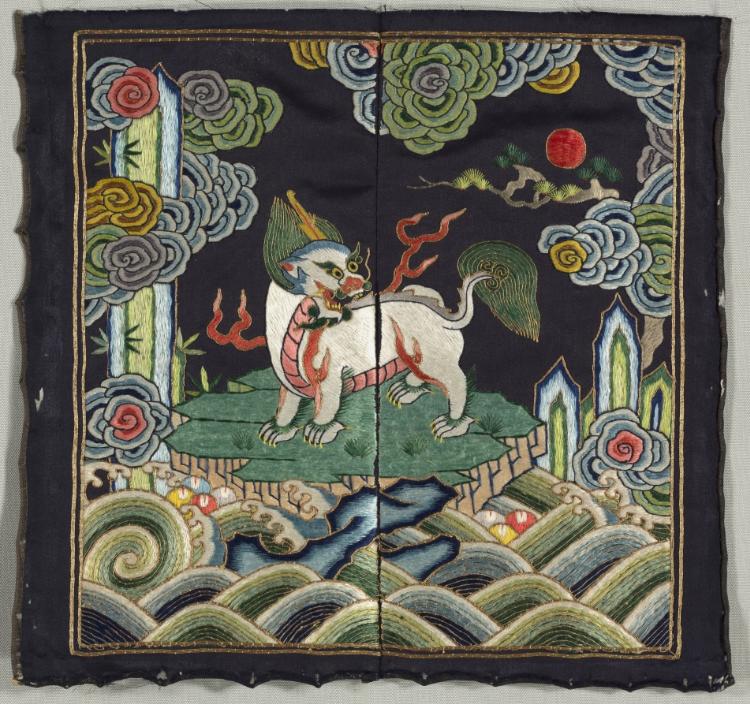
The Rank Badge (Buzi): A Study in Imperial Silk and the Architecture of Authority
Introduction: The Fabric of Governance
In the rarefied atmosphere of imperial China, authority was not merely exercised; it was *worn*. Among the most potent symbols of this sartorial governance is the *buzi*, the square or circular rank badge stitched to the surcoat of civil and military officials. To the uninitiated, it is a striking piece of embroidery. To the discerning eye—trained, as ours is, in the language of cloth—it is a document of power, a manifesto of hierarchy, and the apotheosis of imperial silk weaving. This artifact, rendered in lustrous silk and metallic thread, is not a mere ornament. It is the distilled essence of a bureaucratic machine that governed a fifth of humanity for over five centuries, a legacy that demands the same reverence as a perfectly cut Savile Row suit: precise, purposeful, and utterly commanding.
Materiality: The Silk Imperative
The *buzi*’s power begins with its substrate. Silk, the exclusive province of the imperial household and its sanctioned workshops, was the *haute couture* of governance. The materiality of the badge is a study in controlled luxury. The ground fabric, typically a fine silk satin or gauze, provided a luminous canvas. Upon this, the weaver and embroiderer applied their art. The thread itself was not mere filament; it was the product of a state-managed industry, the Imperial Silkworks of Nanjing and Suzhou, where every stage—from sericulture to the final twist of the weft—was overseen by eunuch administrators. This was not commercial production. This was the manufacture of state ideology, woven with a precision that rivals the finest British tailoring.
The technique employed was predominantly counted-thread embroidery and Peking knot, creating a dense, sculptural surface. The silk floss, dyed with natural pigments—indigo for the azure sky, madder for the cinnabar sun, and orpiment for the gold of the sun’s rays—was laid in meticulous satin stitches. The effect is one of extraordinary tactility. The raised, almost bas-relief quality of the birds and beasts is not accidental. It was designed to catch the light, to shimmer with the movement of the wearer, to announce his presence before a word was spoken. In this, the *buzi* shares a kinship with the structured shoulder of a bespoke jacket—both are engineered to create a silhouette of authority, to project a physicality that commands a room.
Iconography: A Zoology of Power
The iconography of the *buzi* is a precise, codified language. For civil officials, the motif was a bird, each species denoting a specific rank in the nine-tiered hierarchy. The crane, symbol of longevity and wisdom, was reserved for the first rank. The golden pheasant, second; the peacock, third; and so on down to the quail for the ninth. For military officials, the language was that of the beast: the qilin (a mythical chimeric creature) for the first rank, the lion for the second, the leopard for the third, descending to the rhinoceros for the ninth.
This is not mere decoration; it is a heraldic system of breathtaking sophistication. Each creature is rendered in a stylized, dynamic pose, often set against a backdrop of auspicious clouds, waves, and Buddhist or Daoist symbols. The composition is rigorously balanced, a microcosm of the cosmic order the official was meant to uphold. The central creature is flanked by symbols of the sun and moon, and the entire scene is framed by a border of geometric or floral patterns. The choice of bird or beast was not a matter of personal taste. It was a legal decree, a sumptuary law enforced with the same severity as a modern compliance regulation. To wear the wrong badge was an act of treason, a breach of the social contract that could result in demotion, exile, or worse.
The Legacy of Imperial Silk Weaving
The *buzi* stands as the culminating expression of a weaving tradition that spanned millennia. The imperial workshops were not merely factories; they were academies of excellence. Master weavers, whose skills were passed down through generations, were treated as national treasures. They operated on looms of extraordinary complexity, capable of producing kesi (slit-tapestry) silk, a technique so demanding that a single square inch could take weeks to complete. The *buzi*, often produced using this method, represents the pinnacle of this craft. The weaver’s hand, guided by a cartoon drawn by a court painter, translated a two-dimensional design into a three-dimensional textile sculpture.
This legacy is not a relic. It is a living standard. The discipline, the patience, the obsessive attention to detail, and the understanding that material and technique are inseparable from meaning—these are the very principles that underpin the finest tailoring on Savile Row. When we cut a jacket from a bolt of cloth, we are not just shaping fabric. We are shaping the wearer’s presence. The *buzi* did the same for a Ming or Qing dynasty mandarin. The silk was not merely a covering; it was an armor of status, a declaration of one’s place in the celestial bureaucracy. The weight of the silk, the stiffness of the embroidery, the precise placement of the badge on the chest—all contributed to a posture of uprightness, a physical embodiment of the official’s moral and administrative rectitude.
Conclusion: A Cut Above
In the contemporary world, the *buzi* is a coveted museum piece, a fragment of a vanished world. Yet its lessons endure. It reminds us that true luxury is not about excess, but about intention. Every thread, every stitch, every choice of color and motif was deliberate, serving a higher purpose. It is a masterclass in the art of communication through cloth. For the modern connoisseur, the *buzi* offers a profound insight: that the most powerful garments are those that speak a silent, precise language of authority. Just as a Savile Row suit is cut to fit the body and the occasion, the *buzi* was cut to fit the soul of the state. It is a testament to the enduring power of silk to not only clothe the body, but to *construct* the man. And in that, it remains, quite simply, the finest example of sartorial governance ever conceived.