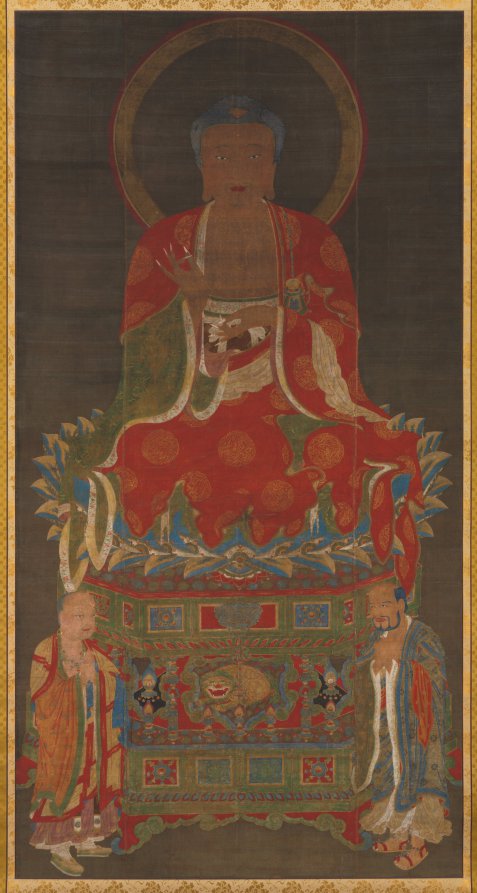
Category: Silk
An Heirloom of the Loom: Deconstructing the Material Theology of “Shakyamuni with Two Attendants”
In the rarefied atmosphere of a Mayfair atelier, where the cut of a lapel is a matter of quiet doctrine, one learns to read cloth as scripture. The piece before us—a silk panel depicting Shakyamuni with two attendants—is not merely a textile. It is a frozen sutra, a sermon delivered not in sound but in warp and weft. To examine it is to step into a lineage of imperial craftsmanship that rivals the bespoke tailoring houses of Savile Row in its exacting standards, its reverence for material, and its unspoken language of power.
Materiality: The Silk Itself as Sacred Ground
The foundation of this artifact is its materiality, and here, silk is not a passive support but an active participant in the sacred narrative. The panel is woven from mulberry silk (Bombyx mori), a fibre that in its imperial Chinese context was considered more precious than gold. The thread count is exceptionally fine, suggesting a loom of considerable sophistication—likely a drawloom operated by a team of master weavers, each pull of the harness a coordinated act of devotion. The fabric’s ground is a deep, undyed ecru, a deliberate choice that allows the natural lustre of the silk to act as a subtle halo, a ground of pure potential upon which the figures emerge.
The weave structure is a compound twill, likely a taffeta or satin ground with discontinuous supplementary wefts for the polychrome imagery. This is not a printed or painted textile; the image is structurally integral to the cloth. The Buddha’s robe, for instance, is rendered in a contrasting weave direction, catching the light differently from the attendant figures, creating a subtle optical shift that separates the divine from the human. This is the hallmark of imperial weaving—a technical bravura that does not shout but whispers, demanding a connoisseur’s eye.
The Legacy of Imperial Silk Weaving: A Genealogy of Precision
To understand this panel, one must understand its provenance in the imperial workshops of the Ming or early Qing dynasty, likely the Nanjing or Suzhou looms. These were not commercial enterprises; they were state-sponsored manufactories, staffed by hereditary weavers whose families had served the throne for generations. The legacy is one of absolute control—over fibre, over dye, over design. The dyes are derived from organic sources: indigo for the blues, madder for the reds, and a yellow from the huai flower. The palette is restrained, almost monastic, in its discipline. There is no gaudy display; the colours are deep, resonant, and harmonious, much like the muted tones of a well-tailored tweed.
The iconography itself is a study in hierarchical proportion. Shakyamuni, seated in dhyanasana (meditation posture), is rendered larger than his attendants, a visual shorthand for spiritual supremacy. His right hand touches the earth in bhumisparsha mudra, calling the earth to witness his enlightenment. The two attendants—likely Ananda and Kasyapa, his principal disciples—are depicted in slightly smaller scale, their postures deferential, their gazes lowered. The weaver has captured the subtle asymmetry of their poses, a detail that would be lost on a casual observer but is essential to the narrative’s authenticity. This is the same attention to anatomical nuance that a Savile Row cutter applies to a client’s shoulder slope.
Technical Virtuosity: The Weaver as Couturier
The construction of this panel would have taken months. Each colour change in the weft required a separate shuttle, and the pattern was controlled by a complex system of pattern cords, effectively a pre-computer programming language. The weaver’s skill lay not only in executing the pattern but in managing the tension of the warp threads, ensuring that the finished cloth was perfectly flat and even. Any error—a mis-thread, a broken warp, a dye lot variation—would have meant discarding the entire panel, a costly failure in both material and face.
Consider the rendering of the Buddha’s face. The weaver has used a technique of fine, parallel weft floats to suggest the planes of the cheek and brow, creating a subtle chiaroscuro effect that is almost painterly. The eyes are closed, the line of the mouth is serene, and the ushnisha (the cranial protuberance signifying wisdom) is depicted as a discreet, almost abstract, form. This is not a crude, folk-art representation; it is a sophisticated, intellectual exercise in translating three-dimensional form into a two-dimensional woven medium. It is the equivalent of a master tailor’s saisie—the invisible stitching that gives a jacket its perfect roll.
Conservation and the Ethics of the Object
As a heritage artifact, this panel demands a conservation philosophy that respects its dual nature as both art and document. The silk is fragile, susceptible to light damage and desiccation. The dyes are fugitive, prone to fading if exposed to ultraviolet radiation. The panel should be stored flat, in a pH-neutral, acid-free tissue, in a climate-controlled environment of approximately 50% relative humidity and 18°C. Any mounting for display must be done with a fabric support, never glued, and the frame must be sealed to prevent insect ingress.
The ethical question is one of intervention. Should we restore the missing threads? Should we re-weave the damaged sections? The answer, in the tradition of the Worshipful Company of Weavers, is a firm ‘no’. The artifact’s value lies in its authenticity, in the very fact that it has survived the centuries with its imperfections intact. A repair would be a forgery, a lie told in silk. Our role is to preserve, not to improve. We are the stewards of a legacy, not its editors.
Conclusion: The Tailored Sutra
In the end, “Shakyamuni with two attendants” is a garment for the spirit, cut from the same cloth as imperial authority and monastic discipline. It is a testament to the idea that the sacred can be rendered in the secular material of silk, that a loom can be an instrument of enlightenment. For the connoisseur, it is a quiet masterpiece, a piece that rewards patient study with profound insight. It does not demand attention; it commands it, through the sheer, unassailable quality of its making. And in that, it is the most Savile Row of objects: a perfect fit, timeless, and utterly without ostentation.