← BACK TO ARCHIVES
Silk
Heritage Synthesis: Silk curtain from the Alhambra palace
Curated on Aug 15, 2026 // Node: LDN-01
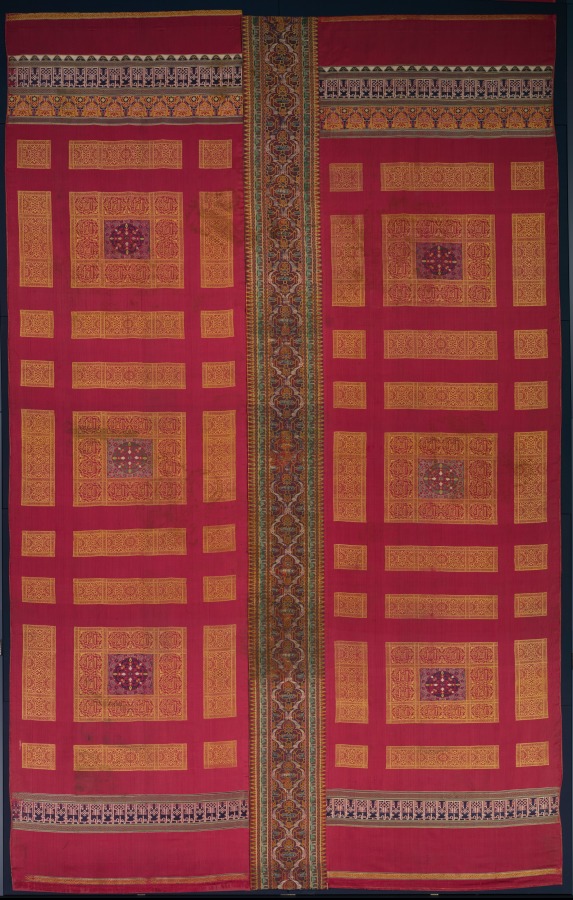
The Alhambra Silk Curtain: A Material Testament to Imperial Weaving
In the hushed, wood-panelled ateliers of Savile Row, where the cut of a jacket is debated with the gravity of a treaty, we understand that true luxury is never loud. It whispers. It endures. It tells a story in the weight of its cloth and the precision of its weave. The silk curtain from the Alhambra Palace is precisely such an artifact—a silent, sumptuous document of a forgotten empire’s ambition. To handle its surviving fragments is to read a ledger of power, written not in ink, but in the lustrous, unbroken filament of the silkworm.
Materiality: The Alchemy of Silk
The curtain’s primary materiality is, of course, silk—a fibre that in the medieval world was worth more than gold by weight. But this is not the flimsy, decorative silk of a modern evening gown. This is imperial silk, woven with a density and technical mastery that speaks to a production line of extraordinary sophistication. The warp and weft are not merely interlaced; they are locked in a structural dialogue. The high twist of the warp threads provides a resilient, almost architectural foundation, while the weft—often a combination of silk and gilded silver or gold thread—creates a surface that shifts between matte and reflective, depending on the light. This is a fabric engineered for grandeur, designed to catch the flicker of oil lamps and the cool Andalusian sun, turning a palace corridor into a theatre of light and shadow.
The weave itself is predominantly a compound structure, likely a lampas or a taqueté, which allowed for the creation of complex, polychromatic patterns without compromising the fabric’s integrity. Unlike a simple tapestry, which is heavy and inflexible, this curtain would have hung with a fluid, majestic drape, its patterns—epigraphic bands, arabesques, and the iconic eight-pointed star—emerging from the ground as if woven by a master calligrapher. The colours, though faded over centuries, retain their authority: deep madder reds, the blue of lapis lazuli, and the verdant green of paradise, all bound by the metallic shimmer of the gilded threads. The very fibre is a testament to the Nasrid dynasty’s control over a vast trade network that stretched from the Far East to the Iberian Peninsula.
Context: The Legacy of Imperial Silk Weaving
To understand this curtain, one must place it within the grand narrative of imperial silk weaving—a legacy that predates the Alhambra by a millennium and outlives it. The craft originated in China, was perfected in Byzantium, and was subsequently adopted and elevated by the Islamic caliphates. By the 13th and 14th centuries, the Iberian Peninsula, particularly the Kingdom of Granada, had become a crucial nexus in this silk road. The Alhambra was not merely a fortress and palace; it was the administrative and ceremonial heart of the Nasrid dynasty, the last Muslim stronghold in Western Europe. The silk workshops, or *tiraz*, were state institutions, producing fabrics not only for the court but also as diplomatic gifts of immense prestige.
The curtain from the Alhambra is a direct product of this *tiraz* system. It was not a casual commission; it was a statement of sovereignty. The inscriptions woven into its borders—often verses from the Quran or panegyrics to the sultan—were not decorative afterthoughts. They were political declarations, asserting the ruler’s divine mandate and his dominion over both the material and spiritual realms. The choice of silk, with its inherent luminosity and cost, was a deliberate assertion of wealth and access. To possess such a curtain was to possess a piece of the empire’s soul. It is the same logic that drives a Savile Row client to commission a suit from a bolt of cloth woven on a 19th-century loom in Huddersfield—the material itself carries the weight of history and exclusivity.
Comparative Analysis: The Andalusian Aesthetic
When we compare this Alhambra silk to its contemporaries—say, the luxurious velvets of Lucca or the brocades of Constantinople—we see a distinct aesthetic philosophy. The Italian silks of the same period often favoured naturalistic motifs, such as pomegranates and acanthus leaves, rendered with a three-dimensional, painterly quality. The Nasrid silk, by contrast, is relentlessly geometric and epigraphic. Its patterns are abstracted, intellectual, and deeply rooted in Islamic aniconism. The design is not meant to imitate nature but to transcend it, to evoke the infinite and the divine through repetition and symmetry.
This is a crucial distinction. The Alhambra curtain is not a decorative object in the Western sense; it is a functional piece of sacred architecture in textile form. Its purpose was to demarcate space, to create a threshold between the mundane and the sacred, and to envelop the sultan in an aura of unassailable authority. The curtain’s very structure—its dense, multi-layered weave—was designed to muffle sound, to create a sense of intimacy and awe. It is the medieval equivalent of a bespoke, sound-proofed boardroom, but with infinitely more grace.
Legacy and Modern Resonance
The legacy of this imperial silk weaving extends far beyond the fall of Granada in 1492. When the Catholic Monarchs conquered the city, they did not dismantle the *tiraz*; they repurposed it. The same looms, the same techniques, and often the same artisans were employed to produce Christian liturgical vestments and aristocratic garments. The Alhambra silk thus became a bridge between two civilisations, its patterns subtly altered to accommodate Christian iconography while retaining the technical brilliance of the Islamic weavers. This is the very essence of heritage: not a static relic, but a living, evolving craft.
For us at the Lauren Fashion Heritage Lab, this curtain is a masterclass in the principles that underpin true luxury. It demonstrates that materiality is not merely about fibre content but about the story embedded in the weave. It reminds us that the most powerful designs are those that carry cultural and political significance, not just aesthetic appeal. And it reinforces the Savile Row creed that craftsmanship is the ultimate form of respect—respect for the material, for the wearer, and for the tradition that precedes us. The Alhambra silk curtain is not a dusty artifact; it is a vibrant, tactile conversation with an empire that understood, perhaps better than any before or since, that cloth is the most intimate form of architecture. And that is a lesson we carry with us, stitch by stitch, into every garment we create.
Heritage Lab Insight
Lab Insight: CMA Silk Archive Node integration.