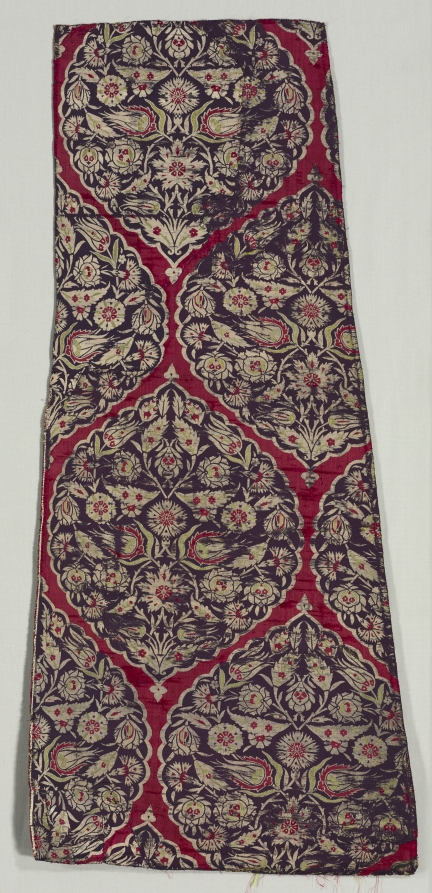
An Heirloom of Empire: Deconstructing the Brocaded Silk Kaftan Fragment
Provenance and the Language of Luxury
Within the hushed, wood-panelled archives of Lauren Fashion Heritage Lab, we encounter not merely a textile, but a diplomatic communiqué woven in silk. This fragment—a brocaded panel of foliate medallions, once part of a ceremonial kaftan—speaks a language of absolute authority. It is a document of imperial power, a testament to the Ottoman and Safavid ateliers where the loom was as potent an instrument as the sword. For the discerning eye, this is not fabric; it is a frozen moment of statecraft, a material assertion of sovereignty that predates the tailored suit by centuries, yet shares its fundamental purpose: to confer upon the wearer an unassailable gravitas.
The materiality is paramount. The ground is a lustrous silk, likely a compound weave where a supplementary weft of gold or silver-gilt thread creates the raised, sculptural pattern. This is not a printed imitation; it is a structural reality. The metallic threads, wound around a silk core, catch the light with a burnished, low-frequency glow—never a garish flash, but a deep, internal radiance. This is the hallmark of the imperial loom: a quiet, confident opulence. The foliate medallions, arranged in a staggered, rhythmic lattice, are not merely decorative. They are a codified system of cosmic and courtly symbolism—the hatayi blossom, the palmette, the cloud band—each motif a node in a network of meaning that signified the sultan’s dominion over both the terrestrial and the celestial.
The Atelier as a Seat of Power
To understand this fragment, one must understand its genesis. These silks were produced in the imperial narh system, a tightly controlled state monopoly. The workshops of Bursa and Istanbul were not commercial enterprises; they were extensions of the palace. The finest raw silk from the Caspian region, the most refined gold from the imperial treasury, and the most skilled weavers—often conscripted from conquered territories—were all marshalled under the direct patronage of the court. The result was a fabric of such technical and artistic complexity that it could not be replicated by provincial or foreign looms. This was a deliberate strategy of economic and cultural warfare. To possess such a kaftan was to possess a piece of the empire’s very essence.
The construction itself is a marvel of engineering. The brocade technique, where the pattern is introduced as a discontinuous supplementary weft, allows for the metallic threads to be placed with surgical precision. The weaver, working on a drawloom with a second operator perched above, would manipulate hundreds of individual heddles to create the intricate design. The density of the weave, the fineness of the silk filament, and the perfect tension of the gold thread are all testaments to a level of artisanal mastery that is, in our age of mass production, almost incomprehensible. This is not a craft; it is a discipline, a form of applied mathematics that yields a garment of breathtaking beauty.
From Court to Clothier: The Tailored Inheritance
The legacy of this imperial silk weaving is not confined to museum vitrines. It is, in a very real sense, the spiritual ancestor of the Savile Row suit. Consider the principles: the use of the finest materials, sourced from a global network; the insistence on handwork and structural integrity over expediency; and the understanding that clothing is a form of communication, a tool for projecting authority and status. The Savile Row tailor, like the Ottoman weaver, is engaged in a form of bespoke diplomacy. The cut of a shoulder, the drape of a lapel, the choice of a cloth—these are the modern equivalents of the foliate medallion. They are the subtle signals that announce a man’s place in the world before he utters a single word.
When a client commissions a suit from a length of cloth, they are participating in a lineage that stretches back to the imperial ateliers. The cloth itself, whether a crisp worsted or a soft cashmere, is the canvas. The tailor, like the weaver, is the interpreter. The finished garment is not merely an object; it is a bearer of meaning. It carries the weight of tradition, the authority of craftsmanship, and the quiet confidence of a man who knows that his attire is not an afterthought, but a deliberate statement of intent.
Conservation and the Continuum of Craft
Our role at the Heritage Lab is to preserve this continuum. The fragment before us is fragile. The metallic threads are tarnished, the silk is delicate, and the colours have faded to a muted, autumnal palette. But within this fragility lies its power. It is a physical link to a vanished world, a world of absolute power and exquisite taste. Our conservation efforts are not about restoring it to a pristine, new state. That would be a falsification. Instead, we seek to stabilise it, to halt the decay, and to allow it to continue to tell its story.
We document every thread, every weave structure, every subtle variation in the dye. We use advanced imaging techniques to reveal the original vibrancy of the colours, hidden beneath centuries of oxidation. We create digital replicas that allow designers and scholars to study the pattern without risking damage to the original. This is not mere preservation; it is a translation. We are translating the language of the imperial loom into a dialect that a contemporary audience can understand. We are ensuring that the lesson of this kaftan—that clothing is a form of power, that materiality matters, and that craftsmanship is a form of intelligence—is not lost to the relentless march of the ephemeral.
In the end, this brocaded silk is a masterclass in permanence. It was designed to outlast its wearer, to serve as a symbol of a dynasty. In our hands, it will outlast us as well. It will continue to inform, to inspire, and to remind us that true luxury is not about novelty, but about legacy. It is the quiet, enduring statement of a fabric that has seen empires rise and fall, and still retains the poise to command a room. That is the heritage we safeguard, and the standard we uphold.