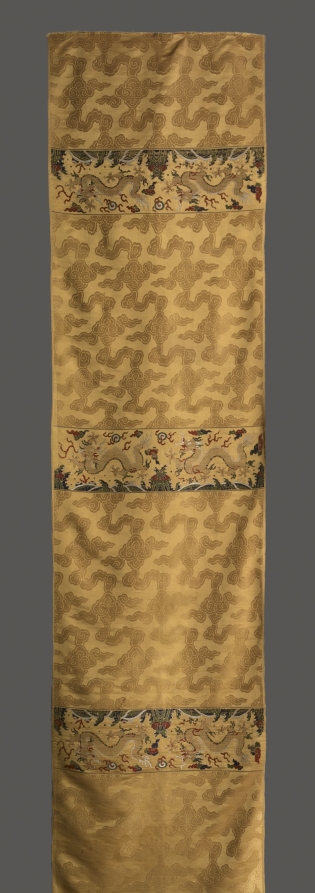
The Material Legacy of Imperial Silk: A Study of the Dragon and Cloud Panel
Provenance and the Imperial Atelier
This silk panel, bearing the intertwined motifs of the five-clawed dragon and the ruyi cloud, is not merely a textile; it is a document of statecraft, a fragment of dynastic power rendered in filament. Its materiality—the lustrous, tightly-woven warp-faced silk—speaks to a production system of unparalleled sophistication, one that was the exclusive purview of the imperial ateliers of the Ming and Qing dynasties. To handle this piece is to understand the absolute centrality of silk to the Chinese imperial project, a legacy that predates the Great Wall and outlasted the last emperor. The fabric’s hand, a smooth, cool resistance that yields with a whisper, is the result of sericulture perfected over millennia, a process guarded as fiercely as any military secret. The weave itself, a twill structure of exceptional density, was not chosen for comfort alone. It was engineered for permanence, for the projection of an immutable cosmic order.
Decoding the Iconography: The Dragon and the Cloud
The iconography is precise, deliberate, and laden with meaning. The dragon, here rendered with a serpentine grace and a palpable muscular tension, is not a decorative flourish. It is the *mang* or *long*, the emblem of the Son of Heaven. Its five claws—a distinction rigorously enforced by sumptuary law—mark this as a garment or furnishing reserved for the emperor and his immediate male kin. A four-clawed dragon would have signified a prince; a three-clawed, a lesser noble. The very act of weaving this motif was a political act. The dragon’s pursuit of the *ruyi* (flaming pearl) is a metaphor for the emperor’s quest for wisdom and prosperity, while the surrounding clouds, rendered in swirling, auspicious forms, are not mere atmosphere. They are the *xiangyun*, the auspicious clouds that carry the celestial mandate, signifying the emperor’s role as the intermediary between heaven and earth. The colour palette, dominated by imperial yellow or a deep, sacrificial blue, further reinforces this hierarchy. The threads, dyed with natural pigments—madder for red, indigo for blue, and the precious, non-fading yellow from the *sophora japonica* bud—were colour-fast to a degree that modern synthetics often fail to match.
The Weave of Power: Technical Mastery and Economic Might
One must consider the sheer logistical and economic engine required to produce such a panel. The imperial silk works, initially centred in Nanjing and later in Suzhou, Hangzhou, and Beijing, operated on a scale that rivals any modern manufacturing concern. Thousands of artisans, from mulberry growers to reeling women to master weavers, were bound to the state’s service. The drawloom, a complex apparatus requiring two operators—one to manage the pattern harness, one to throw the shuttle—was the supercomputer of its age. The pattern repeat on this panel, with its intricate cloud scrolls and the dragon’s sinuous body, would have required a harness of several thousand threads, each individually controlled by a pattern cord. A single mistake, a snapped thread, a miscalculated shed, could ruin hours of work. The precision of the design, the crisp delineation of the dragon’s scales and the cloud’s volutes, is a testament to the weaver’s extraordinary skill, a skill honed over a lifetime of apprenticeship. This was not craft; it was a form of worship, a ritualised act of creation that mirrored the cosmic order it depicted.
From Court to Cloth: A Legacy in the Modern Age
For the contemporary observer, particularly one attuned to the language of bespoke tailoring, this panel offers a profound lesson in the relationship between material and meaning. In Savile Row, we speak of cloth as the foundation of the garment; the drape, the fall, the way a fabric holds a crease. But here, the cloth is the message. The silk does not merely support the design; it *is* the design. The lustre of the filament catches the light in a way that makes the dragon appear to move, to breathe. The weight of the textile gives it a sculptural presence, a gravitas that a printed or painted reproduction could never achieve. This is the antithesis of fast fashion. It is a slow, deliberate, and deeply considered object, one that took months to produce and was meant to last for centuries. Its value lies not in its novelty but in its permanence, its connection to a lineage of craft that stretches back to the earliest dynasties.
Conservation and the Contemporary Gaze
Today, the panel exists in a state of suspended animation. The silk, though remarkably well-preserved, shows the subtle craquelure of age—fine lines of wear where the filament has begun to fatigue, a slight fading in the deepest recesses of the cloud motifs. These are not flaws; they are the patina of history. They are the physical record of the panel’s journey from the imperial wardrobe to the museum case, from a symbol of absolute power to an object of scholarly and aesthetic contemplation. To conserve it is to respect its material integrity, to resist the urge to "restore" it to a hypothetical original state. The cracks and creases are as much a part of its story as the dragon’s claws. In a world of disposable goods, this panel stands as a quiet rebuke. It demands a slower way of seeing, a deeper appreciation for the hands that made it and the power it once represented. It is a reminder that true luxury is not about price or rarity alone, but about the weight of meaning that a material can carry. And in that regard, this panel of imperial silk remains, quite simply, without equal.