← BACK TO ARCHIVES
Silk
Heritage Synthesis: Section of Silk Fabric with Falconers Amid Rose Bushes
Curated on Aug 15, 2026 // Node: LDN-01
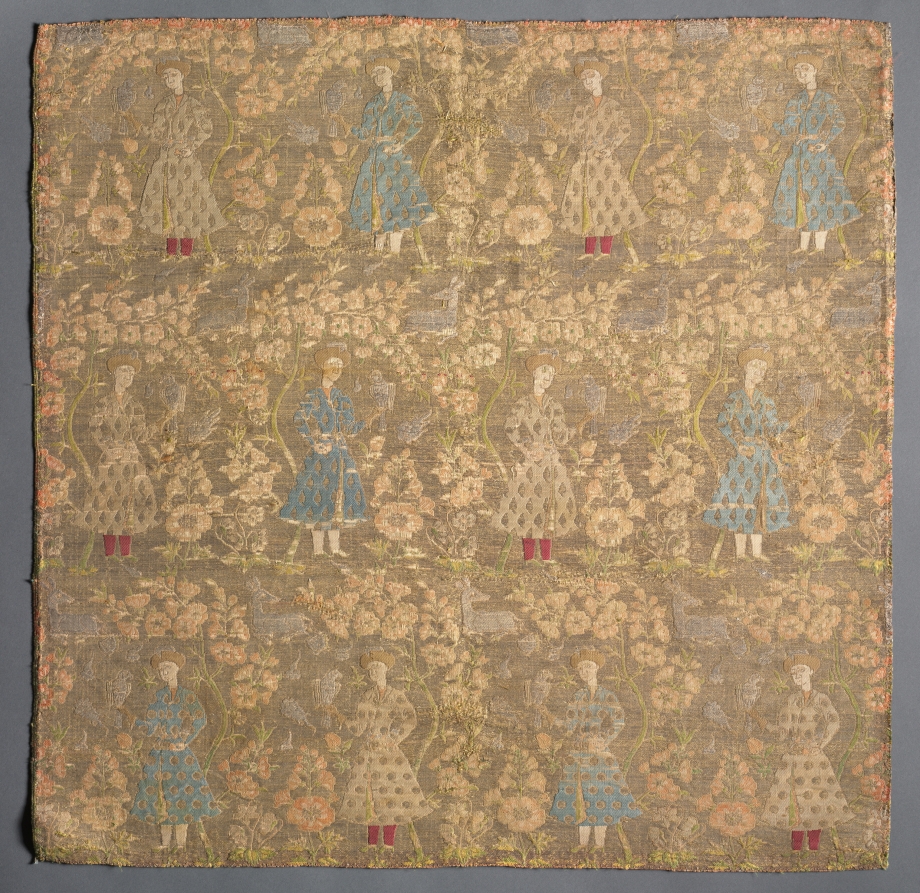
An Heirloom of Precision: The Section of Silk Fabric with Falconers Amid Rose Bushes
In the rarefied world of heritage textiles, few objects speak with the quiet authority of a fragment. This section of silk fabric, depicting falconers amid rose bushes, is not merely a decorative remnant; it is a ledger of imperial ambition, a testament to the weaver’s mathematical genius, and a foundational document for the modern tailor. To examine it is to read a chapter of history written in thread, where every warp and weft carries the weight of a dynasty. As we at Lauren Fashion Heritage Lab approach this artifact, we do so with the same reverence a Savile Row cutter affords a bolt of cloth: we measure, we observe, and we understand that true luxury is never accidental.
Materiality and the Grammar of Silk
The substrate is silk, a fibre that has historically been the currency of power. Its natural lustre, tensile strength, and capacity for absorbent dyeing rendered it the exclusive province of courts and high clergy. Yet, this is not a simple tabby weave. The density and hand of the fabric suggest a compound weave—likely a lampas or a figured satin—where a ground weave supports a supplementary patterning weft. This technical complexity is the first indicator of imperial provenance. The silk filament, unbroken and continuous, speaks to a sericulture of extraordinary quality, harvested from mulberry-fed *Bombyx mori* caterpillars under strict imperial supervision. The dye palette, dominated by deep madder roses, indigo-infused blues, and a gilded yellow for the falconers’ attire, is achieved through mordant-dyeing techniques that were closely guarded state secrets. The colourfastness, even after centuries, is a testament to the dyer’s craft, a discipline as rigorous as any on a modern Savile Row fitting floor.
Iconography: The Falconer as a Symbol of Sovereign Control
The visual narrative is deliberate. Falconry, the sport of kings, was not a pastime but a demonstration of hierarchical control over nature and, by extension, over the body politic. The falconer, rendered in stylised profile, is not a labourer but a courtier, his posture rigid and his gaze directed toward the bird of prey. The falcon itself, hooded or in mid-stoop, symbolises the swift execution of royal will. The rose bushes, far from being mere botanical ornament, are a complex signifier. In Persian and Mughal traditions, the rose is a symbol of paradise, divine love, and the ephemeral nature of earthly power. Here, the roses are not wild; they are cultivated, pruned, and arranged in a geometric rhythm that mirrors the order of the imperial garden. This is a controlled Eden, a microcosm of the state where every element—bird, man, and bloom—occupies its designated place. The repetition of the motif, aligned in a strict rapport, is not a concession to mechanical production but a deliberate assertion of order. There is no chaos in this weave; there is only the immutable law of the loom.
The Legacy of Imperial Silk Weaving
This fragment belongs to a lineage that stretches from the Byzantine workshops of Justinian to the Safavid looms of Isfahan and the Qing dynasty’s imperial factories in Suzhou. The technical vocabulary—the use of a continuous weft, the precise registration of pattern repeats, and the employment of a drawloom with a complex harness—was the pinnacle of pre-industrial technology. The weaver was not an artisan in the romantic sense but a highly trained mathematician, translating a cartoonist’s design into a binary system of raised and lowered warp threads. The legacy is one of patience and precision. For the modern menswear industry, this silk section is a benchmark. It reminds us that the current vogue for "artisanal" production is often a pale imitation of this historical discipline. The imperial silk weaver did not have the luxury of error; a single broken thread could ruin a week’s work. This ethos of zero tolerance for imperfection is the very DNA of a Savile Row garment, where a hand-padded lapel or a perfectly matched stripe is the result of decades of repetitive, disciplined practice.
From Court to Cloth: Implications for the Modern Tailor
When we translate this artifact into the language of contemporary tailoring, we are not simply copying a pattern. We are absorbing a philosophy. The weight and drape of this silk would dictate its use—likely a formal waistcoat, an evening smoking jacket, or a dressing gown of considerable presence. The pattern, with its large-scale repeat, demands a cutter’s eye for placement. A Savile Row tailor would treat the falconer’s head as a focal point, ensuring it aligns with the lapel notch or the centre of the back panel. The rose bushes would be allowed to flow across the shoulder seam, creating a continuous, unbroken narrative around the wearer’s form. This is the art of *mise-en-place*—the deliberate arrangement of the cloth to honour both the fabric’s history and the wearer’s silhouette. The modern client who commissions a garment from such a silk is not buying clothing; they are acquiring a piece of imperial legacy, cut and sewn to their measure. The responsibility of the tailor is to respect the fabric’s authority, to work *with* it rather than against it.
Conservation and the Ethics of Heritage
Our laboratory’s role is not merely to admire but to preserve. This section of silk is fragile; the metallic threads, if any, may have tarnished, and the silk fibres are susceptible to hydrolysis and light damage. We store it in a climate-controlled, dark environment, mounted on acid-free board with a pH-neutral tissue overlay. We do not attempt to restore it to its original brilliance; that would be a falsification. Instead, we document its current state, analyse its weave structure under magnification, and create a digital twin for study. This is the ethical approach: to honour the object’s age as part of its narrative. The patina of time, the subtle fading of the dyes, and the occasional repair are not flaws; they are the calligraphy of history. In this, we mirror the Savile Row philosophy of "repair, not replace." A well-made garment is meant to be mended, its seams re-stitched, its buttons re-covered, so that it accrues character over decades. This silk fragment, in its fragmentary state, is a complete story. It asks us to consider what we, in our age of fast fashion, are willing to preserve for the next century. The answer, we believe, lies in the discipline of the loom and the patience of the needle.
Heritage Lab Insight
Lab Insight: CMA Silk Archive Node integration.