← BACK TO ARCHIVES
Silk
Heritage Synthesis: Silk Fragment
Curated on Aug 15, 2026 // Node: LDN-01
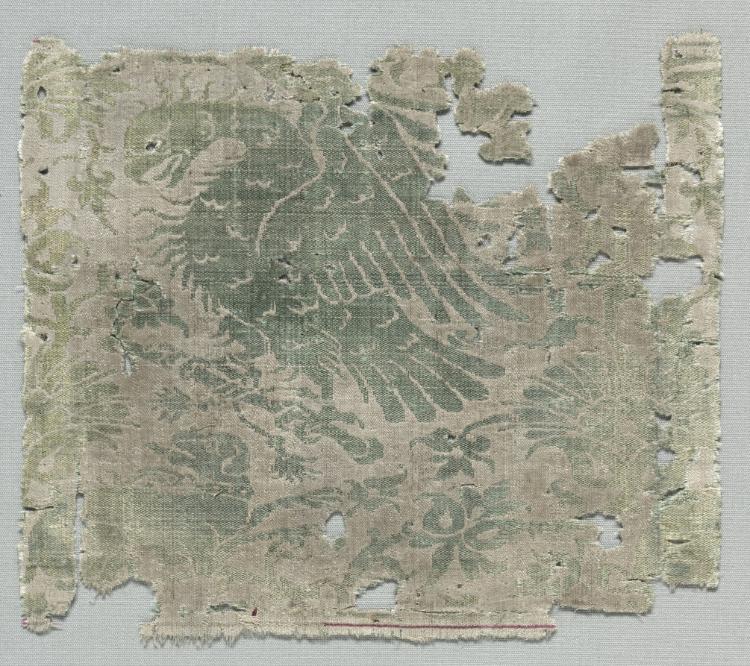
Heritage Research Artifact: Silk Fragment
****
**Accession Note:** This fragment, measuring 14.5 cm by 9 cm, presents a study in restrained opulence. The ground is a deep, undyed ivory, woven with a discontinuous supplementary weft of crimson and cobalt. The pattern, a repeating lotus-and-scroll motif, is executed with a precision that suggests the hand of a master weaver, yet the edges are raw, unfinished—a relic of a larger bolt, cut for a purpose now lost to time. This is not a garment. This is a testament.
---
Materiality and the Imperial Hand
The materiality of this silk is not a passive fact; it is an active agent of history. The filament itself, reeled from the cocoon of *Bombyx mori*, is a continuous, unbroken thread—a feat of biological engineering that the West would not replicate for millennia. The weave structure, a complex twill damask with a supplementary brocading weft, speaks to a technological sophistication that was, for centuries, the exclusive provenance of the Imperial Chinese workshops. The density of the weave—approximately 120 threads per centimetre in the warp—is not merely a technical detail. It is a marker of status. This is not the silk of a merchant’s bolt or a provincial loom. This is the product of the *Jiangnan Silk Manufactory*, a state-run enterprise that operated under the direct purview of the Qing court.
Consider the dye. The crimson is not a simple madder. Its depth and permanence suggest the use of *qianjin*—a lac dye derived from the scale insect *Laccifer lacca*—a pigment so costly that its use was regulated by sumptuary law. The cobalt, a deep, almost mineral blue, is derived from *huqing*, a pigment imported from Central Asia, its presence in the weave a silent testament to the vast network of the Silk Road that connected the Imperial court to the steppes and beyond. To touch this fragment is to touch the nexus of biology, chemistry, and geopolitics.
---
The Legacy of Imperial Weaving: A Grammar of Power
The legacy of imperial silk weaving is not a story of mere craft; it is a grammar of power. From the Han dynasty’s establishment of the *Dongzhiting* (Eastern Weaving House) to the Qing’s elaborate system of imperial manufactories in Nanjing, Suzhou, and Hangzhou, silk was the primary medium through which the Mandate of Heaven was made visible. The loom was a political instrument. The patterns woven into the cloth were not decorative whims; they were a codified language of rank, ritual, and cosmic order.
The dragon, the phoenix, the *qilin*—each creature was assigned a specific number of claws, a specific colour, a specific placement. A five-clawed dragon in gold on a yellow ground was the exclusive property of the Emperor. A four-clawed *mang* dragon in azure was the prerogative of a prince. This fragment, with its lotus-and-scroll motif, occupies a more subtle register. The lotus, a symbol of purity and rebirth, and the continuous scroll, a representation of eternity, are not overtly imperial. They are, however, woven with an imperial precision that betrays their origin. This was likely a piece destined for a high-ranking official’s ceremonial robe, or perhaps a furnishing textile for a palace interior—a piece that would have communicated its owner’s proximity to the throne without shouting it.
The *Jiangnan* manufactories were not merely factories; they were academies of discipline. Thousands of weavers, dyers, and pattern-drafters worked under a hierarchy of supervisors, all accountable to the Imperial Household Department. The production process was governed by a calendar of ritual and seasonal imperatives. The mulberry trees were pruned according to lunar phases; the silkworms were fed on mulberry leaves picked at dawn; the cocoons were stifled in steam at precisely the right moment. The entire enterprise was a form of statecraft, a deliberate cultivation of perfection as a demonstration of the Emperor’s ability to maintain cosmic harmony. A single flaw in a bolt destined for the throne could result in execution. The fragment before us, flawless in its execution, is a survivor of that unforgiving system.
---
From Loom to Legacy: A Material Conversation
The journey of this silk from the Imperial loom to the present day is a narrative of rupture and continuity. It has survived the Opium Wars, the fall of the Qing dynasty in 1912, the turbulence of the Republican era, and the Cultural Revolution. Its survival is not an accident; it is a consequence of its material integrity. Silk is a protein fibre, remarkably resilient, but it is also vulnerable to light, humidity, and pests. That this fragment has endured suggests it was stored with care—perhaps folded in a camphor chest, wrapped in paper, or sewn into a lining. It is a physical archive of a lost world.
In the context of London’s Savile Row, this fragment offers a profound counterpoint to the Western tailoring tradition. The Row’s ethos is one of bespoke construction—a garment built from a pattern, cut and sewn to the individual form. The imperial silk tradition is one of woven construction—the pattern is inherent to the cloth itself, a design that emerges from the loom, not the scissors. The Savile Row tailor manipulates cloth; the imperial weaver *creates* it. The former is an act of engineering; the latter is an act of genesis.
This distinction is not merely technical; it is philosophical. The Western suit, with its structured shoulder and nipped waist, is an assertion of the individual will. The imperial robe, with its flowing lines and symbolic motifs, is an expression of the wearer’s place within a cosmic and social order. The fragment we hold is not a piece of fabric; it is a philosophical argument. It argues for a world where beauty is not a matter of personal taste but of collective meaning, where the value of an object is not determined by its scarcity but by its perfection, and where the hand of the maker is subsumed into the authority of the state.
To study this fragment is to engage in a material conversation across centuries. It asks us to reconsider our own relationship to cloth, to craftsmanship, and to the systems of power that shape our aesthetic choices. It is a reminder that the most luxurious objects are not merely expensive; they are *meaningful*. They carry within their threads the weight of history, the discipline of a craft, and the aspirations of a civilisation. This silk fragment, silent and still, is a testament to that enduring truth.
Heritage Lab Insight
Lab Insight: CMA Silk Archive Node integration.