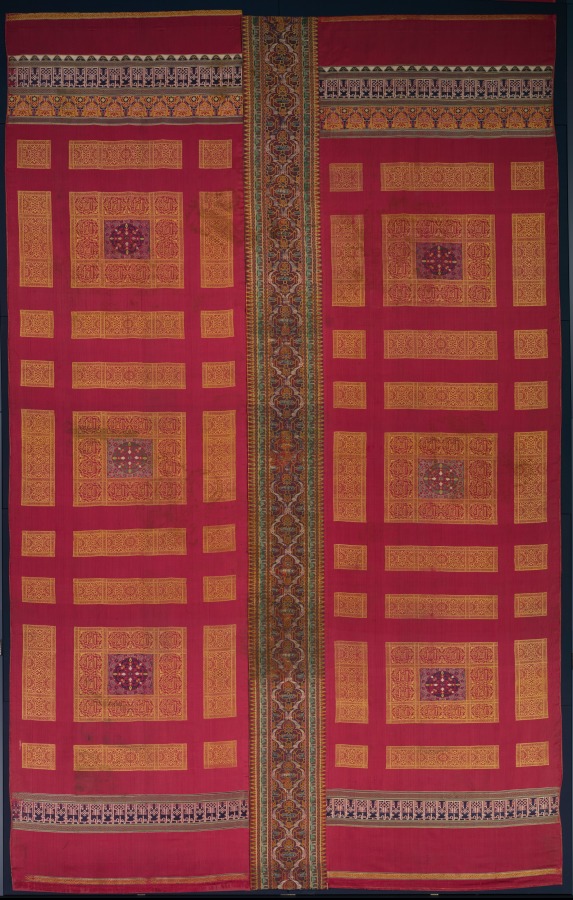
The Alhambra Silk Curtain: A Study in Imperial Weft and the Architecture of Desire
Provenance and the Paradox of Preservation
To hold a fragment of the Alhambra’s silk is to hold a paradox. The palace, that zenith of Nasrid artistry, was built from stone and stucco, from cedar and marble—materials that defy time. Yet its most intimate interiors, the very chambers where sultans received emissaries and poets composed their ghazals, were dressed in silk. This curtain, now a fragile whisper of its former self, is not merely a textile. It is a document of imperial ambition, a testament to the fact that power, in the medieval Mediterranean, was woven as much as it was built. The materiality of this piece—its warp and weft, its dye and drape—speaks a language of conquest, trade, and exquisite, agonizing transience.
The Alhambra’s silk industry was not a local craft; it was the product of a globalised economy. The Nasrid dynasty, ruling Granada from the 13th to the 15th century, inherited a weaving tradition that was the envy of the known world. This was the legacy of *tiraz* workshops, royal manufactories that had flourished under the Umayyads of Cordoba. These ateliers were not mere factories; they were instruments of statecraft. The production of silk was a royal monopoly, a strategic asset that financed the kingdom and projected its cultural supremacy. To possess a length of Granadan silk was to possess a piece of the state itself.
The Imperial Weft: From China to the Sierra Nevada
The journey of this silk begins not in Granada, but in the Far East. The sericulture—the raising of silkworms and the reeling of their cocoons—was a closely guarded secret of the Chinese empire for millennia. By the time the technology reached the Iberian Peninsula via the Silk Road and the Byzantine and Islamic worlds, it had been transformed. The raw material, however, retained its intrinsic luxury. The thread itself is a continuous filament, often up to a kilometre in length, unbroken and lustrous. This is the fundamental distinction of silk: it is not spun from short staples like wool or cotton, but drawn as a single, unbroken strand. This gives the fabric its unique tensile strength and its incomparable, almost liquid, sheen.
In the Alhambra, this imported technology was married to an indigenous aesthetic. The curtain you see before you, in its surviving fragments, would have been woven on a horizontal drawloom, a complex piece of machinery that allowed for the creation of intricate, repeating patterns. The legacy of imperial silk weaving is evident in the design lexicon: the *ataurique* (vegetal arabesques), the *lacería* (geometric strapwork), and the calligraphic bands that would have proclaimed the glory of the sultan. These were not mere decorations. They were a visual articulation of paradise, a terrestrial reflection of the celestial gardens promised in the Quran. The curtain was a threshold, a liminal object that separated the profane world of the court from the sacred space of the ruler.
Materiality and the Grammar of Power
Consider the weight of this object. Silk, contrary to popular perception, is not always a diaphanous, flimsy material. The finest imperial silks were often woven with a dense, substantial hand, using multiple warp and weft threads to create a fabric that was both supple and structurally robust. This curtain would have hung in heavy, dramatic folds, catching the light that filtered through the intricate latticework of the palace windows. The play of light on the silk’s surface—its ability to shift from deep, shadowed crimson to a brilliant, reflective gold—was a calculated effect. It was a form of architectural theatre, a dynamic interplay between the static stone of the palace and the living, breathing textile that adorned it.
The dyeing process was equally sophisticated. The deep reds, the lapis blues, and the verdant greens were achieved through complex mordanting techniques, using natural dyes derived from insects, plants, and minerals. The colour was not merely superficial; it was chemically bonded to the fibre, ensuring a permanence that was itself a metaphor for dynastic endurance. Yet, as we now observe, time is the ultimate dyer. The colours have faded, the once-crisp edges have frayed, and the fabric has become brittle. This degradation is not a flaw; it is an essential part of the object’s biography. It tells us of the centuries it has witnessed, of the hands that have touched it, and of the air it has breathed.
The Legacy: A Fabric of Civilisations
The legacy of this silk extends far beyond the walls of the Alhambra. When the Catholic Monarchs conquered Granada in 1492, they did not dismantle the silk industry. They recognised its immense economic and symbolic value. The *tiraz* workshops were repurposed, and the techniques were absorbed into the Spanish silk industry, which would later supply the courts of Europe. The patterns of the Alhambra—its interlacing stars and its stylised foliage—found their way into the textiles of the Renaissance, a silent, persistent echo of Islamic aesthetics in the heart of Christendom.
This curtain, therefore, is not a relic of a vanished world. It is a living link in a chain of transmission. It embodies the confluence of Chinese technology, Islamic artistry, and European ambition. It is a testament to the fact that luxury is never created in a vacuum; it is always the product of exchange, of conquest, and of cultural synthesis. To study this object is to understand that the architecture of power is not merely built from stone, but also woven from thread. And in that weaving, we find the true, enduring legacy of empire.
As a heritage specialist, I must conclude with a note on conservation. The most respectful act we can perform for this object is not to restore it to a false, pristine state, but to preserve its current condition, to halt the decay, and to allow it to continue its slow, dignified passage through time. The Alhambra silk curtain is not a static artefact; it is a process. And our role is not to freeze it, but to bear witness to its extraordinary, fragile, and eternal story.