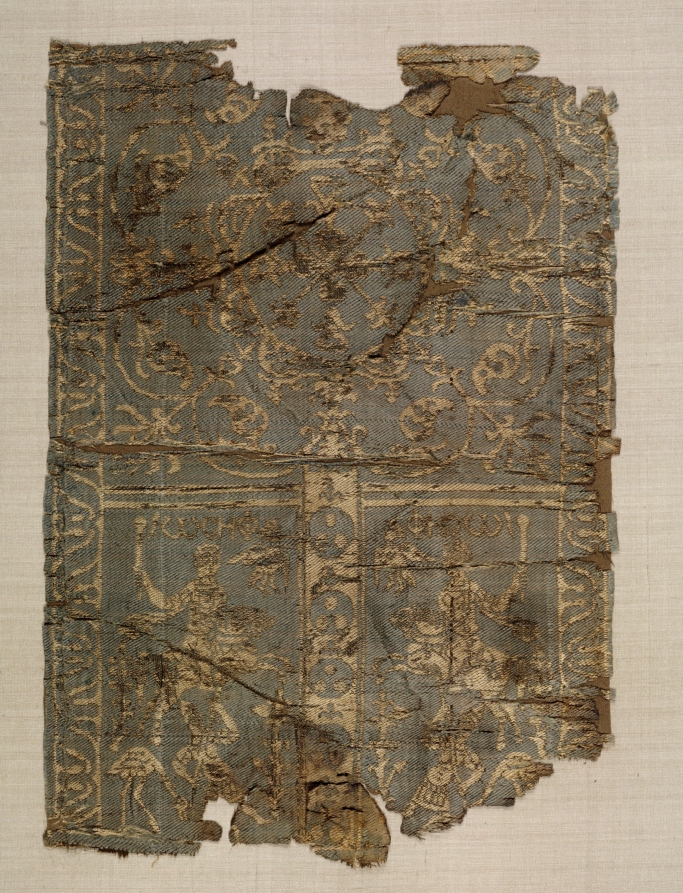
The Persistent Thread: A Silk Sleeve Decoration with Hunters
Provenance and the Imperial Loom
Within the hushed archives of the Lauren Fashion Heritage Lab, we encounter not merely a fragment of textile, but a concentrated manifesto of power, patience, and precision. The Silk Sleeve Decoration with Hunters is a relic of the imperial ateliers, a period when the loom was not a machine but an instrument of statecraft. To hold this piece—its ground a whisper of ivory, its narrative woven in polychrome silks—is to understand that the legacy of imperial silk weaving was never about mere adornment. It was a language of absolute control, spoken in threads that could take a master weaver months to articulate.
The materiality of this object is its first and most profound argument. Silk, in its raw form, is a continuous filament secreted by the silkworm, a biological marvel that the Chinese courts guarded for millennia. By the time this sleeve decoration was conceived, the craft had evolved from a secret to a supreme art. The fabric’s handle—its tactile resistance—speaks to a specific weight and density, a damask or twill ground engineered to hold the intricate weft-faced patterning without distortion. This is not a flimsy ribbon; it is a structural document. The weave is so fine that the individual threads are almost imperceptible to the naked eye, creating a surface that is simultaneously lustrous and matte, depending on the angle of the light. This optical depth is the hallmark of the imperial loom, a technology that was as much about optics as it was about tensile strength.
Deciphering the Narrative: The Hunt as Metaphor
The iconography—the hunters, the quarry, the undulating landscape—is not a pastoral idyll. In the imperial lexicon, the hunt was a metaphor for the governance of the realm. The mounted archer, his bow drawn, is not a sportsman; he is the sovereign, or his proxy, imposing order upon the wild. The prey—often depicted as deer, hare, or mythical beasts—represents the forces of chaos that must be subdued for the empire to flourish. The composition on this sleeve is deliberately dynamic: figures are caught mid-gallop, robes billowing, horses’ manes flying. This is not a static tableau but a frozen moment of decisive action, a visual assertion of the emperor’s unerring aim and, by extension, his moral and political infallibility.
The technical execution of this narrative is where the legacy of imperial weaving reaches its zenith. The weaver has employed a technique known as kesi, or “cut silk,” a form of tapestry weaving that eschews a continuous weft thread. Instead, each color area is woven with its own small shuttle, creating a tapestry-like structure where the design is identical on both sides. This is a painstaking, almost perverse, level of craftsmanship. The result is a surface where the contours of the hunters’ faces, the musculature of the horses, and the texture of the foliage are rendered with a painterly precision that rivals brushwork. The slits—the tiny gaps where the weft threads turn—are not flaws but signatures. They are the physical evidence of the weaver’s hand, a testament to the human agency embedded within this imperial product.
Materiality and the Savile Row Parallel
One cannot examine this sleeve without drawing a parallel to the ethos of Savile Row. The principles that govern the construction of a bespoke suit—the obsessive attention to internal structure, the use of materials that will drape and age with dignity, the invisible seams that hold a garment together—are mirrored in this textile. On Savile Row, a cutter will spend hours on the canvas, the internal layer of horsehair and wool that gives a jacket its chest. Here, the imperial weaver spent weeks on the warp and weft, creating an internal architecture of tension and release that gives the silk its body and its drape.
The connection is not merely aesthetic; it is philosophical. Both traditions reject the ephemeral. A Savile Row suit is built to last decades, its cloth improving with wear, its construction allowing for alteration and repair. This sleeve decoration, too, was designed for endurance. It was not a seasonal fashion; it was a permanent statement of lineage. The silk is not merely dyed; it is infused with color from natural pigments that have, in many cases, retained their vibrancy for centuries. The gold thread, likely a gilded paper wrapped around a silk core, has not tarnished but has developed a soft, burnished patina that speaks to its age and its handling. This is the materiality of legacy—the understanding that a garment or an accessory is not a disposable commodity but a vessel for history.
The Legacy of the Loom
What remains when we consider this artifact today is a profound sense of loss and continuity. The imperial ateliers are gone, their techniques passed down through generations of artisans who now work in a vastly different economic landscape. The patience required to produce a single sleeve decoration—a process that could take months—is antithetical to the contemporary fashion cycle of rapid production and consumption. Yet, the legacy persists. It persists in the DNA of modern luxury houses that still commission hand-woven silks for couture collections. It persists in the technical knowledge preserved by master weavers in Suzhou and Hangzhou, who continue to practice the ancient arts of kesi and yunjin (cloud brocade).
For the Lauren Fashion Heritage Lab, this object is not a museum piece to be viewed with detached reverence. It is a benchmark of excellence. It challenges our contemporary understanding of what constitutes value in fashion. The value here is not in the brand name or the seasonal trend; it is in the time, the skill, and the cultural weight embedded in every square inch of the fabric. The silk sleeve decoration with hunters is a reminder that the most luxurious thing one can possess is not the rarest material, but the mastery required to transform it into a narrative. It is a lesson in the art of the long view—a philosophy that Savile Row, in its stubborn insistence on craft, has never forgotten. The thread, it seems, is unbroken.