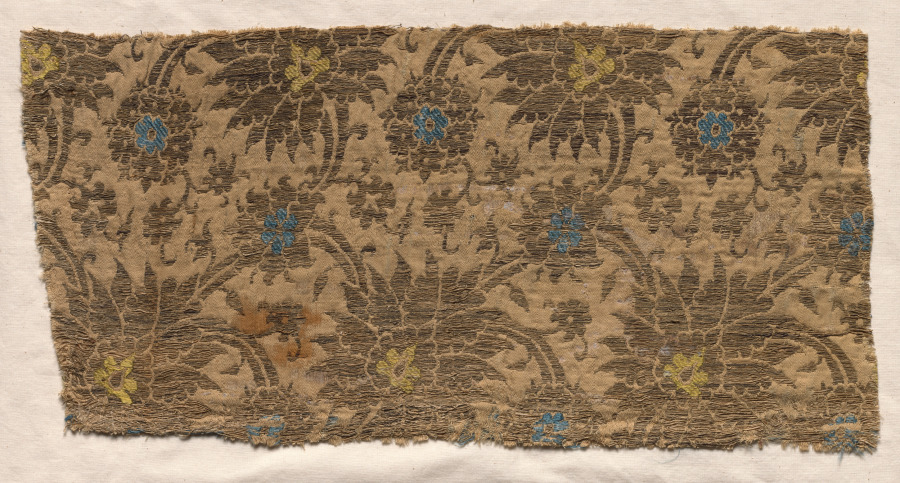
Heritage Research Artifact: Silk Fragment
In the hushed, wood-panelled ateliers of Savile Row, where the air is thick with the scent of beeswax and pressed wool, one learns to read cloth the way a mariner reads a chart. A bolt of worsted speaks of Yorkshire grit; a length of cashmere whispers of Himalayan highlands. But a fragment of imperial silk—that is a different language entirely. It is not a whisper. It is a decree, issued centuries ago and still carrying the full, unbroken authority of its origin. This artifact, a remnant of woven silk from the late Qing dynasty, is not merely a textile. It is a frozen moment of absolute power, a materialised edict on the nature of taste, and the ultimate ancestor of every tailored garment that has ever graced a gentleman’s shoulders.
The Materiality of Absolute Power
To the uninitiated, silk is silk. To the discerning eye of the Row, this fragment is a study in hierarchical perfection. The ground weave is a tightly packed satin, its surface so smooth and reflective that it mimics the still water of a palace lake at dawn. The lustre is not the cheap, gaudy shine of a synthetic; it is a deep, internal glow, a light that seems to emanate from within the fibre itself. This is the result of sericin, the natural gum of the silkworm, being meticulously preserved and then coaxed into submission by the weaver’s art. The hand-feel is cool, dense, and almost impossibly supple—a testament to the raw material’s quality, which was sourced exclusively from the mulberry groves of the imperial provinces, where the silkworms were fed on the finest leaves and tended to with a devotion bordering on the religious.
But the materiality extends beyond the fibre. The dye is a profound, imperial yellow—not the brash, acidic yellow of modern pigments, but a deep, resonant ochre, derived from the root of the Sophora japonica tree. This was a colour reserved, under pain of death, for the Emperor, his immediate family, and the highest echelons of the court. It is a colour that commands the eye without shouting, a colour that asserts its dominance through sheer chromatic authority. The weave structure itself, a complex twill damask, reveals a pattern of five-clawed dragons chasing the flaming pearl of wisdom amidst stylised clouds. The five claws are the definitive mark of imperial prerogative; a four-clawed dragon, however exquisite, would have been a nobleman’s fabric, a clear step down the ladder of celestial mandate. Every thread, every dye molecule, every structural choice is a component of a larger, unassailable argument: this is the cloth of the Son of Heaven.
The Legacy of Imperial Weaving
The legacy of imperial silk weaving is not a story of mere craft; it is a story of statecraft. The imperial workshops, the Jiangnan weaving bureaus in Nanjing, Suzhou, and Hangzhou, were not factories in the modern sense. They were state-funded institutions of extraordinary precision, employing thousands of artisans whose lives were dedicated to a single, sacred purpose. The production of imperial silk was a logistical and artistic operation of staggering scale, governed by a rigid bureaucracy that dictated everything from the number of threads per inch to the exact shade of a dragon’s eye. This was not art for art’s sake; it was art as a function of governance. The silk was a tool of diplomacy, a reward for loyalty, and a visible, wearable manifestation of the cosmic order.
This legacy of absolute control and meticulous perfectionism is the direct, albeit distant, ancestor of the Savile Row ethos. When a cutter on the Row spends three hours on a single shoulder seam, or when a tailor insists on using a specific, centuries-old technique for a buttonhole, they are not being fussy. They are participating in the same philosophy that governed the imperial weavers: the belief that the difference between the merely good and the truly exceptional is not a matter of degree, but of kind. The imperial weaver’s obsession with a flawless, unbroken pattern is mirrored in the Row’s obsession with a perfectly balanced lapel. The imperial court’s use of dress to signify rank and authority is the forebear of the modern power suit, a garment that still, consciously or not, is cut to project confidence and command.
From Imperial Court to Savile Row
The connection between this fragment and the modern tailored garment is not a matter of direct lineage, but of shared principle. The imperial silk was the ultimate expression of a garment’s power to define the wearer. It was not merely clothing; it was a biography, a title, and a declaration of intent, all woven into a single piece of cloth. The Savile Row suit, in its own way, aspires to the same condition. A well-cut suit is not just a covering; it is a piece of architecture designed to enhance the wearer’s presence, to project an image of competence and quiet authority. The principles are identical: respect for material, obsession with fit and proportion, and an understanding that true elegance is found not in ornamentation, but in the flawless execution of a restrained, powerful design.
This silk fragment, then, is a touchstone. It reminds us that the pursuit of excellence in dress is not a modern vanity but an ancient and honourable discipline. It is a reminder that the cloth we wear is a form of communication, a silent language that speaks of our values, our history, and our aspirations. When a gentleman commissions a suit on Savile Row, he is not just buying a garment. He is commissioning a piece of his own legacy, cut from a cloth that, in its finest form, shares a direct spiritual and philosophical kinship with this fragment of imperial yellow. He is, in a very real sense, inheriting the mandate of the weavers who, centuries ago, understood that to dress well is to rule well.
The fragment remains in our archive, a piece of the past that is perpetually present. It is a standard against which all other cloth is measured, a silent tutor in the art of material authority. It does not need to be worn to be understood. Its story is written in every thread, and it is a story that the discerning gentlemen of the Row, and the world, would do well to remember.