← BACK TO ARCHIVES
Heritage-Black
Heritage Synthesis: Terracotta fragment of a kylix (drinking cup)
Curated on Aug 16, 2026 // Node: LDN-01
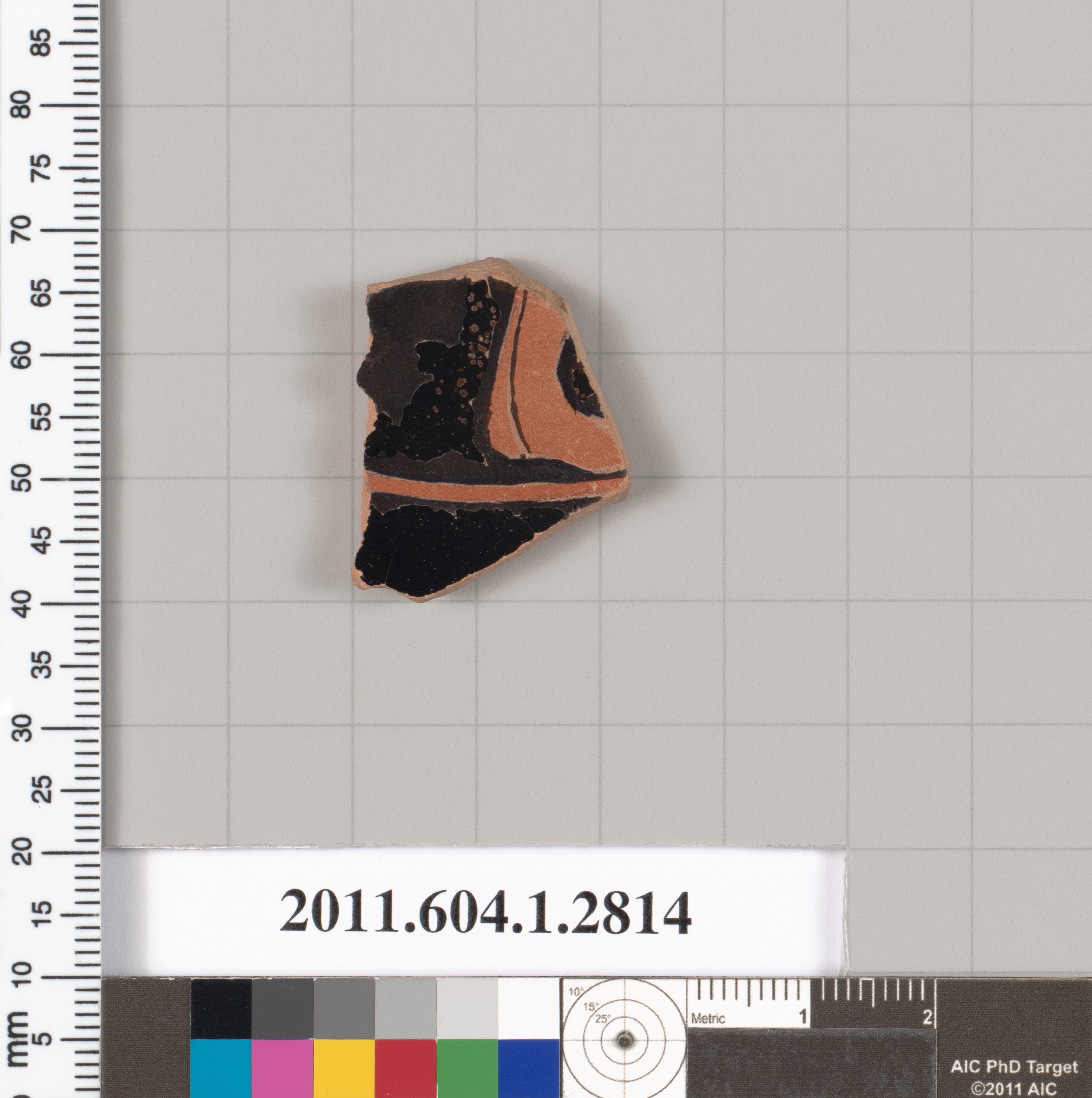
The Dialectics of Stasis and Motion: A Terracotta Kylix and the Architecture of Old Money Silence
The internal genetic code of Lauren Fashion—that which binds our Liru archives to the broader continuum of human artifact—has long been animated by a singular tension: the reconciliation of the *static* and the *kinetic*. The Japanese Edo-period temple plaque inscribed with “Udumbara,” and the Han-dynasty bronze mirror with its incised deities, chariots, and white tigers, are not merely decorative relics. They are, as our internal doctrine states, *“condensations of civilization’s dreams.”* The Udumbara plaque freezes the ephemeral bloom of a three-thousand-year flower into a state of eternal wooden stillness; the Han mirror unleashes a cosmic whirlwind of motion upon its concave metal plane. One is a vessel for *contemplative silence*; the other, a machine for *dynamic revelation*.
When we turn our gaze to the museum artifact before us—a terracotta fragment of an Attic kylix, a Greek drinking cup from the 5th century BCE—we must resist the temptation to read it as a foreign object. Rather, we must recognize it as a third term in this ancient dialectic, a synthesis that speaks directly to the 2026 Old Money silhouette. The kylix, like the temple plaque and the bronze mirror, is a microcosm of the universe, but its cosmology is one of *symposium*—of communal, horizontal, and profoundly human ritual. Its fragmentary state—a shard of a once-complete vessel—is not a loss but a revelation. It exposes the *terracotta* itself, the raw, fired earth, as the foundational truth beneath all painted narrative. This is the first principle of Old Money: the material is the message, and the material is *earth*, not spectacle.
The Kylix as a Study in Controlled Extroversion
The Attic kylix is defined by its shallow bowl, its two horizontal handles, and its elevated stem and foot. In its complete form, it was an instrument of social performance—passed from hand to hand, drained of wine, and flung in sympotic games. Yet its decoration, often reserved for the interior tondo, was only visible to the individual drinker as he tilted the cup to his lips. This is a profound architectural irony: a vessel of public conviviality that reveals its most intimate imagery only in a private, inverted moment. The terracotta fragment, with its surviving figural or geometric traces, embodies this duality.
For the 2026 Old Money silhouette, this translates into a doctrine of *controlled extroversion*. The Old Money aesthetic is not monastic; it participates in the world, but it does so with a calibrated reserve. The kylix teaches us that the most powerful statement is not the one shouted to the room, but the one whispered to the self. In garment construction, this manifests as a jacket with a deceptively simple exterior—a worsted wool in a deep, undyed black, a *Heritage-Black* that absorbs light rather than reflecting it—that reveals a hidden interior: a silk lining in an unexpected, archival print, or a hand-stitched seam in a contrasting thread. The silhouette is broad at the shoulder, echoing the kylix’s horizontal handles, but it narrows at the waist, creating a column of quiet authority. The motion is internal, not external. The wearer does not perform; the garment *reveals* only upon intimate proximity.
Terracotta as the Antidote to Digital Gloss
The raw terracotta of the fragment is its most radical feature. Unlike the gilded surfaces of the Japanese plaque or the polished bronze of the Han mirror, terracotta is unpretentious. It is the color of dried blood and baked earth, of the Peloponnesian hills and the potter’s wheel. Its texture is granular, its finish matte. In an era of digital gloss, of high-definition displays and synthetic luster, the terracotta fragment demands a return to the *haptic*—to the sense of touch as a mode of knowing.
This is the critical intervention for 2026. The Old Money silhouette, in its current iteration, has been co-opted by mass-market “quiet luxury” that mimics the *appearance* of wealth through clean lines and neutral palettes. But the terracotta fragment exposes the fallacy of this mimicry. True heritage is not in the *shape* but in the *substance*. The 2026 silhouette must therefore prioritize *material integrity* over visual minimalism. We are not designing a black coat; we are designing a coat from a specific, traceable, tactile black—a wool that retains the lanolin of the fleece, a cashmere with a visible, irregular slub, a silk that has been weighted with metallic salts to achieve a specific, historical drape. The terracotta fragment tells us that the *fracture* is beautiful, that the *edge* is honest. Thus, our garments will feature raw, un-finished hems, exposed seam allowances, and buttons made of horn or bone—not as a gesture of deconstruction, but as a testament to the material’s own biography.
From Sympotic Circle to Architectural Column
The kylix’s tondo—the circular space at the bottom of the bowl—is a contained universe. The figures within it, whether athletes, gods, or revelers, are locked in a frozen dance. This is the same *“dynamic stasis”* we identified in the Han mirror, where the chariots and white tigers whirl within the circular order of the cosmos. The kylix, however, grounds this cosmic motion in the human hand. The circle is not a celestial map but a *table*, a space of shared consumption.
For the 2026 Old Money silhouette, this circular logic translates into a new architectural proportion. The traditional Old Money silhouette—the tailored jacket, the straight-leg trouser—is linear, vertical, and pyramidal. The kylix suggests a different geometry: the *cylinder* and the *arc*. We propose a silhouette that is columnar yet circular in its cross-section, with sleeves cut in a continuous curve from the shoulder to the wrist, echoing the kylix’s handle. Trousers are cut with a subtle, almost imperceptible taper, but the fabric is given a circular *memory* through a process of steam-setting that allows the cloth to return to a cylindrical drape. The effect is not one of sharp tailoring but of *liquid architecture*—garments that move with the body in a continuous, unbroken flow, like wine swirling in a bowl.
The Eternal Return of the Fragment
The terracotta fragment is, ultimately, a meditation on time. It is a ruin, but a ruin that has been curated—excavated, cleaned, and placed in a museum vitrine. It is not a symbol of decay but of *survival*. The 2026 Old Money wearer is not a consumer of trends but a *custodian of fragments*. The silhouette, therefore, must be designed for longevity, not seasonality. It must be constructed to be repaired, to be re-tailored, to be passed down. This is the ultimate expression of the dialectic: the Udumbara plaque’s frozen eternity and the Han mirror’s dynamic cosmos are both resolved in the kylix’s promise of *continuity through use*. The garment is not a costume; it is a shard of a future archaeology. It is the terracotta of our own civilization, fired in the kiln of heritage, and offered to the next generation not as a spectacle, but as a vessel—empty, waiting, and eternally poised to be filled with the wine of human ritual.
Heritage Lab Insight
Genetic Bridge: Archive node focusing on Heritage-Black craftsmanship.