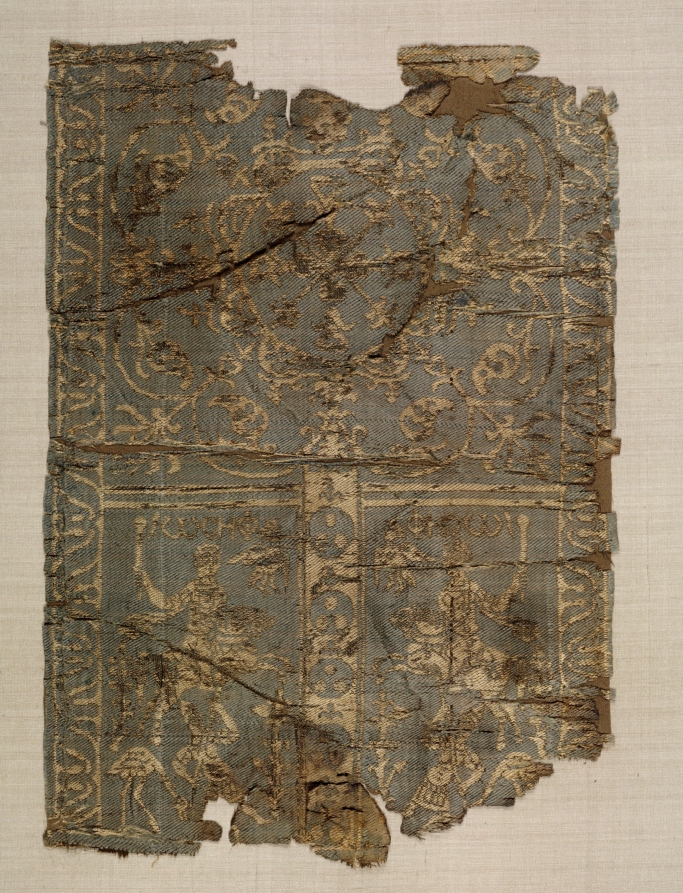
The Silk Sleeve Decoration with Hunters: A Material Testament to Imperial Craft
Provenance and the Imperial Loom
In the hushed, wood-panelled ateliers of Savile Row, where cloth is treated with the reverence of scripture, the Silk Sleeve Decoration with Hunters arrives not as a mere textile, but as a diplomatic communiqué from a vanished court. This fragment, woven in a lustrous, tightly packed silk, speaks to the apogee of imperial weaving—a discipline where the loom was not a machine but an instrument of statecraft. The materiality of this piece is its first and most commanding argument. The silk’s hand—that tactile quality we assess before a single snip of the shears—is one of dense, liquid resilience. It is not the flimsy habotai of commercial export; rather, it is a weft-faced compound weave, likely a kesi (tapestry weave) or a sophisticated satin ground, engineered to hold its chromatic intensity for centuries. The thread count is formidable, each filament so fine that the surface reads as a single, unbroken pane of colour, yet upon close inspection, reveals a topography of interlocking fibres that catch the light with a muted, aristocratic sheen—never gaudy, always present.
The Materiality of Power: Silk as Political Currency
To understand this sleeve, one must first discard the Western notion of silk as a luxury commodity. In the imperial context, silk was hard currency, a form of tribute, and a marker of rank so precise that its patterns were sumptuary law. The very fact that this is a sleeve decoration—a detachable or integrated cuff panel—indicates it was part of a chao fu (court robe) or a mangfu (python robe), worn by the nobility or high-ranking officials. The choice of silk here is not incidental; it is the medium through which the emperor’s mandate was woven into the very fabric of his court. The loom, often operated by teams of skilled artisans under the aegis of the Imperial Silk Works in Nanjing or Suzhou, was a site of quasi-religious precision. A single broken thread could ruin months of labour, and the dyeing process—using natural indigo, madder, and the precious qianjin (golden yellow) derived from the sophora japonica—was a closely guarded alchemy. The resulting fabric is not merely decorative; it is a structural record of imperial logistics, a testament to the supply chains, the botanical knowledge, and the hierarchical labour that sustained the Forbidden City.
The Hunt Scene: Iconography as Tailored Narrative
Our eye, trained on the clean lines of a British drape, might initially read the sleeve’s decoration as a chaotic pastoral. But the iconography is rigorously ordered. The hunt scene—typically featuring mounted archers, leaping felines (often the xie zhi, a mythical beast of justice), and stylised cloud scrolls—is not a genre painting. It is a cosmological diagram. The hunters represent the Son of Heaven and his generals, their pursuit of game symbolising the subjugation of chaos and the maintenance of cosmic order. The silk’s surface becomes a field of action, where the tension between the static ground and the dynamic figures is rendered in contrasting weave densities. Notice how the horses’ manes are picked out in a slightly looser, longer float of thread, creating a subtle relief that mimics the texture of hair—a detail that would be lost on a casual observer but is immediately apparent to a tailor’s touch. The clouds, rendered in a swirling, ruyi form, are not mere filler; they are auspicious symbols of eternity, woven into the sleeve to ensure the wearer’s longevity and the dynasty’s permanence.
This is where the Savile Row sensibility finds its kinship. A master cutter understands that a garment’s interior—its canvas, its linings, its buttonholes—must be as immaculate as its exterior. The imperial weaver operated on the same principle. The reverse of this silk, though not meant for public view, is a lattice of clean, clipped floats, revealing the technical virtuosity of the weaver. There is no sloppiness, no hidden compromise. This is the hallmark of a culture that viewed the unseen as a reflection of the seen—a philosophy that resonates with the Row’s own obsession with the inside finish of a bespoke jacket.
Contextual Legacy: From Forbidden City to the Modern Loom
The legacy of this imperial silk weaving extends far beyond the Qing dynasty’s fall in 1911. It survives in the DNA of contemporary luxury. When a modern house like Dior or Gucci references a Chinese motif, they are drawing on a visual vocabulary first codified in these very sleeves. But the materiality—the actual silk, the weave structure—remains a benchmark. The weight and drape of this sleeve decoration are instructive. It does not fall in a limp cascade; it holds a sculptural fold, a memory of the loom’s tension. This is a quality that a Savile Row tailor would recognise as body—the ability of a fabric to support a structured shoulder or a clean lapel without collapsing. The imperial weavers achieved this not through chemical finishes, but through the sheer density of the silk filament and the complexity of the weave. It is a lesson in restraint: the decoration is lavish, but the ground is disciplined.
Moreover, the sleeve serves as a material archive of cross-cultural exchange. The hunt motif, while distinctly Chinese in execution, echoes the nomadic traditions of the Manchu conquerors who established the Qing dynasty. The silk itself, while produced in China, was often traded along the Silk Road, absorbing influences from Persia and Byzantium. This sleeve is not a static relic; it is a node in a global network of textile production. For the contemporary designer, it offers a cautionary tale: true luxury is not about volume or novelty, but about material integrity. The silk’s ability to retain its colour and structure after centuries is a direct result of the weaver’s refusal to cut corners.
Conclusion: A Cut Above Time
In the final analysis, the Silk Sleeve Decoration with Hunters is a masterclass in the marriage of art and engineering. It demands to be read not as a painting on cloth, but as a three-dimensional object with a weight, a texture, and a history of labour. For the heritage specialist, it is a primary document. For the tailor, it is a benchmark of material excellence. And for the wearer—past or present—it is a suit of armour for the soul, woven in the most precious medium the ancient world knew. As we handle this fragment, we are not merely touching silk; we are gripping the very threads of imperial authority, and they hold fast. The legacy is not in the pattern, but in the make. And that, as any cutter on the Row will tell you, is where the true value lies.