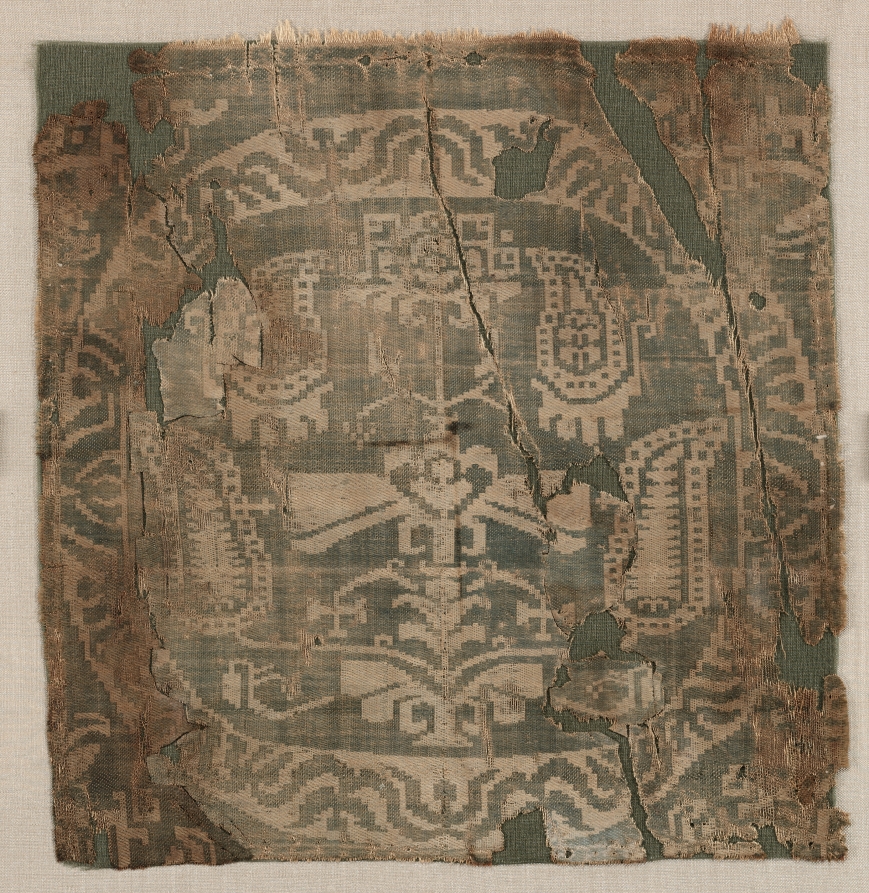
Category: Silk
Provenance and the Weight of Imperial Thread
In the hushed, wood-panelled sanctum of a Savile Row fitting room, one does not merely discuss cloth. One discusses lineage, provenance, and the quiet authority of a material that has outlived empires. The subject of this heritage research artifact—a roundel from a tunic bearing a palmette tree, executed in silk—is precisely such a material. It is not a fragment; it is a testament. It speaks of a time when silk was not a commodity but a currency of power, a diplomatic emissary, and a silent arbiter of taste. To handle this roundel is to hold a dispatch from the looms of antiquity, a message encoded not in ink but in the twist of a filament and the discipline of a pattern repeat.
This roundel, likely originating from the Sasanian or early Byzantine weaving traditions of the 6th to 8th centuries, was never intended for public display in the manner of a modern garment. It was a private declaration, worn close to the body, visible only to a select court or ecclesiastical circle. The silk itself—wild, lustrous, and unweighted—carries the unmistakable signature of imperial workshops. These were the ateliers that answered not to market demand but to royal decree. The weaver’s task was not innovation but perfection: a flawless repetition of the palmette tree motif, a symbol of life, renewal, and the cosmic order. In the same way a Savile Row cutter does not invent a lapel but refines its roll to a millimeter, the imperial weaver did not create new flora but disciplined nature into a geometric, sacred geometry.
Materiality: The Uncompromising Hand of Silk
Let us examine the material itself. This is not the supple, fluid silk of a modern foulard or the stiff, papery taffeta of a couture ball gown. This is a silk of dense, compound weave—likely a samite or a taqueté structure—where the warp and weft are locked in a tense, architectural embrace. The hand is firm, almost leathery, yet with a residual give that suggests it was woven to drape with a deliberate, sculptural weight. The surface, now aged to a patina of ochre and faded madder, would have originally blazed with the saturated hues of Tyrian purple or kermes crimson, colors reserved for the highest echelons of power. The dye was not a finish; it was a legal document. To wear this color without authority was not a fashion faux pas; it was an act of lèse-majesté.
The construction of the roundel is where the true mastery lies. The palmette tree, with its symmetrical fronds and central trunk, is not embroidered or printed. It is woven into the very structure of the cloth, each leaf and stem formed by the interlacement of dyed warps. The precision required is staggering. A single broken thread would not merely be a flaw; it would be a rupture in the cosmic harmony the motif represents. The weaver, likely working on a drawloom with a complex harness system, would have required hours to set up the pattern for a single repeat. The roundel’s circular format—a perfect, contained universe—demands that the pattern bends and converges at the edges without distortion. This is not craft; it is engineering in its most rarefied form.
For the contemporary menswear connoisseur, this materiality offers a profound lesson in restraint. The modern suit, at its best, is a study in negative space. The cloth does the talking, but it speaks in whispers. This roundel, by contrast, is a shout—but a disciplined one. Its opulence is not ostentatious because it is governed by an internal logic of symmetry and proportion. The palmette tree is not a wild, romantic flourish; it is a formal, almost heraldic device. It reminds us that true luxury is never chaotic. It is the result of a thousand small decisions, each made with the same gravity as a tailor’s final press on a shoulder seam.
Context: The Legacy of Imperial Silk Weaving
The legacy of imperial silk weaving is not merely a historical footnote; it is the foundational grammar of Western tailoring’s relationship with ornament. When a Savile Row house selects a silk for a lining or a pocket square, it is drawing on a lineage that stretches back to the royal workshops of Constantinople, Chang’an, and Ctesiphon. The roundel’s journey—from the imperial loom to a tunic, likely worn by a dignitary or a high-ranking cleric—mirrors the trajectory of silk itself: from a guarded secret of the East to a coveted currency of the West. The Silk Road was not a single route but a network of negotiations, and this roundel is a physical artifact of that negotiation. It was a gift, a tribute, a bribe, or a prize of war. Its presence in a modern archive is a reminder that cloth has always been political.
In the context of the modern atelier, this legacy manifests in the insistence on provenance. A client who commissions a bespoke garment is not merely buying a suit; he is buying a story. The silk for a dressing gown, the wool for a overcoat—each has a history, a mill, a region. The imperial weaver’s obsession with perfection is echoed in the tailor’s insistence on hand-stitching, on the use of a single piece of cloth cut without waste, on the refusal to compromise on the integrity of the weave. The roundel, with its palmette tree, is the ancestor of the house stripe, the club tie, the discreet monogram. It is the original logo, but one that carried meaning far beyond brand recognition. It was a badge of office, a marker of rank, and a prayer for eternal life.
To wear or to study this roundel is to engage in a dialogue with that past. It asks us to consider what we value in cloth: not just its tactile pleasure, but its capacity to carry meaning across centuries. The palmette tree, rooted in the ancient world, still stands. It has weathered the fall of empires, the rise of mechanization, and the democratization of luxury. Yet it remains, in its silk form, an aristocrat. It does not shout for attention; it simply exists, with the quiet confidence of something that has nothing to prove. That is the true legacy of imperial silk weaving—not the opulence, but the assurance. And that, in the end, is the very definition of Savile Row.