← BACK TO ARCHIVES
Heritage-Black
Heritage Synthesis: Terracotta fragment of a column-krater (bowl for mixing wine and water)?
Curated on Aug 17, 2026 // Node: LDN-01
The Terracotta Dialectic: Violence, Absence, and the Architecture of Old Money
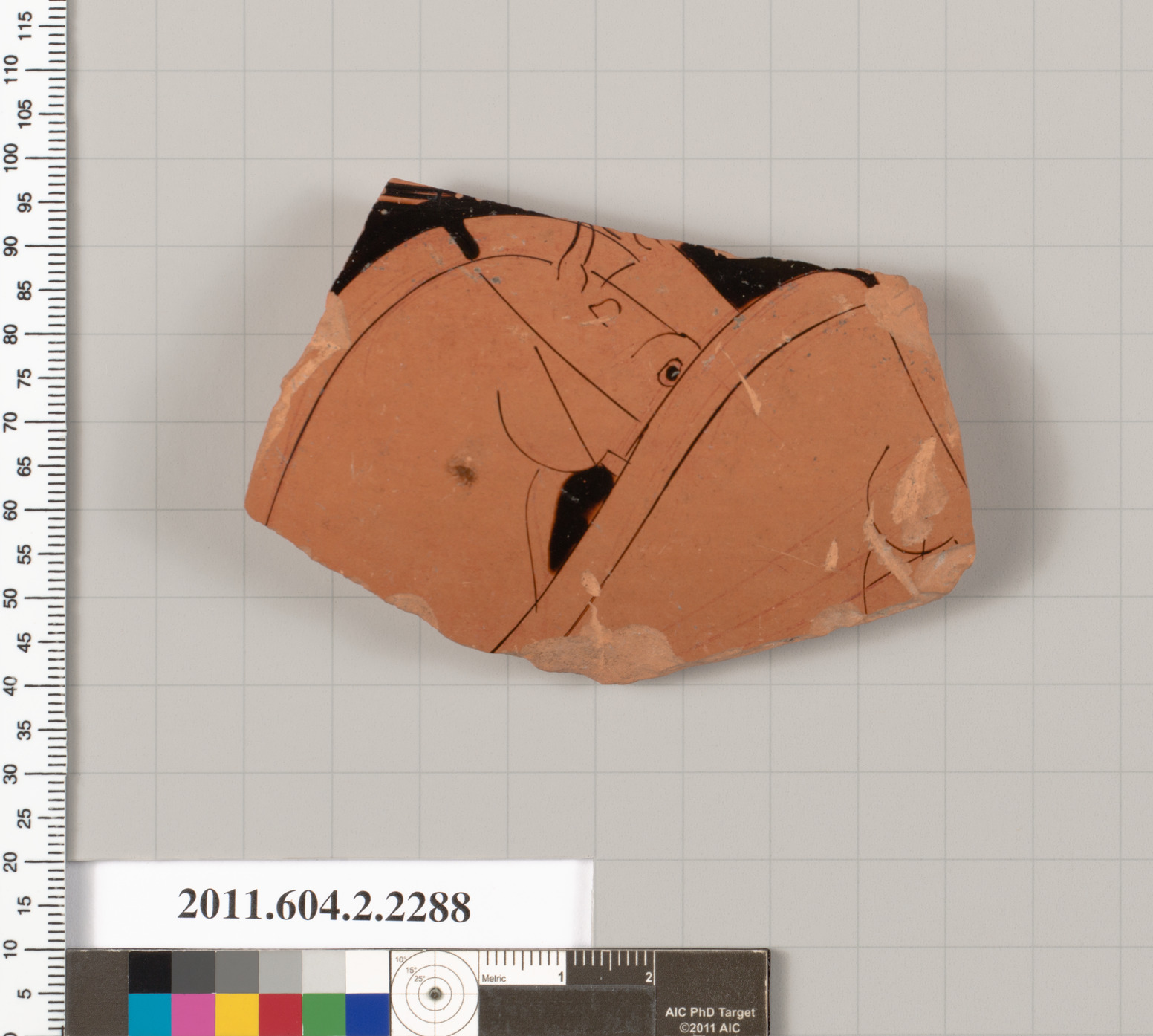
The internal genetic code of Lauren Fashion—the juxtaposition of a deer pierced by an arrow and a flower blooming in the void—finds an unexpected archaeological echo in the museum artifact before us: a terracotta fragment of an Attic column-krater. This shard of Greek antiquity, designed for the mixing of wine and water, is not merely a vessel for libation. It is a palimpsest of existential confrontation. In its painted remnants—hunters, hounds, the taut sinew of pursuit—we discern the same Western obsession with *presence* that animates the medieval *Hunting* scene. Yet the fragment’s broken edges, its missing figures, its silent terracotta ground, whisper the Eastern truth of *absence* found in the *Udumbara Temple Plaque*. For the 2026 Old Money silhouette, this dialectic is not academic; it is structural. The fragment teaches us that true heritage is not the preservation of a complete image, but the curation of a rupture—a lesson that must be woven into the very seams of our forthcoming collection.
I. The Krater’s Dual Nature: Vessel as Vanitas
The column-krater, in its original wholeness, was an instrument of *symposium*—the Greek ritual of wine, philosophy, and competitive display. Its painted friezes, often depicting the *kalos* inscriptions or mythological hunts, were celebrations of mortal vigor. The hunter’s arrow, the boar’s charge, the hound’s leap: these were affirmations of a life lived at maximum intensity, a direct precursor to the medieval *Hunting* painting’s “energy converter” of death into vitality. The terracotta’s orange-red clay, fired and burnished, is the very color of blood and earth—a carnal substrate.
However, our fragment is not whole. It is a shard, a survivor of burial, of looting, of museum curation. This is where the East intrudes. The Udumbara flower, blooming once every three millennia, is an emblem of the unattainable. The plaque’s beauty lies in its *not-yet* and *never-again*. The krater fragment, similarly, is a monument to a *not-now*. The painted hunter’s arm may be severed at the elbow; the hound’s body may dissolve into a jagged edge. This is not damage; it is *negative space made sacred*. The fragment performs the same aesthetic operation as the Udumbara plaque: it points to a wholeness that is absent, a truth that cannot be fully possessed. The Greek shard, in its brokenness, becomes an Eastern koan.
II. Translating Rupture into Tailoring: The 2026 Silhouette
How does this inform the 2026 Old Money silhouette? The prevailing myth of “Old Money” is one of seamless continuity—a blazer passed down through generations, unblemished, immutable. This is a lie. True old money, like the krater, is a collection of fragments: a grandfather’s cufflink, a grandmother’s brooch, a single sleeve from a 1920s riding coat. The 2026 silhouette must reject the *complete* garment in favor of the *composed* garment. We will not design a new coat; we will design a coat that *appears* to have been reassembled from memory.
Concretely, this means three tailoring interventions. First, **the engineered fracture**: shoulders will be cut with a deliberate asymmetry—one side slightly more padded, the other softer, evoking the krater’s uneven break. This is not a fashion quirk; it is a nod to the *Hunting* scene’s “critical moment” of the arrow’s release, a tension frozen in the cloth. Second, **the exposed seam**: we will employ a technique of *visible mending* using contrasting silk thread, not to hide the joint but to celebrate it. This echoes the terracotta’s painted lines, which delineate the fragment’s edge. The seam becomes a line of poetry, a boundary between what is known and what is lost. Third, **the hollowed interior**: jackets will be constructed with a floating canvas that is intentionally incomplete—a missing panel in the chest, a void where a pocket should be. This is the *Udumbara* principle: the garment’s most luxurious element is the space it refuses to fill.
III. Materiality as Memory: Terracotta, Wool, and the Patina of Time
The krater’s terracotta body offers a chromatic and textural directive. Its color—a burnt umber with a ferrous undertone—will inform our *Heritage-Black* palette. We will not use a pure black; we will use a *terracotta-black*, a black that has been “fired” with a hint of rust, achieved through over-dyeing a wool twill with a madder root infusion. This is the black of the earth, not the void. The surface of our fabrics must mimic the krater’s *slip*—a fine, almost chalky finish that catches light differently from every angle. This will be achieved by a double-faced cloth: a smooth worsted exterior and a napped, brushed interior, like the unglazed interior of the krater.
The fragment’s broken edges also dictate our approach to *trimming*. We will not use clean, cut edges on hems or lapels. Instead, we will employ a *ravelling edge* technique—a deliberate, controlled fray that suggests the garment has been excavated, not manufactured. This is the *Wabi-sabi* of the Attic shard. In the *Hunting* scene, the horse’s dust has not yet settled; in the *Udumbara* plaque, the wood grain is worn smooth by centuries of absent touch. Our 2026 silhouette will carry both: the dust of action and the smoothness of neglect.
IV. The Wearer as Curator: A New Old Money Ethos
The 2026 Old Money wearer is not an inheritor; she is a *curator of fragments*. She does not wear a suit; she wears a *testimony*. The garment must invite inquiry: “Where is the rest of this sleeve?” “What was in this missing pocket?” These questions are the modern equivalent of the krater’s missing figures. The wearer becomes a living museum, and the garment a display case that withholds more than it reveals.
This is the ultimate synthesis of the two aesthetic poles. The *Hunting* scene’s violence is transmuted into the *tailoring*—the sharp, decisive cut of a lapel that mimics the arrow’s flight. The *Udumbara* plaque’s emptiness is transmuted into the *silhouette*—the generous, unconstructed drape that allows the body to disappear into the cloth. The terracotta fragment, caught between these forces, is our blueprint. It is both a trophy of the hunt and a relic of the void. In 2026, we will not design clothes. We will design *archaeological events*—garments that are, in their very structure, a meditation on what it means to be present while haunted by absence. The krater’s wine is long gone, but its stain remains. Our garments will be that stain: a permanent, beautiful, and unfillable mark of heritage.
Heritage Lab Insight
Genetic Bridge: Archive node focusing on Heritage-Black craftsmanship.