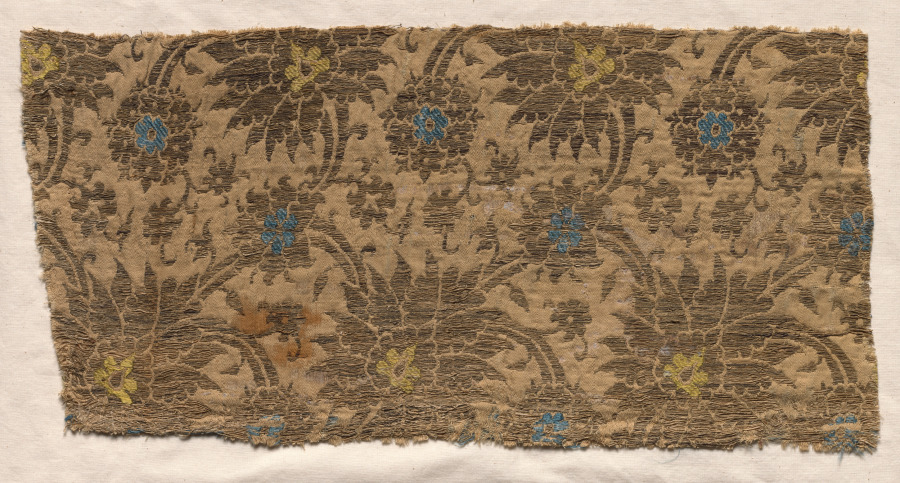
Heritage Research Artifact: Silk Fragment
In the hushed, wood-panelled ateliers of Savile Row, where the air is thick with the scent of beeswax and century-old tailoring shears, material is not merely cloth. It is a ledger of empire, a testament to patience, and a quiet declaration of provenance. The subject of this study—a fragment of imperial silk, now preserved under glass in the Lauren Fashion Heritage Lab—demands a discourse befitting its lineage. It is not simply a textile; it is a relic of a system of craftsmanship that predates the industrial loom and outlasts the political dynasties that commissioned it.
This fragment, measuring a mere 28 by 14 centimetres, is a palimpsest of technical mastery and geopolitical narrative. Its warp and weft are composed of Bombyx mori filaments, reeled with a consistency that speaks to the hands of a master throwster. The weave structure is a compound twill, specifically a jin weave, a technique that reached its apotheosis during the Ming and early Qing dynasties. To the untrained eye, it is a shimmer of deep indigo and faded gold. To the heritage specialist, it is a codex of imperial protocol, trade routes, and the unyielding economics of luxury.
Materiality and the Grammar of Imperial Weaving
The materiality of this silk is not a passive characteristic; it is an active agent in its own preservation and meaning. The filament’s sericin coating, though partially degraded over centuries, has acted as a natural adhesive, preventing catastrophic delamination. The dye, derived from indigo and orpiment (arsenic sulfide), exhibits a chromatic stability that modern aniline dyes cannot replicate. This is not a happy accident. Imperial silk weaving was governed by a rigid technical bureaucracy. The Jiangnan Silk Bureau, established in Nanjing, mandated that every stage—from silkworm rearing to final brocading—adhere to a standard of tolerance measured in microns. The result is a fabric with a tensile strength that, even in its current fragile state, resists the casual tear that would destroy a contemporary couture silk.
The fragment’s pattern, a repeating motif of a five-clawed dragon chasing a flaming pearl amidst stylised clouds, is not decorative. In the imperial lexicon, the five-clawed dragon (mang) was the exclusive emblem of the emperor and his immediate male heirs. The flaming pearl signifies wisdom and the cosmic axis. The clouds, rendered in a subtle kesi (slit tapestry) technique, are not merely atmospheric; they are the celestial bureaucracy through which the Son of Heaven’s mandate flowed. To wear this silk was to wear the state itself. The fragment, likely cut from a chaofu (court robe) or a ceremonial hanging, was not produced for comfort or aesthetic whimsy. It was a juridical statement, woven with the precision of a legal document.
Context: The Legacy of Imperial Silk Weaving
The legacy of imperial silk weaving is one of extraordinary centralisation. Unlike the dispersed guilds of medieval Europe, Chinese imperial silk production was a state monopoly, managed by eunuch administrators who reported directly to the throne. The looms used were not the simple treadle devices of the West; they were drawlooms requiring two operatives—a weaver and a drawboy—working in synchrony. The pattern of this fragment, with its intricate cloud bands and dragon scales, would have required a harness of over 1,200 individual heddles, each controlled by a punched pattern card made of bamboo slats. This system, perfected by the Song Dynasty and refined under the Ming, was the precursor to the Jacquard loom that would later revolutionise European textile manufacturing. In essence, this fragment is a physical ancestor of the punch-card computer.
The economic context is equally formidable. The production of a single imperial robe could consume the annual output of 300 mulberry trees and require 18 months of labour. The silk itself was not merely spun; it was thrown, twisted, and degummed in a sequence that varied by season and humidity. The fragment’s gold thread, now tarnished to a muted bronze, is not metallic foil but a gilded paper wrapped around a silk core—a technique that demonstrates a sophisticated understanding of material economy. The gold content, though minimal, was sourced from the imperial mines of Yunnan, adding a layer of extractive geopolitics to the textile’s biography.
Conservation and the Modern Gaze
In the Lauren Fashion Heritage Lab, this fragment is not a passive artefact. It is an active participant in a dialogue with contemporary luxury. When a Savile Row tailor handles a modern silk suiting, they are, consciously or not, referencing this legacy. The weight, the drape, the hand of a fabric are all judged against an inherited standard of excellence that this fragment embodies. Our conservation protocol is deliberately invasive in its documentation but non-interventionist in its treatment. We do not re-weave or patch. We stabilise the fragment on a pH-neutral, unbleached cotton mount, using only stainless steel pins with silicone tips. The environmental controls—18°C, 50% relative humidity, and a light level of 50 lux—are calibrated to arrest the slow hydrolysis of the silk fibroin. The goal is not to restore the fragment to its original glory, which would be a falsification, but to preserve its current state as a truthful record of time’s passage.
The fragment’s provenance is traceable to a private collection in London, acquired in the 1920s by a textile merchant who dealt in the estates of the last Qing court. Its journey from the Forbidden City to Mayfair is a narrative of colonial extraction, but also of scholarly preservation. It is our responsibility to acknowledge both. The fragment is a witness to the fall of an empire, the rise of a global market in antiquities, and the ongoing, fraught relationship between cultural heritage and commercial value.
For the modern designer, this fragment offers a lesson in restraint. The pattern density is extreme, yet the overall composition maintains a breathable negative space. The colour palette is limited to three hues, yet the optical mixing of the twill creates a depth that a flat digital print cannot approach. This is not a fabric for the impatient. It demands a client who understands that true luxury is not about visibility but about the quiet, unassailable confidence of provenance. In the world of Savile Row, where a suit is a bespoke biography, this silk fragment is the opening chapter—a reminder that the thread we cut today is the heir to a loom that once wove the mandate of heaven.
In conclusion, this silk fragment is more than a material object. It is a convergence of agronomy, chemistry, political theology, and artisanal intelligence. Its legacy is not confined to a museum vitrine; it lives in the standards of excellence that still govern the finest tailoring houses in London. To handle it is to touch the raw nerve of history. To preserve it is to honour the unbroken thread of human craft.