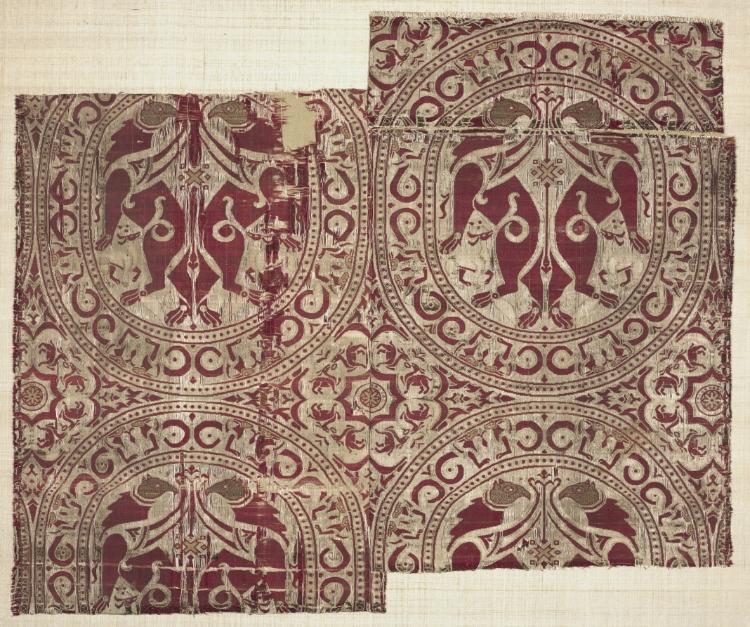
An Examination of Provenance and Power: The Lampas with Griffins from Siguenza
To engage with this artifact—a fragment of lampas silk depicting griffins enclosed within pearl-bordered roundels, drawn from the Reliquary of Saint Librada in the Cathedral of Siguenza—is to handle the very fabric of empire. It is not merely a textile; it is a document. Woven not with ink but with the finest filaments of Bombyx mori, its narrative is one of transcendent technical mastery, deliberate iconographic assertion, and the silent, relentless machinery of imperial economics. One must appreciate it as a strategic asset, as definitive of status as a bespoke silhouette, and as politically charged as a royal cipher.
The Fabric of Dominion: Materiality as Statement
The foundation of its authority lies in its material: silk. In the medieval period, particularly within the context of the Byzantine and early Islamic caliphates, silk was not a mere luxury. It was a controlled substance. The production of such lampas—a complex weave employing two sets of warps and wefts to create a patterned, often polychrome, textile—represented the apex of industrial technology. The knowledge of sericulture, the vast, state-sponsored ergastéria or tiraz workshops, and the closely guarded techniques for dyes like kermes (yielding that distinctive, authoritative crimson) constituted a form of sovereign intellectual property. To possess this lampas was to signal direct access to the most exclusive of networks; it was to wear, or in this case, enshrine, proof of one’s position within the uppermost echelon of both spiritual and temporal power. The hand, assessing its weight and drape, would immediately recognise a quality that spoke of monopoly.
Heraldry in the Weave: The Iconography of the Griffin
The pattern, however, is where intention becomes unmistakable. The griffin—a leonine body paired with the aquiline head and wings of an eagle—is no whimsical motif. It is a heraldic beast of the first order, a synthesis of terrestrial and celestial dominion. In the imperial lexicons of both Byzantium and the Sassanian precedent from which so much silk iconography flowed, the griffin was a guardian of the divine and the regal, often associated with apotropaic power and Christological triumph. Its enclosure within a perfectly executed roundel, itself framed by a string of pearls, is a classic formulation of the so-called "beaded roundel" style that dominated prestige silks from the 10th to the 12th centuries.
This was not decoration; it was branding. The repeat of the motif across the fabric’s field creates a relentless, grid-like assertion of power and order. Each roundel functions as a seal, stamping the cloth—and by extension its owner—with an emblem of protection and authority. The use of such a textile to line or wrap the reliquary of Saint Librada was a deliberate act of visual rhetoric. It elevated the sacred remains by enveloping them in a material that was itself a relic of imperial sacrality, creating a powerful consonance between the heavenly authority of the saint and the earthly authority implied by the cloth.
A Provenance of Appropriation: The Journey to Siguenza
The presence of this specific artifact in the treasury of Siguenza Cathedral is, perhaps, its most eloquent chapter. It speaks to the complex afterlife of these imperial commodities. Such silks, often acquired as diplomatic gifts, war booty, or through the rarified channels of Mediterranean trade, were disassembled from their original contexts and re-purposed within the Latin West. A mantle fit for a Byzantine basileus or a caliphal gift would be carefully unstitched and reapplied to the veneration of Catholic saints.
This translocation is critical. It represents a strategic appropriation of inherited prestige. The Christian clerics who adorned Librada’s reliquary were acutely aware of the cloth’s valence. They were not merely using a "pretty fabric"; they were integrating a symbol of vanquished or rivalling empires into their own sacred economy, thereby transferring its aura of invincibility and luxury to their own devotional framework. The silk becomes a palimpsest: its original imperial message is subsumed, yet fundamentally amplifies, its new Christian purpose.
The Lasting Cut: A Legacy in the Modern Lexicon
To conclude, the Lampas with Griffins from Siguenza stands as a paramount exemplar of how material culture operates at the highest levels of statecraft and sanctity. Its value was tripartite: intrinsic, in the unparalleled quality of its weave; iconic, in the calculated use of heraldic symbolism; and associative, in its provenance. It served as soft power incarnate, a medium for broadcasting ideology through touch and sight.
In a contemporary context, the principles it embodies remain utterly relevant. The pursuit of the exceptional fibre, the narrative weight of a signature pattern, the cachet of a protected geographical indication—these are the modern equivalents of the silk tiraz workshop and the griffin roundel. To understand this fragment is to understand that true heritage in fashion or fabric is never merely aesthetic. It is, and has always been, an exercise in the concentrated application of resource, symbol, and story to project an incontrovertible statement of place, power, and identity. The loom, in the right hands, is as potent as the sceptre.