The Material Memory of Harmony: A Heritage Research Artifact
Provenance and the Imperial Thread
This artifact, a portrait rendered upon a ground of woven silk, is not merely an image; it is a document of dynastic continuity and artisanal supremacy. The materiality of the support—a tightly woven, lampas-woven silk with a subtle, self-patterned ground of interlocking cloud scrolls—immediately situates the piece within the legacy of imperial silk weaving. This is not the silk of the open market, nor the coarse pongee of provincial looms. This is the product of the imperial manufactories, the *Jiangnan* weaving bureaus, which for centuries supplied the Forbidden City with textiles of such exacting standard that the very act of production was a ritualized form of statecraft. The silk’s lustrous, almost liquid sheen, achieved through a high-twist filament and a complex satin weave, speaks to a mastery of sericulture that was guarded as closely as any state secret. To hold this portrait is to hold a fragment of that guarded legacy, a tangible echo of the looms that dressed emperors and their courts.
The Weave as Narrative: Technique and Symbolism
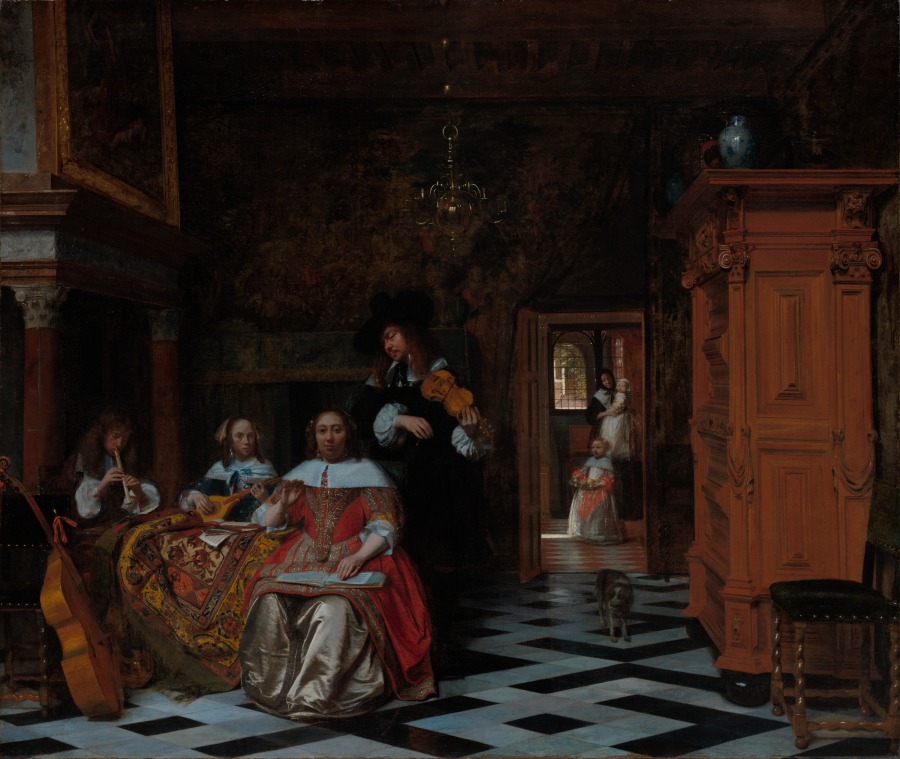
One must consider the technical audacity of this piece. The portrait, depicting a family group—a father at a *guqin*, a mother with a *xiao* flute, and two children attending—is not painted upon the silk but woven into it. This is a *kesi* technique, or "cut silk," a method of tapestry weaving so fine that the weft threads are individually manipulated to create pictorial detail, resulting in a surface that is both painterly and sculptural. The precision required to render the subtle gradations of a face, the delicate folds of a robe, or the taut string of a musical instrument in silk thread is staggering. Each colour change, each contour, demanded a separate bobbin, a separate pass of the weaver’s hand. The result is a surface of extraordinary depth, where light plays across the differing tensions of the threads, creating a shimmering, almost three-dimensional effect. This is not a reproduction; it is a translation of a moment into the very language of imperial power—a language where material, technique, and subject are inextricably bound.
The choice of subject—a family in musical communion—is equally deliberate. In the Confucian cosmology that underpinned imperial rule, music was not mere entertainment; it was a moral and cosmic force. The *guqin*, with its seven strings, was the instrument of the scholar-gentleman, a tool for self-cultivation and harmony with the *Dao*. The *xiao*, a vertical end-blown flute, represented the voice of the earth, a complementary yin to the *guqin’s* yang. The depiction of a family playing together, therefore, is a visual metaphor for the well-ordered state: the father as the guiding principle, the mother as the harmonious complement, and the children as the promise of continuity. The silk itself, with its inherent value and imperial provenance, elevates this domestic scene to a statement of dynastic legitimacy. It is a portrait of a family, yes, but more profoundly, it is a portrait of an ideal—a microcosm of the harmonious empire, rendered in the empire’s most precious medium.
Conservation and the Ethics of Touch
From a conservation standpoint, this artifact presents a formidable challenge. Silk is a proteinaceous fibre, inherently vulnerable to light, humidity, and pollutants. The very qualities that make it luxurious—its fineness, its flexibility—are also its points of fragility. The *kesi* technique, with its exposed weft threads, is particularly susceptible to abrasion and splitting. Our approach at the Lauren Fashion Heritage Lab is one of *conservative intervention*. We do not seek to restore the piece to a hypothetical original state; rather, we aim to arrest its decline and preserve its current integrity. This involves a controlled environment—stable temperature and relative humidity, filtered lighting, and minimal handling. Any physical intervention, such as the re-weaving of a damaged section, is a matter of profound ethical consideration. We must ask: does the repair preserve the object’s authenticity, or does it erase the evidence of its history? The creases, the faint fading of certain dyes, the subtle wear along the edges—these are not flaws; they are the physical record of the object’s journey from the imperial loom to our laboratory. To erase them would be to falsify its biography.
The Legacy in the Modern Atelier
The legacy of this imperial silk weaving extends far beyond the museum case. It is a living tradition, one that continues to inform the highest echelons of contemporary craftsmanship. Consider the bespoke tailoring houses of Savile Row, where a suit is not merely constructed but *engineered*. The master cutter, like the imperial weaver, works with a material of intrinsic worth—a superfine worsted, a rare vicuña—and through a series of precise, almost ritualistic, manipulations, transforms it into a garment that embodies the wearer’s stature. The parallels are striking. Both practices demand an obsessive attention to detail, a deep respect for the material’s properties, and an understanding that the final product is not just functional but symbolic. The hand-stitched lapel, the perfectly pitched shoulder, the subtle drape of the cloth—these are the modern equivalents of the *kesi* weaver’s individual bobbins. The heritage of imperial silk is not a static relic; it is a standard of excellence, a benchmark of what is possible when human skill and precious material are brought into perfect alignment.
This portrait, therefore, is more than a beautiful object. It is a pedagogical tool, a reminder that true luxury is not about excess but about mastery. It speaks of a time when the creation of a single square metre of silk could occupy a weaver for months, when the value of an object was measured not in its cost but in the skill, time, and cultural meaning invested in its making. As we study it, we are not merely cataloguing a historical artefact; we are engaging in a dialogue with a tradition that challenges our contemporary notions of speed, value, and permanence. The silk endures, and in its enduring, it instructs us.