← BACK TO ARCHIVES
Silk
Heritage Synthesis: Textile Fragment with the Annunciation
Curated on Aug 18, 2026 // Node: LDN-01
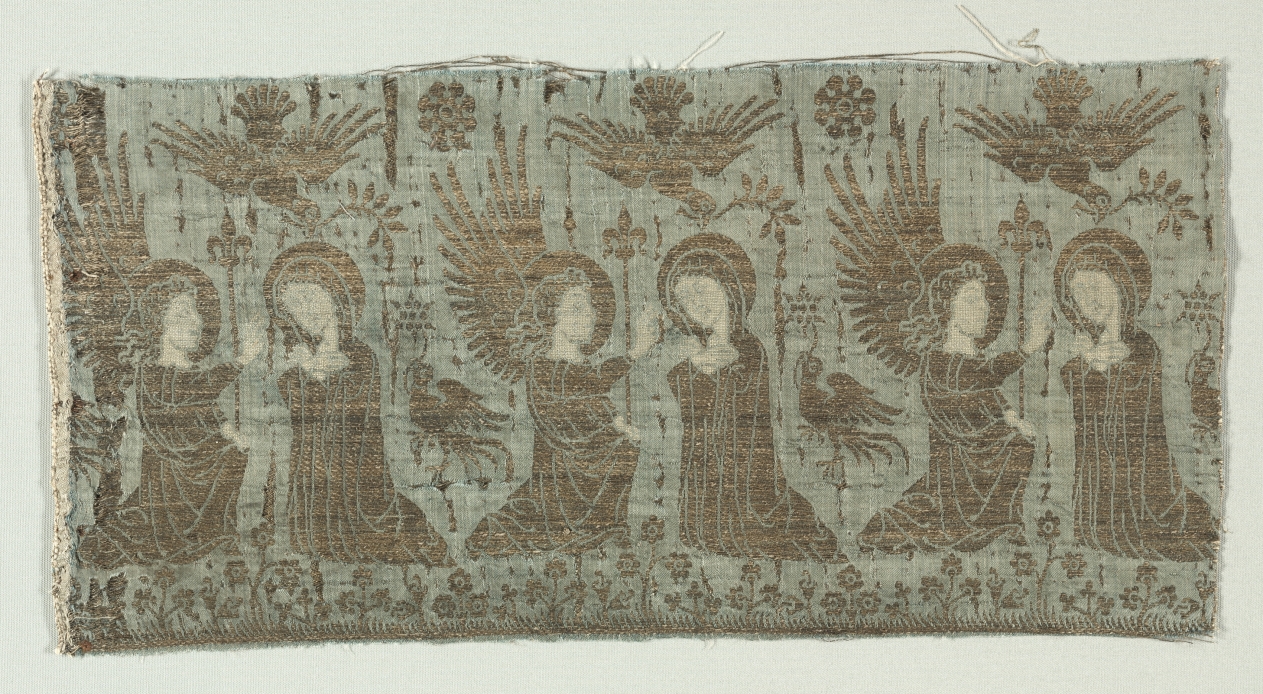
Category: Silk
The Thread of Divinity: A Material Reading of the Annunciation Fragment
In the hushed, wood-panelled quiet of a Savile Row atelier, where the air is thick with the scent of wool and the low murmur of scissors on cloth, one learns to read cloth as a language. It is a language of drape, of weight, of light’s stubborn refusal to surrender. But there is a lexicon beyond the bolt and the bale—a grammar of history, of power, of prayer. The textile fragment before us, a silk panel depicting the Annunciation, is not merely a piece of fabric. It is a document, a relic, a testament to the absolute pinnacle of imperial silk weaving, a craft so refined that it blurred the line between the earthly and the celestial.
This fragment, woven in a lustrous, lampas-woven silk, is a masterclass in materiality. The ground is a deep, ecclesiastical crimson, a hue achieved through the laborious extraction of kermes, the scale insect that yielded the most precious red of the medieval world. This is not a colour; it is a statement of wealth and devotion, a pigment more costly than gold by weight. The weft, a shimmering, undyed silk of near-white, forms the figures of the Archangel Gabriel and the Virgin Mary. The contrast is stark, almost theatrical: the divine messenger, rendered in luminous ivory, against the passionate, sacrificial ground of the human world. The very touch of the silk—its cool, smooth surface, its almost liquid resilience—speaks of a loom technology that was the envy of the known world. This is not the coarse, utilitarian silk of trade routes; this is the silk of the imperial *officinae*, the state-run workshops of Byzantium, where the production of purple and of figured silks was a closely guarded imperial monopoly.
The iconography is rendered with a precision that borders on the obsessive. Gabriel, his wing articulated with a feather-by-feather realism, raises his hand in a gesture of benediction. Mary, seated at a spinning distaff, turns her head in a pose of humble acceptance. The scene is framed by a border of stylized acanthus leaves and confronted peacocks, symbols of immortality and the resurrection. The composition is not painterly; it is architectural. The figures are built from the loom, their drapery falling in geometric, almost abstract folds. This is the language of the *drawloom*, a machine of such complexity that it required two operators—one to manipulate the pattern cords, the other to throw the shuttle. The pattern, in this case, was likely recorded on a series of punched cards, a proto-computer program that encoded the image of the Annunciation into the very structure of the cloth. The weaver was not an artist in the modern sense; he was an engineer of faith, translating a theological narrative into a binary code of warp and weft.
The legacy of this weaving tradition is not confined to the reliquary or the museum. It is the ghost in the machine of Western tailoring. When a Savile Row cutter drapes a length of cloth over a client’s shoulder, he is engaging in a dialogue with this same history of material control. The imperial silks of Byzantium, and their later iterations in Lucca, Venice, and Lyons, established the paradigm of the *figured* textile—a cloth that carries meaning beyond its physical form. The heavy, structured silks and brocades that defined the great houses of European fashion owe their DNA to these liturgical and courtly weaves. The very concept of a *pattern*—a repeatable design that confers identity and status—is a direct inheritance from the imperial loom. The discipline of the tailor, the insistence on a perfect seam, the respect for the integrity of the cloth, is a secular echo of the weaver’s devotion to the integrity of the image.
To hold this fragment is to hold a paradox. It is a fabric of immense fragility, its edges frayed, its surface creased by centuries of veneration and neglect. Yet it is also a fabric of immense strength, its message undimmed by time. The silk has survived the fall of empires, the sacking of cities, the slow decay of the ages. It has outlived the hands that wove it, the eyes that prayed upon it, the monarchs who wore it. Its resilience is not merely physical; it is semiotic. The Annunciation, the moment of the Incarnation, the word made flesh, is here made thread. The silk, a product of the silkworm’s labour, is itself a symbol of transformation—from caterpillar to cocoon to cloth. The weaver, in turn, transforms the raw material into a vehicle for the divine. The fragment is a reminder that the most profound expressions of human culture are often found not in stone or paint, but in the humble, yet exalted, medium of cloth.
In the end, this fragment is a lesson in the discipline of the eye. It demands that we look, not just see. It asks us to consider the weight of a thread, the logic of a weave, the politics of a colour. It is a quiet, insistent voice from a vanished world, reminding us that the true luxury of a garment lies not in its label, but in its story. And for those of us who work with cloth, who measure, cut, and sew, it is a humbling reminder that we are but the latest custodians of a craft that has, for millennia, sought to clothe the human form in meaning. The loom is silent now, but its pattern endures.
Heritage Lab Insight
Lab Insight: CMA Silk Archive Node integration.