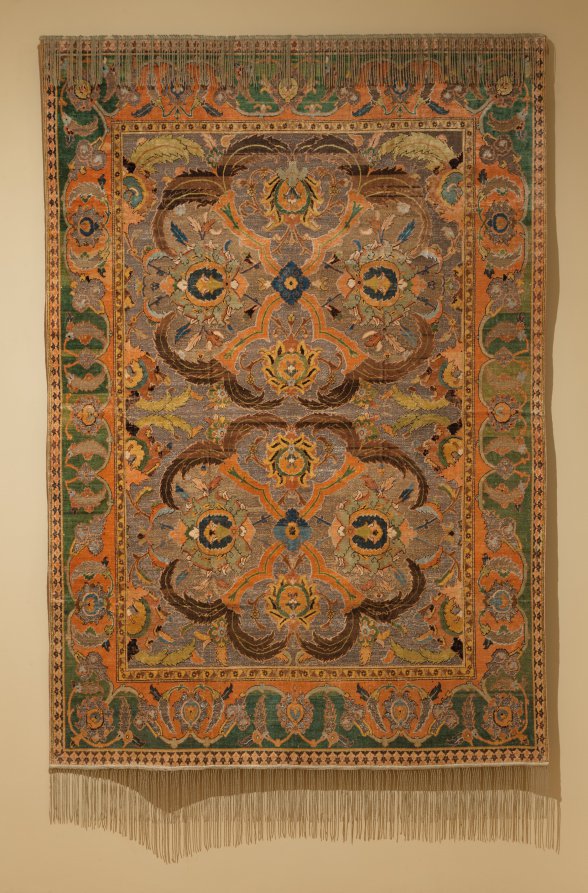
The Royal Carpet: A Study in Imperial Silk and the Persistence of Mastery
Provenance and the Language of Thread
In the hushed ateliers of London’s Savile Row, where cloth is not merely cut but composed, we understand that material is destiny. A bolt of worsted wool speaks of discipline; a length of cashmere whispers of quiet luxury. Yet neither can prepare the uninitiated for the presence of a Royal Carpet woven with silk and metal thread. This is not a floor covering. It is a document of statecraft, a frozen symphony of imperial ambition, and a testament to a weaving tradition that predates the very concept of tailoring by millennia. Our analysis begins not with pattern, but with substance.
The materiality of this artifact is its primary argument. The warp and weft are composed of mulberry silk (*Bombyx mori*), a fibre that, in its unbroken filament, can extend for nearly a kilometre. This is not the coarse, spun silk of lesser textiles. This is reeled silk, drawn directly from the cocoon in a single, unbroken strand, producing a surface of almost liquid luminosity. The silk’s protein structure refracts light differently depending on the angle of the pile, creating a subtle, shifting topography that no synthetic substitute can replicate. For the imperial courts of Persia, the Ottoman Empire, or Mughal India, this was not decoration; it was the physical manifestation of divine order. The sheen was the light of the throne, the softness a metaphor for the sovereign’s benevolent hand.
Metal Thread: The Gilding of Power
To dismiss the metal thread as mere ornamentation is to misread the artifact’s entire political economy. The gilded threads—typically a core of fine silk or linen wrapped in strips of silver gilt—were not chosen for aesthetic flair alone. Their presence signified access to bullion, to the royal mint, and to the vast trade networks that brought gold from Nubia, silver from the Andes (via Spanish galleons), and the technical expertise to draw it into gossamer-thin lamella. The metal thread is not a component; it is a declaration of solvency. When the light catches these threads, the carpet does not merely glow; it flashes with the authority of coinage. In the dim, incense-filled halls of a royal audience chamber, this flash would have been the first and last thing a visiting dignitary saw, a visual assertion of the host’s unassailable wealth and technological superiority.
The technique of weaving these disparate materials—the supple silk and the rigid metal—required a mastery that borders on the alchemical. The weaver had to maintain a tension that would not snap the delicate silk warp while simultaneously beating down the metal weft with a comb so heavy that it could fracture a lesser loom. The result is a fabric of extraordinary density, often exceeding 120 knots per square inch, a density that renders the carpet nearly impermeable to air. This is not a textile for warmth; it is a textile for permanence.
The Legacy of Imperial Silk Weaving
Our subject sits squarely within the legacy of imperial silk weaving, a tradition that stretches from the Han dynasty’s secret sericulture to the Safavid workshops of Isfahan. In these royal manufactories, weavers were not artisans; they were civil servants, bound by oath and subject to the crown’s audit. Their patterns—the palmettes, the cloud bands, the hunting scenes—were codified iconography, a visual language that communicated the sovereign’s lineage, his conquests, and his cosmic mandate. To commission such a carpet was to commission a piece of propaganda, but one woven with such technical perfection that it transcended mere rhetoric.
The legacy is one of controlled excellence. Unlike the mercantile silk of the Levant, which was produced for a thriving middle class, imperial silk was a monopoly of the state. The looms were housed within the palace complex, the dyers were forbidden from leaving the city, and the designs were registered in imperial ledgers. This centralization of production ensured an unprecedented consistency of quality. There is no variance in the pile height, no irregularity in the knotting, no bleeding of the madder red into the indigo blue. This is the hallmark of the imperial atelier: the suppression of the individual hand in favour of the collective, flawless result. It is the same philosophy that underpins a Savile Row house’s dedication to a 40-hour, hand-finished garment—the erasure of the maker to elevate the making.
Materiality as a Mirror for Modern Craft
For the contemporary observer, the Royal Carpet offers a profound lesson in the value of material integrity. In an era of fast fashion and synthetic blends, this artifact reminds us that true luxury is not a price point but a process. The silk’s natural protein fibres are inherently resilient, resisting crushing and recovering their shape with a memory that polyester cannot emulate. The metal thread, though it may tarnish over centuries, does so gracefully, developing a patina that adds historical depth rather than detracting from it. This is the antithesis of disposability. It is an investment in permanence, a commitment to an object that will outlive its owner by generations.
Moreover, the carpet’s construction demands a recalibration of our understanding of “hand feel.” The combination of silk’s cool, smooth touch with the rigid, slightly abrasive texture of the metal thread creates a sensory paradox. It is at once luxurious and formidable, inviting the hand yet warning of its own durability. This duality is the essence of imperial power—the promise of comfort under the shadow of authority. A Savile Row tailor understands this paradox intimately. A well-constructed jacket should feel like a second skin, yet its internal canvas and horsehair structure provide a rigid, architectural frame. The Royal Carpet is that same principle, writ large upon the floor.
Conclusion: The Weave of Eternity
In the final analysis, the Royal Carpet with silk and metal thread is not a relic of a bygone era; it is a benchmark. It challenges us to consider what we are willing to invest in the objects that surround us. The imperial silk weavers did not ask, “How quickly can this be made?” They asked, “How perfectly can this be made, and for how long will it endure?” The answer lies in the carpet’s very fibres—a testament to the fact that when materiality is honoured, when technique is mastered, and when legacy is prioritised over immediacy, the resulting object ceases to be a commodity and becomes a heritage. It is a standard against which all subsequent textile arts, including our own, must be measured. And it is a standard that, frankly, we are still striving to meet.